Introducing the New Renewal Calendar: Four Paths for Every Renewal - Renew, Consolidate, Replace, or Walk Away
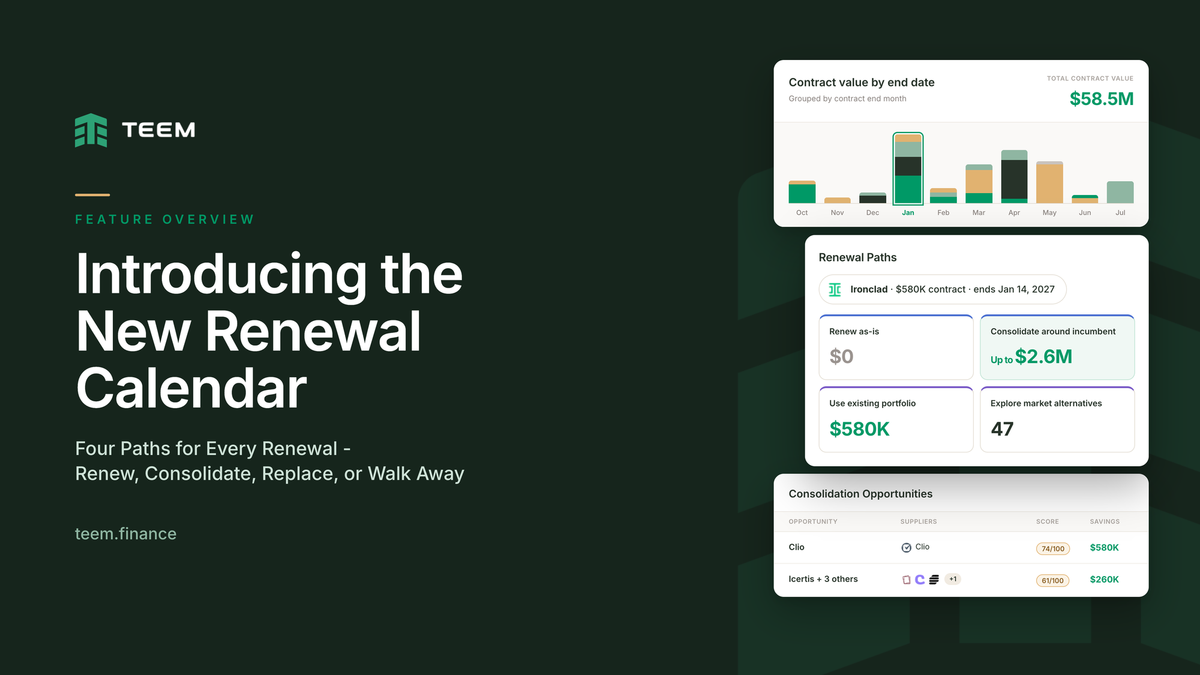
Most renewals go through as-is because there are too many to review. The rebuilt Renewal Calendar shows you which ones to question, and what each option is worth. Every contract end date, across software, services, physical goods, and real estate, sits in one view, with the suppliers that overlap your portfolio flagged. Open any supplier, and you get four renewal paths, each with potential savings, a deadline, and a next step. It's in early access for Teem customers now.
Most companies renew their contracts on autopilot. Software especially.
The reason is volume. When dozens of contracts come up every quarter, the easy assumption is that people still use the tool, so it renews. Nobody has time to question each one.
But an as-is renewal rarely saves money. Prices usually go up at renewal, and any overlap with tools you already pay for renews too.
Every renewal is a decision point, and there are only four things you can do with one:
- Renew it as it is.
- Renew it and consolidate overlapping suppliers into it.
- Don't renew, and shift the work to suppliers you already have.
- Don't renew, and go to market for something better.
We rebuilt Teem's Renewal Calendar around those four options, so you can pick one with the numbers in front of you before the contract end date picks for you.
The new calendar is in early access for Teem customers, and we'd like you to try it.
1. One calendar for every offering type
The previous calendar split renewals into four tabs: software, services, physical goods, and real estate. To see everything ending next quarter, you had to click through each tab and add it up yourself.
Why it's needed: Renewals compete for the same budget and the same people. A heavy month in services and a heavy month in software are the same heavy month for procurement. Looking at them separately hides how much is coming due at once.
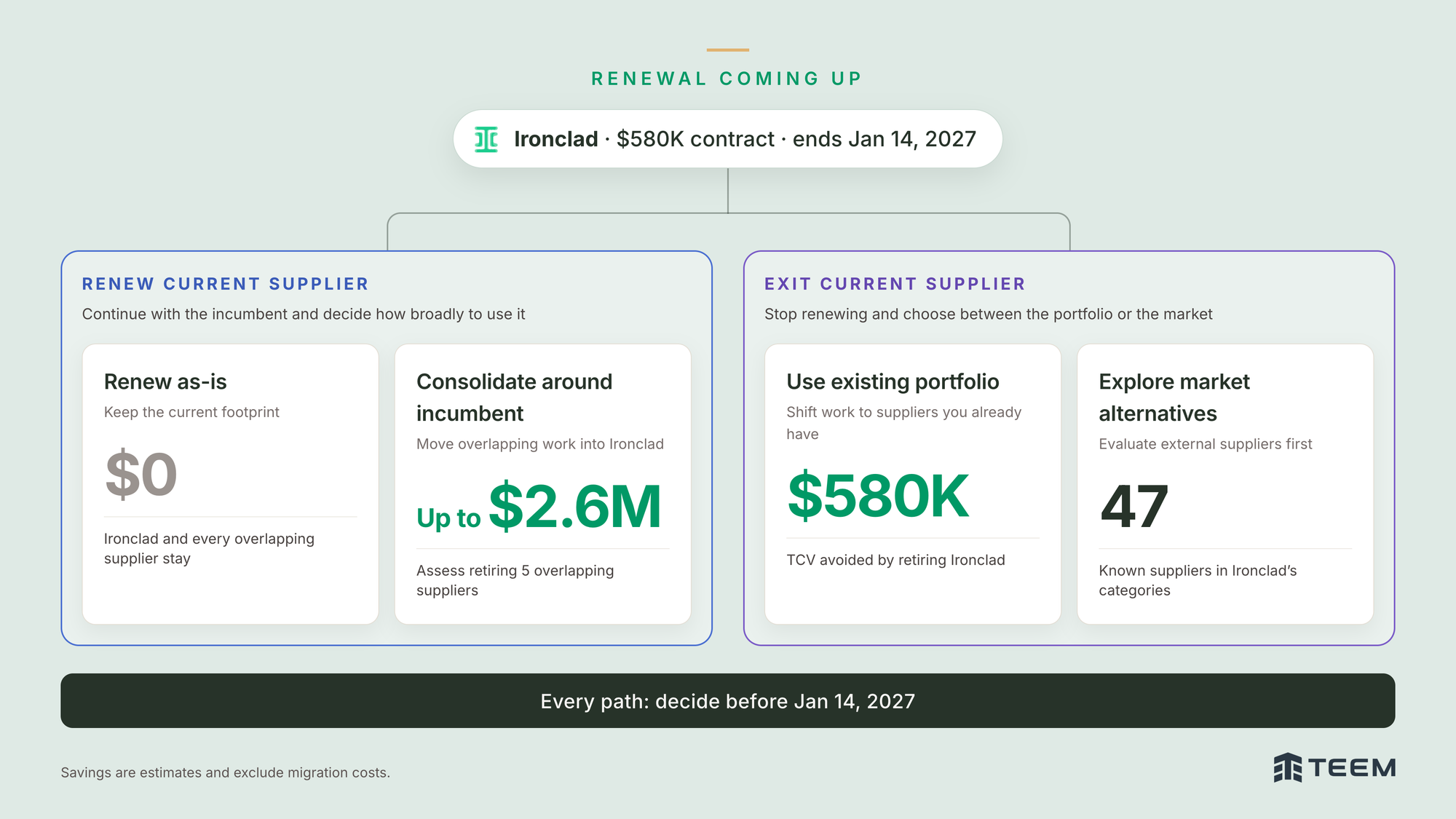
How we solve it: The new calendar shows contract end dates across all offering types in a single view. At the top, a bar chart groups contract value by end month, shows the largest suppliers individually, and groups smaller ones as Other. Switch it to contract count when you care more about workload than dollars. Total contract value and supplier count sit beside the chart.
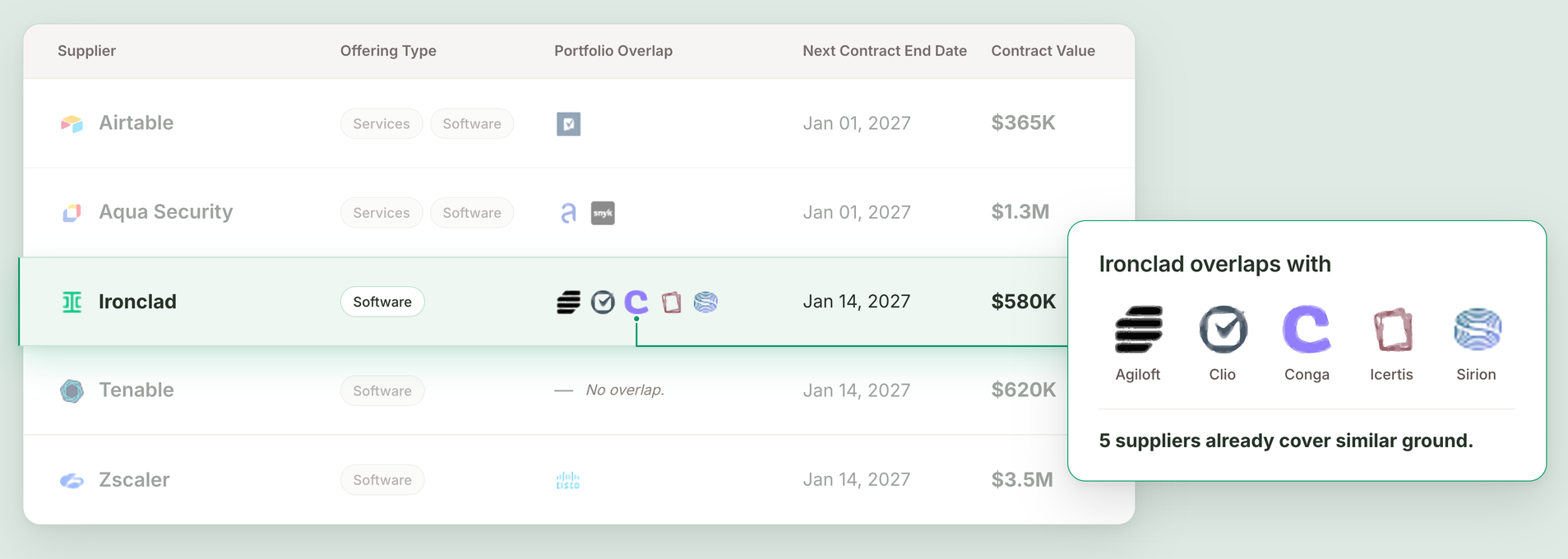
Below the chart, every supplier gets one row: offering type, portfolio overlap, when it was executed or purchased, next contract end date, contract value, TCV, and number of contracts. You can search, filter, and hide the columns you don't use.
2. Portfolio Overlap
A renewal looks routine on its own. It looks different when five other suppliers in your portfolio already do some of the same job.
Why it's needed: Overlap is the strongest reason not to renew as-is, and it almost never shows up on a renewal list. Without it, every contract looks like the only one of its kind.
How we solve it: Every supplier in the calendar now has a Portfolio Overlap column showing the other suppliers you already pay for that cover similar ground. Ironclad's row, for example, shows five: Agiloft, Clio, Conga, Icertis, and Sirion. Scan down the column and the renewals worth questioning stand out.
3. A renewal page for every supplier
When a renewal comes up, the information needed to judge it is scattered across the contract, the supplier's website, and someone's inbox.
Why it's needed: You can't negotiate a contract you haven't read. Auto-renewal clauses and payment schedules are details people often find a week after the notice period closes.
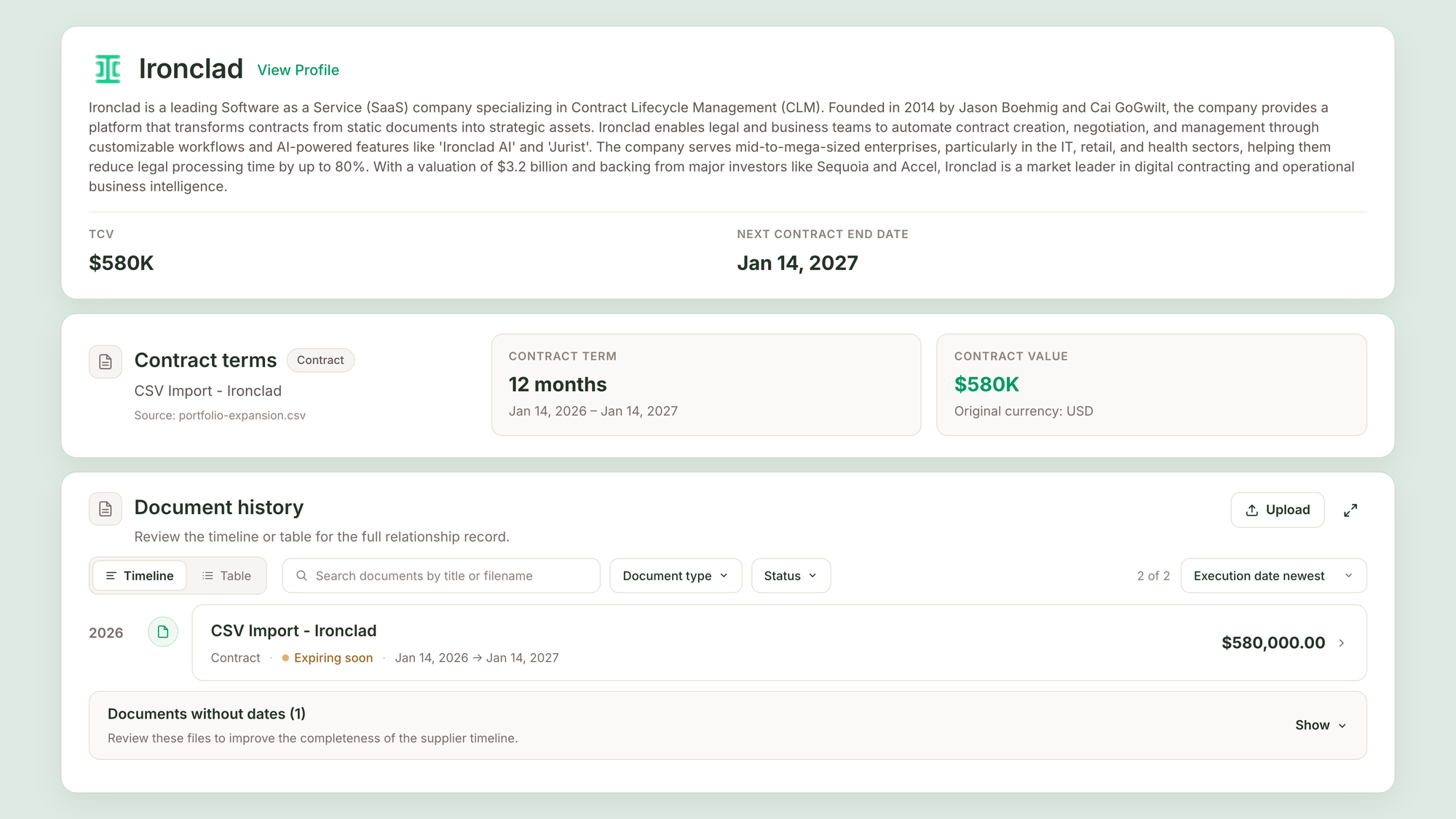
How we solve it: Click any supplier in the calendar to open its renewal page. At the top, you'll see what the supplier does, the total contract value, and the next contract end date. Below that, Teem pulls the key terms from the contract documents you've uploaded: contract term and dates, whether auto-renewal is enabled, payment terms, and contract value. The source document is named, so you can check it before acting.
4. Renewal paths
Most renewal reviews ask one question: renew or not?
Why it's needed: A yes-or-no review can only keep the status quo or start a full replacement. The two options in between, consolidating into this supplier or shifting its work to tools you already own, rarely get considered because nobody has the data in front of them.
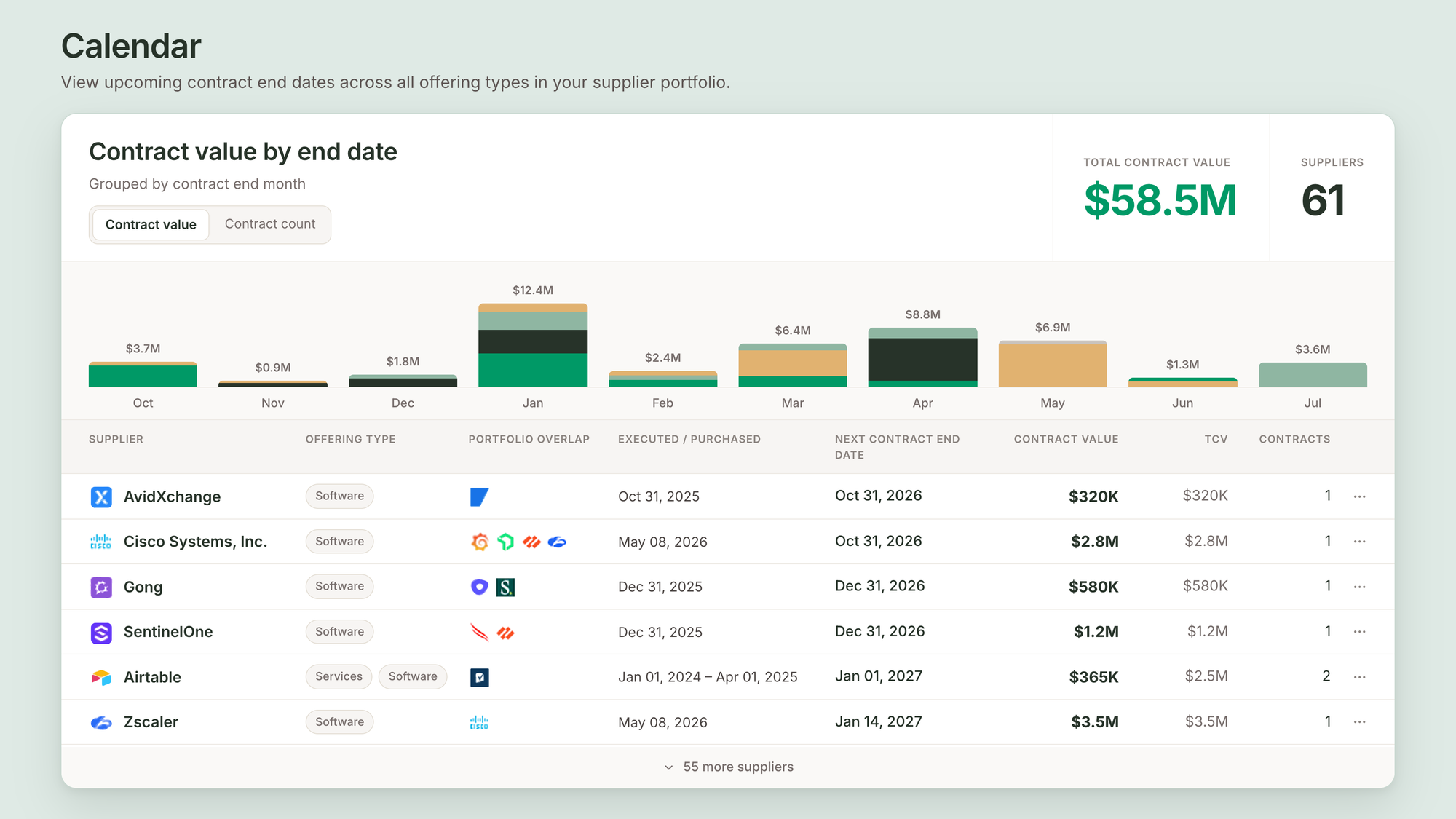
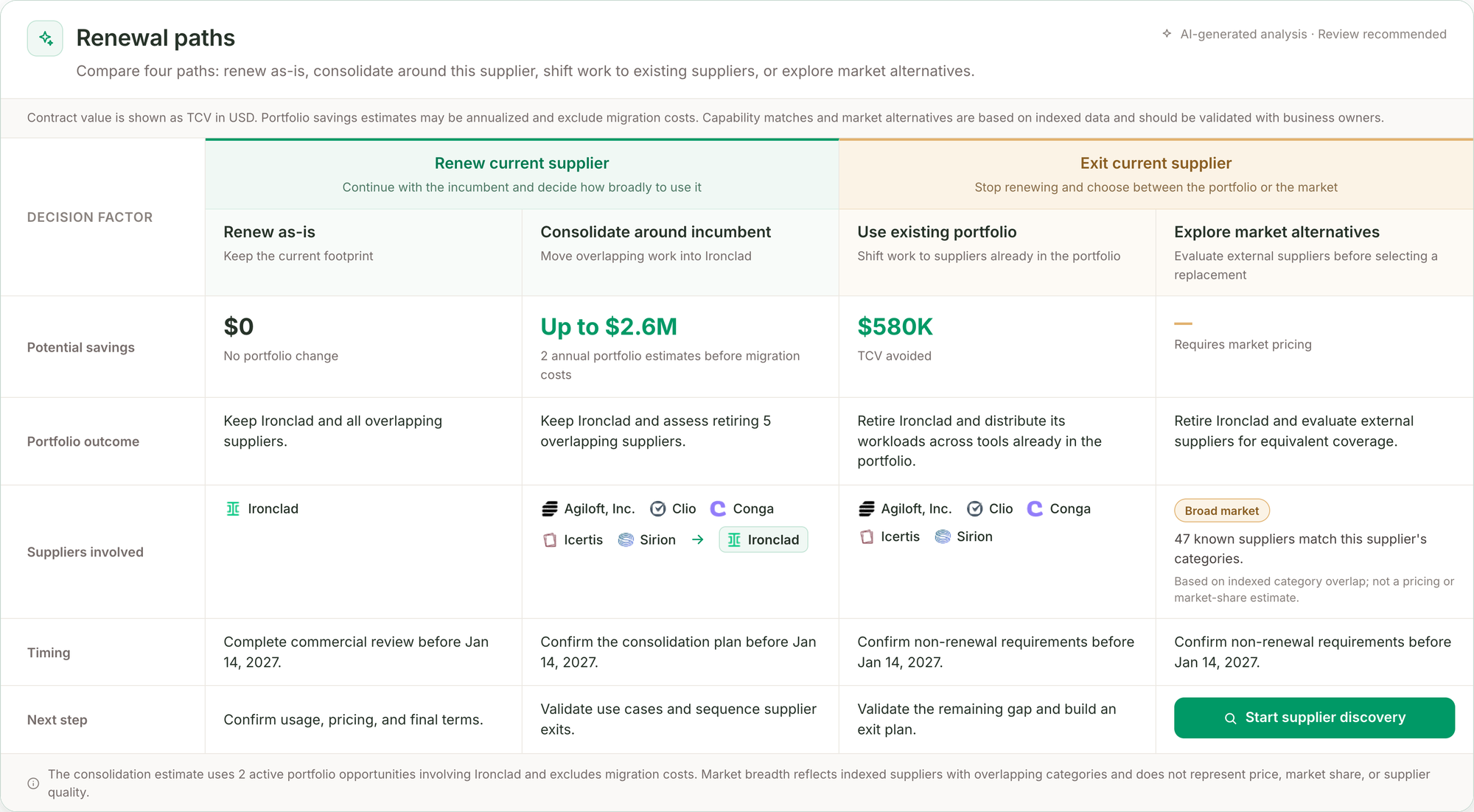
How we solve it: Each renewal page now includes Renewal Paths, which compares all four options side by side in two groups.
Under Renew current supplier, you can renew as-is and keep the current footprint, or consolidate around the incumbent by moving overlapping work into it.
Under Exit current supplier, you can use your existing portfolio and shift the work to tools you already have, or explore market alternatives before picking a replacement.
For each path, you see the potential savings, the portfolio outcome, the suppliers involved, the timing, and the next step.
Take Ironclad, a $580K contract ending 14 January 2027:
- Renewing as-is saves nothing. Ironclad stays, and so do all overlapping suppliers.
- Consolidating around Ironclad could save up to $2.6M by retiring five overlapping suppliers: Agiloft, Clio, Conga, Icertis, and Sirion.
- Using the existing portfolio avoids Ironclad's $580K TCV by spreading its work across those same five tools.
- Exploring the market turns up 47 known suppliers in Ironclad's categories, and one button starts Supplier Discovery.
Every path has the same deadline attached: decide before January 14, 2027. Miss it, and you're back to renewing as-is.
The savings figures are estimates. They exclude migration costs, and business owners should validate capability matches. The page says so, right next to the numbers.
5. Consolidation opportunities and document history
Renewal decisions spill over. Cutting one supplier affects the others, and the paperwork behind a single contract is usually spread across several files.
Why it's needed: If consolidation is on the table, you need to see the opportunity. If you're about to negotiate, you need the full contract history, not just the latest order form.
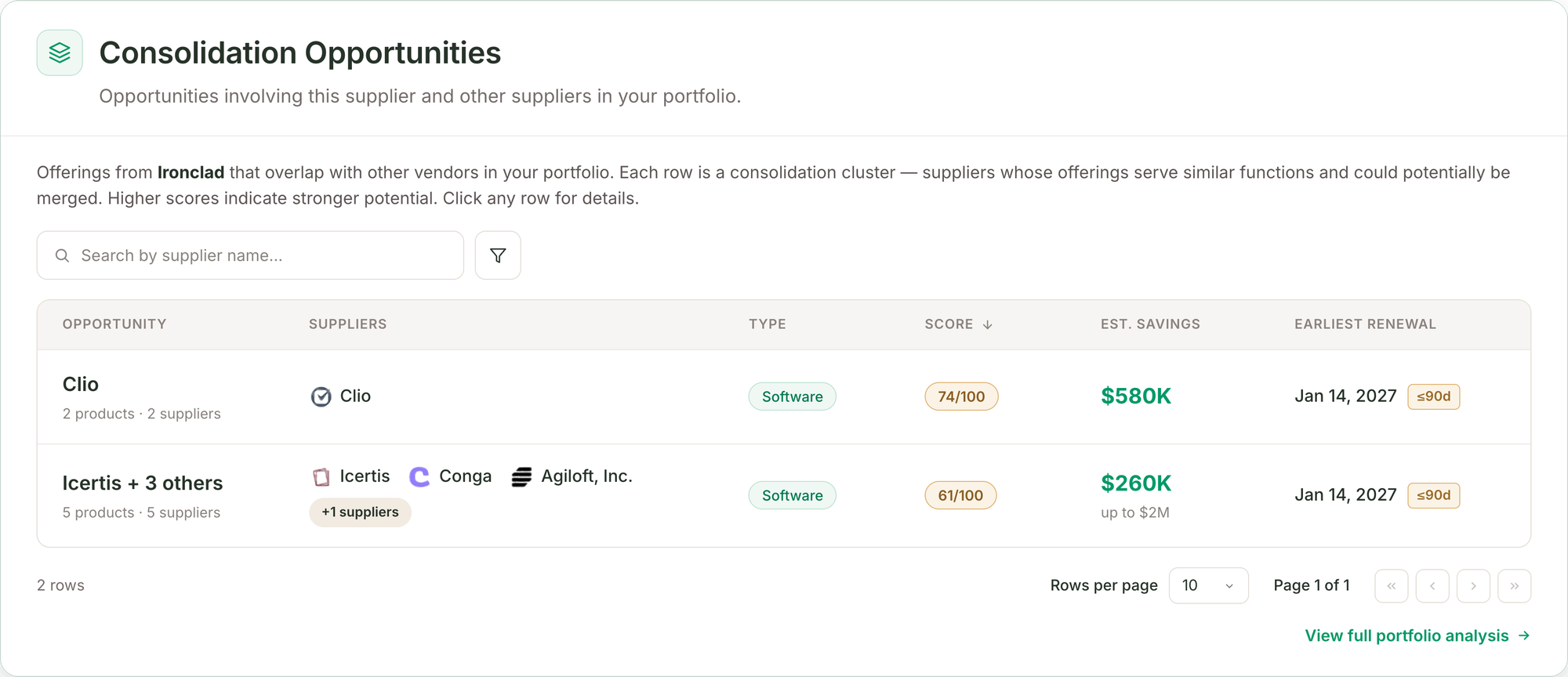
How we solve it: Below the renewal paths, each page lists the consolidation opportunities it's part of, pulled from Portfolio Analysis, with opportunity scores, estimated savings, and earliest renewal dates. One click opens the full analysis, where the Consolidation Planner shows exactly which products to keep and which to eliminate.
Document history keeps a full record of the relationship: every contract and order form, with value, status, and term dates, viewed as a timeline or table. Upload new documents straight from the page.
Early access
The new Renewal Calendar is in early access for Teem customers. Open the calendar and click the banner to try it. You can switch back to the current view anytime. We're still working on it, so if something's missing or gets in your way, hit Share feedback and tell us.
Summary
The old Renewal Calendar told you what was renewing and when. The new one also tells you what doing nothing will cost, and what else you could do.
Renewals will keep coming. The difference is whether you decide what happens to each one, or the end date decides for you.
Try it
Already using Teem? Go to View Calendar, click Try the new Calendar, and open any supplier to see its renewal paths.
Log in to Teem
New to Teem? Book a time on my calendar, and I'll show you what's renewing in your portfolio over the next 90 days.