Zip Intake-to-Pay vs Workday Strategic Sourcing: Product Comparison Report
Zip and Workday Strategic Sourcing both appear on procurement shortlists, but they solve for different ends of the same problem. One is built to orchestrate how spending enters and moves through an organization. The other is built to run structured sourcing events and manage suppliers and contracts with depth. Knowing which end matters more to your team is the fastest way to tell them apart.
Zip is a procurement orchestration layer that sits on top of existing ERP and finance systems. Its strength is intake-to-pay: a centralized spend intake front door, employee purchase request intake, purchase requisition initiation, pre-PO workflow orchestration, approval routing and policy enforcement, and the path from an approved request through ordering, invoicing, and payment coordination. It is designed to control demand before it reaches the ERP, rather than replacing the ERP itself, and it leans on AI to route and automate that workflow.
Workday Strategic Sourcing is a strategic sourcing and source-to-contract platform with a mature supplier-management model. Its strength is upstream: sourcing intake and project capture, RFx event creation and response analysis, dynamic negotiations, and a full contract lifecycle covering authoring, negotiation, repository and search, and renewal tracking. It also carries supplier management well beyond onboarding, into performance management, risk monitoring, collaborative scoring, and KPI tracking, with reporting and savings analytics on top.
The comparison below follows an independent capability assessment of both products. The scores at a glance come first, then the detailed analysis, then the full capability heatmap.
Key Differentiators
The clearest split between the two products is platform orientation. Workday Strategic Sourcing is substantially stronger for strategic sourcing, supplier management, and contract-centric processes, while Zip is substantially stronger for procurement orchestration and intake-to-pay execution.
Workday stands out in source-to-contract process management, sourcing project intake and pipeline management, RFx response analysis and comparison, dynamic negotiation workflows, contract authoring, contract negotiation and revision, contract repository and search, contract renewal tracking, supplier performance management, supplier risk monitoring and validation, KPI tracking for supplier management, reporting and savings tracking, and collaborative supplier scoring. Zip stands out in intake-to-pay workflow automation, purchase requisition initiation, purchase order initiation support, pre-PO workflow orchestration, tail spend management, AI-assisted procurement workflow orchestration, global payment coordination, and procurement admin enablement and training.
Both products are strong in a shared middle band. That includes a centralized spend intake front door, vendor onboarding, cross-system procurement orchestration, integration with finance and procurement systems, API-based integration support, a prebuilt integrations ecosystem, approval routing and policy enforcement, a supplier collaboration portal, and vendor onboarding workflow management.
In short, Workday is the better fit when the priority is structured sourcing execution and supplier governance, while Zip is the better fit when the priority is broad intake, workflow control, and downstream procurement coordination.
Workday Strategic Sourcing Strengths
Workday Strategic Sourcing has the most complete strategic sourcing footprint in the comparison. It shows clear strength in sourcing intake and project capture; sourcing project intake and pipeline management; RFx event creation and management; RFx response analysis and comparison; supplier competition management; stakeholder collaboration in sourcing; and source-to-contract process management.
Its contract capabilities are materially deeper, covering AI-powered contract lifecycle management, contract authoring, contract negotiation and revision, contract approval workflow, contract repository and search, and contract renewal tracking. On supplier management, it is notably ahead, with supplier lifecycle management, supplier performance management, action item tracking for supplier development, collaborative supplier scoring, KPI tracking for supplier management, supplier compliance workflow management, supplier risk workflows, supplier risk management, supplier risk monitoring and validation, and third-party risk data integrations.
Workday also offers stronger business-value reporting through spend dashboards, configurable analytics, savings tracking, and visibility into sourcing outcomes. Additional differentiators include configurable stakeholder approval groups, a low-training user experience, supplier credential reuse across customer tenants, tight integration with Workday Procurement, and industry-specific sourcing use cases. The main message is that Workday offers a mature sourcing and supplier governance operating model, especially for organizations that need disciplined sourcing execution rather than just request orchestration.
Zip Strengths
Zip's biggest advantage is its strength as a procurement orchestration layer that sits over existing ERP and finance systems. It performs especially well across the centralized spend intake front door, employee purchase request intake, purchase requisition initiation, pre-PO workflow orchestration, approval routing and policy enforcement, spend visibility and operational control, and cross-system procurement orchestration.
Zip is also clearly stronger in intake-to-pay workflow automation, purchase order initiation support, and global payment coordination, making it a better fit for organizations trying to control demand before it reaches the ERP and then move approved requests through downstream procurement and payment steps. Its AI-assisted procurement workflow orchestration is a further differentiator, with stronger evidence of AI application in routing and workflow automation than in Workday Strategic Sourcing.
Zip performs well in vendor-facing process design too, including vendor portal and vendor app access, customer-specific vendor requests and document collection, reusable supplier profile data across onboarding flows, supplier onboarding, a supplier collaboration portal, and vendor onboarding workflow management. It also has stronger evidence of structured training and enablement through procurement admin enablement and training. Overall, Zip is best characterized as a workflow-first orchestration platform that simplifies intake, policy enforcement, vendor onboarding, and downstream handoffs across procurement systems.
Feature Coverage Gaps
The most notable gaps are concentrated in opposite areas for each product. Workday Strategic Sourcing is comparatively weaker in full intake-to-pay execution. It does not demonstrate native strength in purchase requisition and purchase order initiation, global payment coordination, or support for intake-to-pay workflow automation, and its support for intake-to-pay workflow automation is only partial. Workday is strong before and around supplier selection and contracting, but weaker as the operational layer for requisition-to-payment workflows.
Zip shows the opposite pattern, with its biggest gaps in strategic sourcing depth and contract management. It lacks verified native strength in AI-powered contract lifecycle management, contract authoring, contract repository and search, contract termination tracking, and full source-to-contract process management. It also trails on supplier performance management, KPI tracking for supplier management, reporting and savings tracking, spend dashboards and configurable analytics, dynamic negotiation workflows, RFx response analysis and comparison, and supplier risk monitoring and validation with third-party risk data integrations. In several of these areas, Zip has adjacent workflow support, but the evidence does not confirm the richer sourcing and supplier-governance depth that Workday demonstrates.
Decision-makers should therefore be careful not to treat these products as interchangeable. Workday has deeper strategic sourcing, while Zip has broader procurement orchestration.
Recommendations
Choose Workday Strategic Sourcing when the priority is to run a structured strategic sourcing program with strong source-to-contract execution, richer supplier governance, and stronger contract and supplier-management capabilities. It is the better choice for teams that need sourcing intake and project capture, sourcing project intake and pipeline management, RFx event creation and management, RFx response analysis and comparison, collaborative supplier scoring, supplier performance management, supplier risk management, and contract lifecycle control in one environment. It is especially attractive for organizations already invested in Workday Procurement, because tight integration there strengthens the broader source-to-pay architecture.
Choose Zip when the priority is to create a single front door for spend, orchestrate approvals across existing systems, improve pre-PO control, and automate the path from intake through approvals, ordering, invoicing, and payment-related coordination. It is the better fit for organizations focused on employee purchase request intake, purchase requisition initiation, pre-PO workflow orchestration, intake-to-pay workflow automation, purchase order initiation support, tail spend management, and AI-assisted procurement workflow orchestration.
If the buying team values strategic sourcing depth and supplier-management maturity, Workday is the stronger option. If the buying team values broad intake, policy enforcement, ERP-overlay orchestration, and operational workflow automation, Zip is the stronger option.
Strategic Recommendations
- Choose Workday Strategic Sourcing if your priority is strategic sourcing depth, especially for source-to-contract execution, RFx management, supplier evaluation, and contract lifecycle management.
- It has clear strengths in sourcing project intake, pipeline management, bid comparison, dynamic negotiations, contract authoring, contract repository and search, renewal tracking, and AI-powered contract lifecycle management, all areas where Zip is partial or unsupported.
- Choose Zip if your main goal is to orchestrate procurement across request intake, approvals, purchase requisition flow, and intake-to-pay automation without replacing your ERP.
- Zip stands out as the stronger orchestration layer for employee request intake, pre-PO workflow control, purchase requisition initiation, purchase order handoff, tail spend management, and payment-related coordination, which makes it a better fit for operational procurement control.
- If supplier performance, supplier risk, and ongoing supplier governance are critical, favor Workday Strategic Sourcing.
- Workday shows stronger support for supplier risk monitoring with third-party risk data, KPI tracking, collaborative supplier scoring, supplier development action tracking, and broader supplier performance management, which matters for teams managing suppliers beyond initial onboarding.
- If fast supplier onboarding with lower vendor friction is the top need, Zip is a strong option, especially for organizations managing many external vendors across customers.
- Zip offers a strong vendor portal experience, reusable supplier profile data across onboarding flows, and customer-specific document and survey collection, which can reduce repetitive data entry and speed onboarding completion.
- For organizations already invested in Workday Procurement or the broader Workday ecosystem, Workday Strategic Sourcing is the safer choice.
- Its tighter native alignment with Workday Procurement can reduce integration complexity and create a smoother source-to-pay operating model, which matters for scalability, administrative simplicity, and cleaner cross-system workflows.
- Be cautious with Zip if contract management is a deal-breaker, especially if you need native contract authoring, contract repository search, termination tracking, or negotiation-heavy legal workflows.
- The analysis shows Zip is strong in orchestration and intake, but much weaker or unverified in core contract lifecycle capabilities, so legal and sourcing teams may need additional tooling.
- Be cautious with Zip if you need advanced strategic sourcing analytics, such as savings tracking, sourcing pipeline visibility, or structured supplier performance reporting.
- Workday Strategic Sourcing provides much stronger evidence for dashboards, savings tracking, sourcing visibility, and supplier management analytics, which matters when procurement leaders need defensible reporting and value measurement.
Capability Heatmap
The heatmap takes the comparison down to the capability level across two dimensions: use cases, meaning what a procurement team needs to get done, and features, meaning how each platform delivers it. A green tick marks a capability that is supported natively. A grey dash marks a gap, or a capability that is not native to the product.
One thing to watch as you read: the capabilities are grouped by territory. One block covers Workday's home ground of source-to-contract and supplier management, the other covers Zip's home ground of procurement orchestration and intake-to-pay. Reading down each column shows how a product performs on its own turf and on the other's.
The first view covers use cases: 32 capabilities.
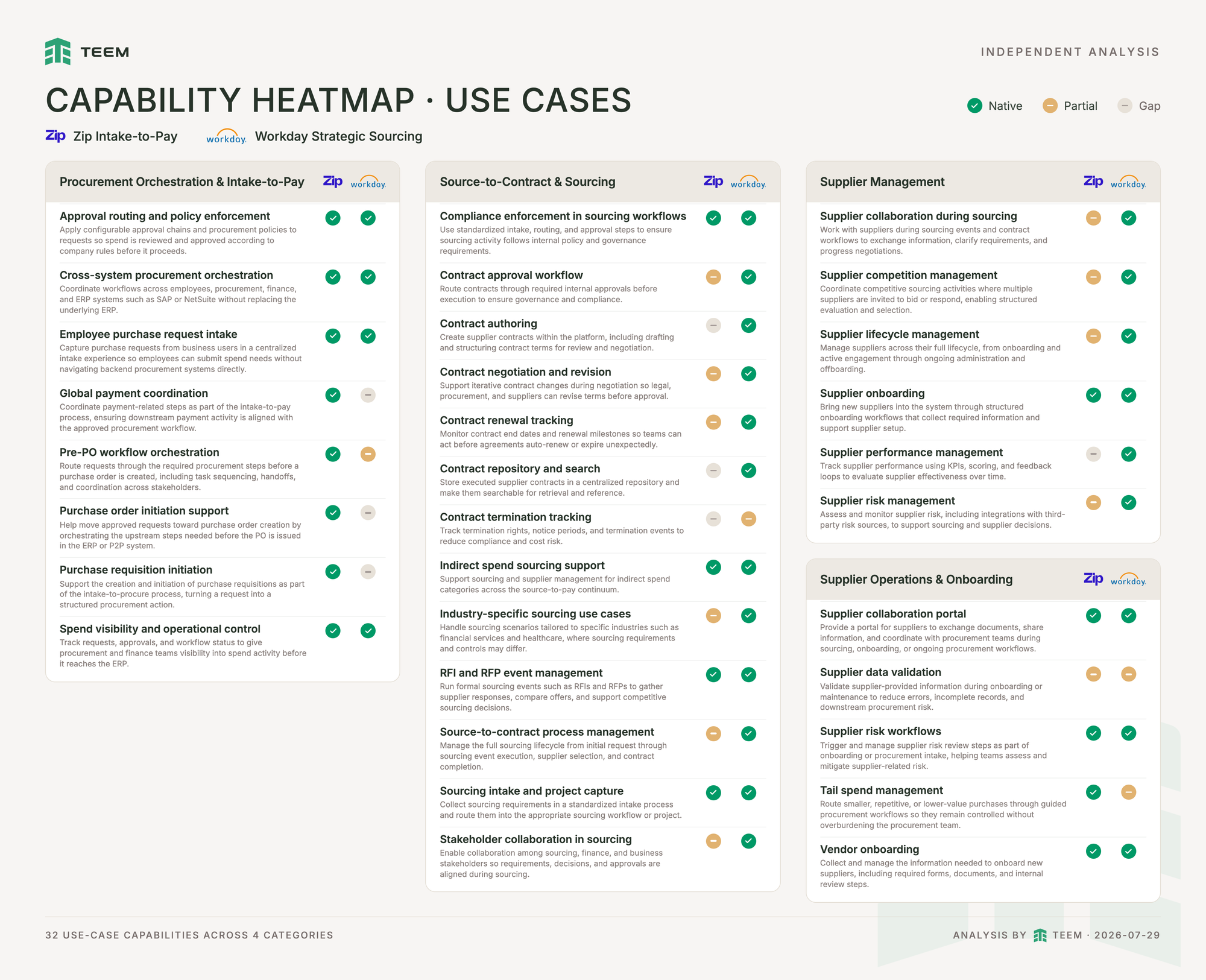
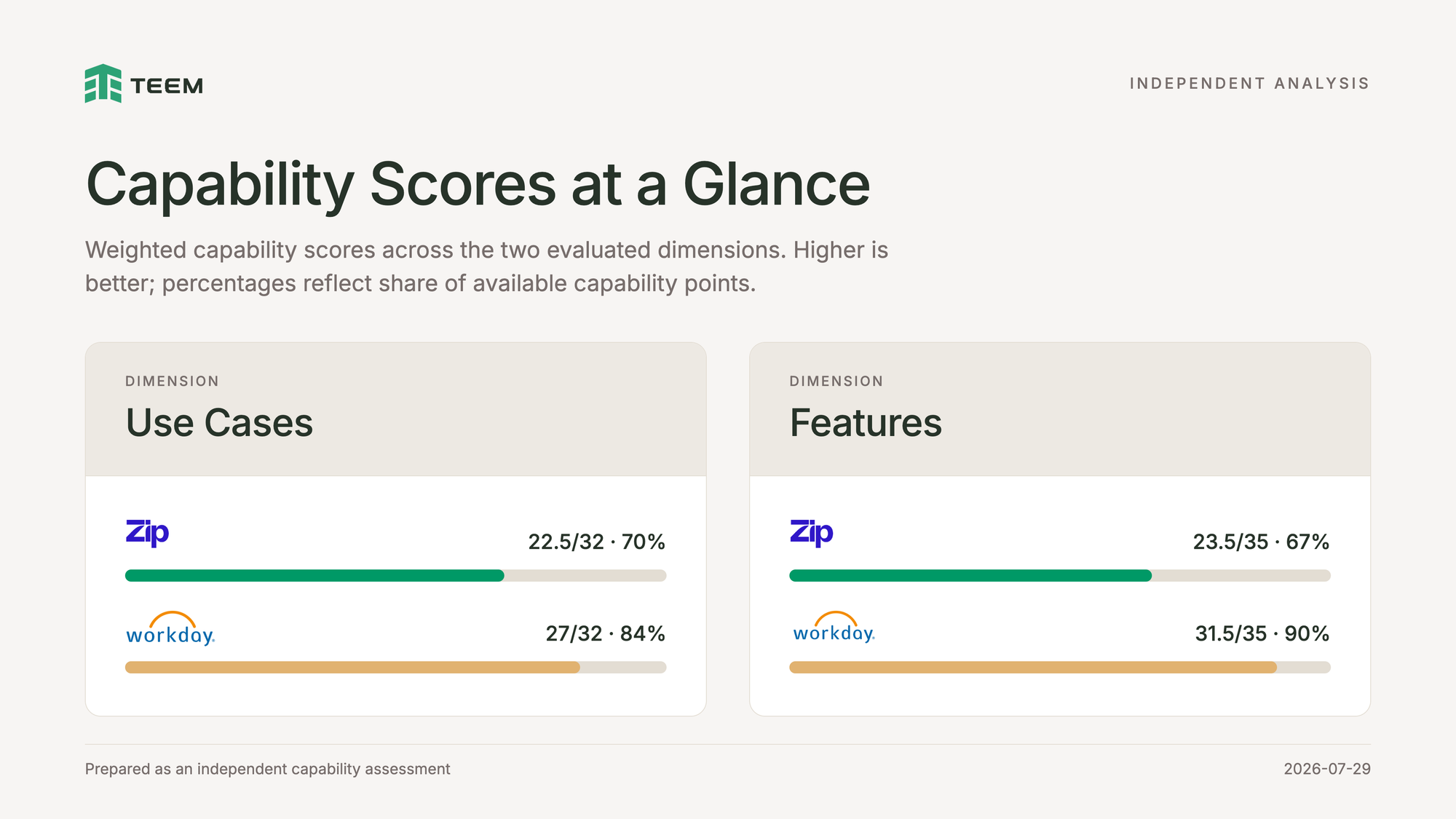
The use-case picture tracks the territory lines closely. Workday leads the dimension at 27 of 32 (84%) against Zip at 22.5 of 32 (70%). On the sourcing and supplier-management capabilities, Workday is close to complete while Zip shows gaps across contract authoring, contract repository and search, contract negotiation, supplier lifecycle management, and supplier performance. On the orchestration and intake-to-pay capabilities that reverses: Zip carries requisition initiation, purchase order initiation support, global payment coordination, and tail spend, where Workday is partial or absent.
The feature view shows the same split, drawn sharper: 35 capabilities.
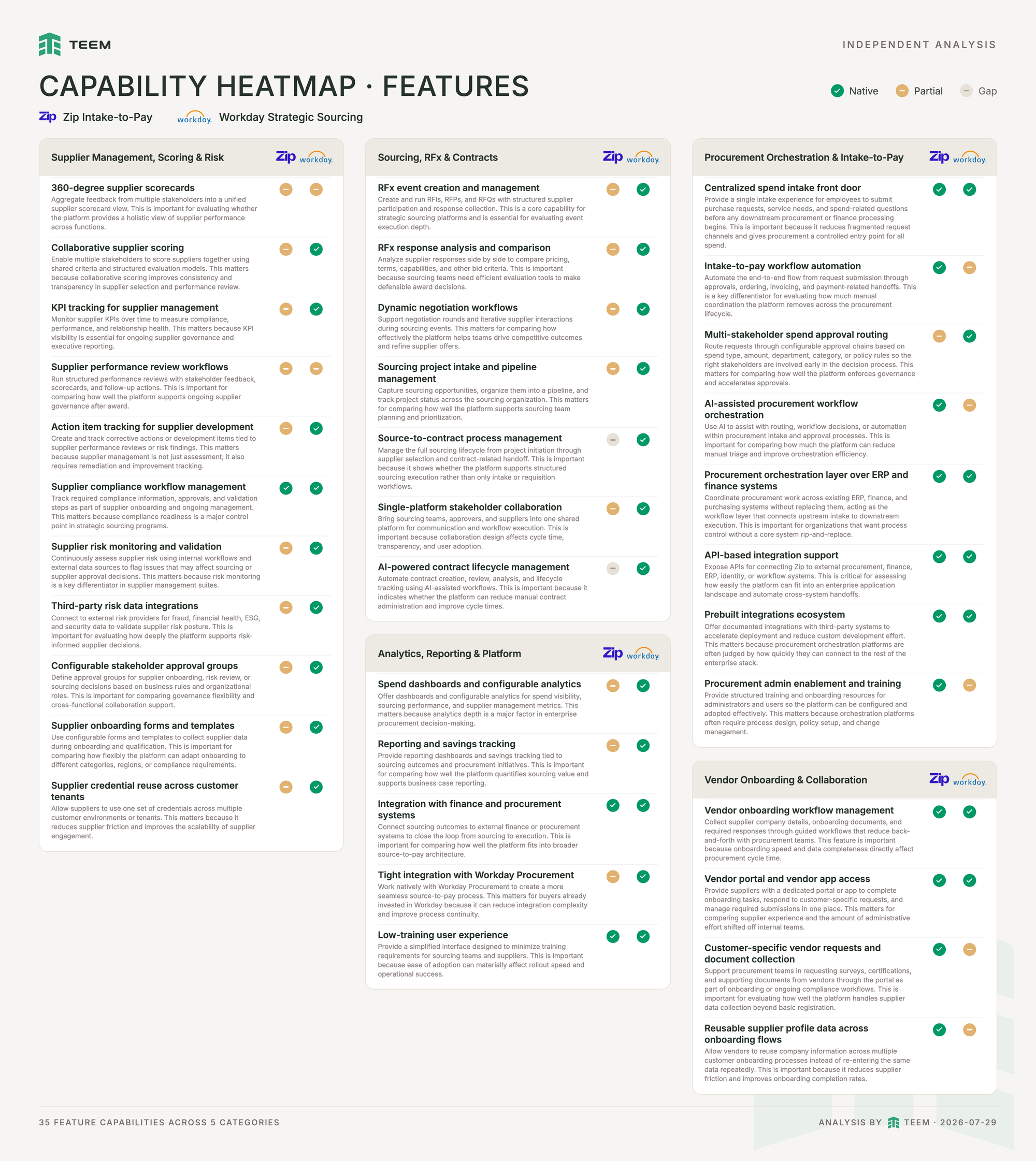
At feature level the gap widens. Workday reaches 31.5 of 35 (90%) against Zip at 23.5 of 35 (67%), on the strength of its sourcing execution, supplier governance, and contract lifecycle coverage. Zip's ticks cluster where you would expect, in orchestration, intake-to-pay automation, and vendor onboarding. Both heatmaps land on the same point: these are not interchangeable products. Workday owns depth in sourcing, suppliers, and contracts, Zip owns breadth in orchestration and intake-to-pay, and the right choice depends on which of those your team actually needs to run.
Making the Call
The scores lean toward Workday, but the more useful question is which job you are trying to do. Zip is an orchestration layer that sits over your existing ERP and finance systems and controls the path from intake to payment. Workday Strategic Sourcing is a sourcing, supplier, and contract platform with real depth. Those are different jobs, and the right pick follows from which one is your priority rather than from the headline percentages.
Two shortcuts usually settle it. If you are already invested in Workday Procurement, Workday Strategic Sourcing is the lower-friction choice and tightens an operating model you already run. If your priority is a single front door for spend that orchestrates approvals across systems you do not want to replace, Zip is built for exactly that. And for some teams these are not mutually exclusive: Zip can orchestrate the front end while a sourcing suite handles events, contracts, and supplier governance. The question worth answering before you shortlist is whether you are buying sourcing depth, orchestration breadth, or both.
This comparison is the kind of analysis Teem runs across the procurement software landscape: what each platform does natively, where the gaps sit, and what it takes to close them. If you are working through a similar decision, you can explore more capability comparisons at teem.finance.