
ServiceNow vs Workday: Product Comparison Report
ServiceNow Sourcing and Procurement Operations vs Workday Strategic Sourcing.
ServiceNow's Sourcing and Procurement Operations and Workday Strategic Sourcing are often shortlisted together, but they are built for different parts of the procurement lifecycle. One is designed to run the operational engine that moves work from employee request through to payment readiness. The other is designed to run the strategic front end, where sourcing events are executed, and contracts are managed. Understanding that a split is the first step to picking the right fit.
ServiceNow Sourcing and Procurement Operations is an operational source-to-pay platform. Its center of gravity is downstream procurement execution: automated procurement intake, employee requests for goods and services, a centralized procurement workspace, procurement case management, guided shopping, compliant purchasing, purchase order creation, receipt processing, and invoicing workflow support. It carries work end-to-end through the purchasing lifecycle and puts an Employee Center front door in front of requesters, with knowledge and to-do surfacing to support self-service.
Workday Strategic Sourcing is a strategic sourcing and source-to-contract platform. Its center of gravity is the upstream: sourcing project intake, source-to-contract workflow orchestration, RFx management, reverse auctions, public bidding, and dynamic negotiations, together with native contract lifecycle management, contract creation, clause and template management, and a contract repository. It also carries supplier management deeper into the sourcing environment, covering supplier onboarding, performance, risk, and qualification.
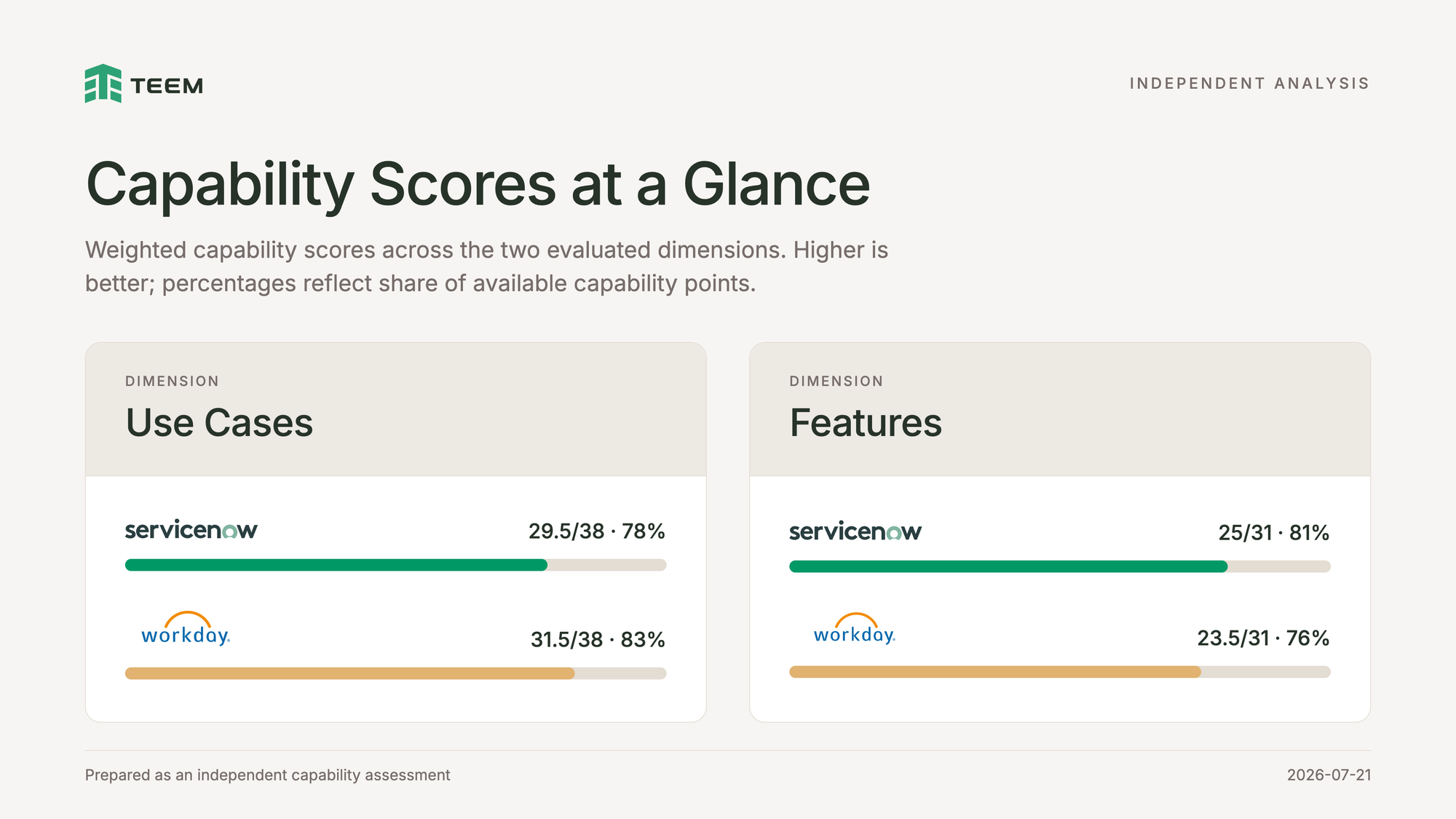
The comparison below follows an independent capability assessment of both products. The scores are shown first, then the detailed analysis, and finally the full capability heatmap.
Key Differentiators
The biggest difference is solution scope. Workday Strategic Sourcing is strongest as a strategic sourcing and source-to-contract platform, while Sourcing and Procurement Operations is stronger as an operational source-to-pay platform.
Workday leads in the sourcing-centric capabilities: RFx management, reverse auctions, public bidding, dynamic negotiations, clause and template management, supplier collaboration, supplier relationship management, and deeper native contract management. Sourcing and Procurement Operations leads in downstream procurement execution: purchase order creation, receipt processing, end-to-end source-to-pay automation, guided shopping, procurement case management, employee shopping experiences, procurement policy guidance, and day-to-day procurement activity management.
Both products are strong in a shared middle band. That includes intake, analytics, savings tracking, sourcing pipeline management, stakeholder collaboration, integration with finance and procurement systems, AI-assisted workflow support, and visibility across sourcing activity.
The practical choice comes down to one question. Does the organization primarily need a strategic sourcing platform with strong sourcing event execution and contract capabilities, or a procurement operations platform that carries work through requisition, purchase order, receipt, and invoicing?
Product Strengths
Workday Strategic Sourcing stands out for its capabilities in strategic sourcing. It is consistently strong across sourcing project intake, source-to-contract workflow orchestration, contract lifecycle management, contract repository and search, contract creation, clause and template management, supplier onboarding, supplier performance management, supplier risk management, supplier qualification support, stakeholder collaboration, dynamic negotiations, reverse auctions, RFx management, public bidding, savings tracking, and sourcing reporting. Its AI support is strong in sourcing analysis, contract-related workflows, and supplier data handling. This makes it a good fit for organizations that want to create procurement value through competitive sourcing, supplier management, and contracting discipline.
Sourcing and Procurement Operations stands out for procurement operations. It is strongest in automated procurement intake, employee requests for goods and services, a centralized procurement workspace, procurement case management, procurement activity management, guided shopping, compliant purchasing, purchase order creation, receipt processing, invoicing workflow support, and end-to-end source-to-pay automation. It also brings an Employee Center-based requester experience, knowledge, and task surfacing for employees, policy-guided buying, and project portfolio integration. Beyond those, it has notable strengths in configurable integration frameworks, business-rule-based integration triggers, and linking procurement work to project cost plans. This makes it a good fit for organizations focused on operational efficiency, employee self-service, and process orchestration across the full purchasing lifecycle.
Feature Coverage Gaps
Workday Strategic Sourcing has clear gaps in downstream procurement execution. The most important weaknesses are the lack of native purchase order creation, receipt processing, invoicing, guided shopping, and full end-to-end source-to-pay automation. It also appears weaker in procurement case management, broader procurement activity management, requester self-service knowledge surfacing, and project-cost capabilities, such as purchase order-to-cost plan linking. Once work moves beyond sourcing and contracting into transactional purchasing operations, the product depends on adjacent procurement products or integrations.
Two upstream sourcing capabilities are also absent. Workday Strategic Sourcing does not provide native supplier discovery, the ability to identify and surface new qualified suppliers, rather than only manage the suppliers a business already knows. It also does not provide native category management, the structured planning and management of spend categories and category strategies. Both sit outside its source-to-contract scope, so teams that treat supplier discovery or category management as core would need to cover them with separate tools.
Sourcing and procurement operations have the opposite pattern. It is strong operationally but weaker in depth of core strategic sourcing. The biggest gaps are a lack of confirmed reverse auctions, weaker public bidding support, less consistent evidence for native RFx depth in some comparisons, weaker standalone supplier relationship management, weaker native clause and template management, and less complete standalone contract lifecycle management. Native support for supplier risk and supplier performance is partial rather than strong unless related ServiceNow modules are added. Several supplier and contract capabilities are more clearly available in the broader ServiceNow ecosystem than in Sourcing and Procurement Operations alone, so organizations seeking a best-in-class sourcing suite may find the base product less complete without add-on modules.
Business Need Priorities and Buying Implications
No capabilities in the comparison are explicitly marked as stakeholder-critical business needs, so the decision should centre on overall fit and where the organisation expects the most operational value.
If the priority is sourcing effectiveness, supplier competition, negotiation leverage, contract standardization, and savings delivery, Workday Strategic Sourcing has a stronger native profile. Its advantages are most evident in reverse auctions, public bidding, RFx execution, clause management, supplier collaboration, and source-to-contract governance.
If the priority is employee intake, guided buying, procurement service delivery, operational workflow automation, request routing, purchase order and receipt handling, and broader source-to-pay orchestration, Sourcing and Procurement Operations has the stronger fit. Its advantage is most visible in procurement case management, the Employee Center front door, policy-guided shopping, purchase order creation, receipts, invoicing workflow, and project-linked procurement controls.
For organizations that need both strong strategic sourcing and strong transactional procurement operations in one environment, each product is best when paired with its broader platform ecosystem. Workday Strategic Sourcing becomes more complete when combined with Workday procurement and financial products. Sourcing and procurement operations become more complete when combined with Contract Management Pro, Supplier Lifecycle Operations, Vendor Risk Management, Performance Analytics, and project portfolio tools. The buying decision should therefore weigh not just current feature fit, but how much additional platform adoption is acceptable to close the remaining gaps.
Recommendations
Choose Workday Strategic Sourcing if the main goal is to improve sourcing rigor, run competitive sourcing events effectively, strengthen contract and supplier management, and drive measurable savings through sourcing-led processes. It is the better fit for procurement teams that operate as strategic sourcing leaders and need strong upstream capability before the purchase order stage.
Choose Sourcing and Procurement Operations if the main goal is to modernize procurement service delivery, simplify employee purchasing, automate request-to-fulfillment workflows, and connect procurement work to purchasing, receiving, invoicing, and project controls. It is a better fit for organizations that want to improve procurement operations efficiency and a more complete process for employees and buyers.
If the organization needs deep sourcing and deep operational procurement in equal measure, neither product should be evaluated in isolation. Workday Strategic Sourcing will likely require complementary Workday procurement components for transactional execution, while Sourcing and Procurement Operations will likely require complementary ServiceNow contract, supplier, risk, and analytics modules for full sourcing maturity. In that scenario, the best decision depends on which platform ecosystem the organization is more willing to standardize on and extend over time.
Strategic Recommendations
- Choose Sourcing and Procurement Operations if you need true end-to-end source-to-pay automation, including purchase order creation, receipt processing, invoicing, guided shopping, and procurement case management.
- It is a better fit for organizations that want a single operational workflow from employee request through to payment readiness, while Workday Strategic Sourcing is much stronger in source-to-contract than in full purchasing execution.
- Choose Workday Strategic Sourcing if your priority is strategic sourcing excellence, especially RFx management, reverse auctions, public bidding, dynamic negotiations, and source-to-contract orchestration.
- Sourcing-led teams focused on competitive events, supplier bidding, and negotiated savings will get deeper native capabilities in these areas than they will from Sourcing and Procurement Operations.
- If contract-centric work is critical, favor Workday Strategic Sourcing for stronger native contract lifecycle management, clause and template management, contract repository support, and sourcing-to-contract continuity.
- Contract creation, negotiation, approvals, storage, and renewal tracking are more clearly documented in Workday Strategic Sourcing, reducing reliance on adjacent modules for a complete contract workflow.
- Favor Sourcing and Procurement Operations when employee experience and intake simplicity are top priorities, especially if you want AI-assisted request capture, Employee Center access, requester to-dos, and policy-guided shopping.
- Broad user adoption often depends on a simple front door for employees, and ServiceNow shows stronger support for self-service procurement experiences beyond sourcing specialists.
- Select Sourcing and Procurement Operations if procurement operations scale, workflow control, and cross-system orchestration are your main goals, especially with ERP integration, third-party sourcing integration, and project portfolio integration.
- Organizations with complex operational environments benefit from ServiceNow's stronger evidence for procurement case workflows, configurable integration triggers, and purchase order-to-cost plan linking.
- Choose Workday Strategic Sourcing if supplier governance after onboarding is a major priority, including supplier performance management, supplier relationship management, supplier risk management, and digital supplier collaboration.
- Workday shows more complete native support for managing supplier performance and relationships inside the sourcing environment, while ServiceNow often relies on related supplier lifecycle or risk products for deeper coverage.
- Be cautious with Workday Strategic Sourcing if your must-haves include invoicing, receipt processing, or native purchase order creation, because those are not supported natively in the evaluated product.
- Buyers could otherwise assume they are getting a full procurement execution platform, when in practice, they may need additional Workday products to cover downstream purchasing and payment workflows.
- Be cautious with Sourcing and Procurement Operations if reverse auctions, clearly differentiated RFx depth, or standalone supplier onboarding and risk capabilities are deal-breakers for your sourcing team.
- Some of these capabilities are weaker, partial, or depend on adjacent ServiceNow products, which can affect implementation scope, licensing complexity, and fit for mature strategic sourcing programs.
Capability Heatmap
The heatmap takes the comparison down to the capability level across two dimensions: use cases, meaning what a team needs to get done, and features, meaning how each platform delivers it. A green tick marks a capability that is supported natively. A grey dash marks a gap, or a capability that is not native to the product. Reading down each column shows where a product stands on its own and where it leans on adjacent tools.
The first view covers use cases: 38 capabilities across seven categories.
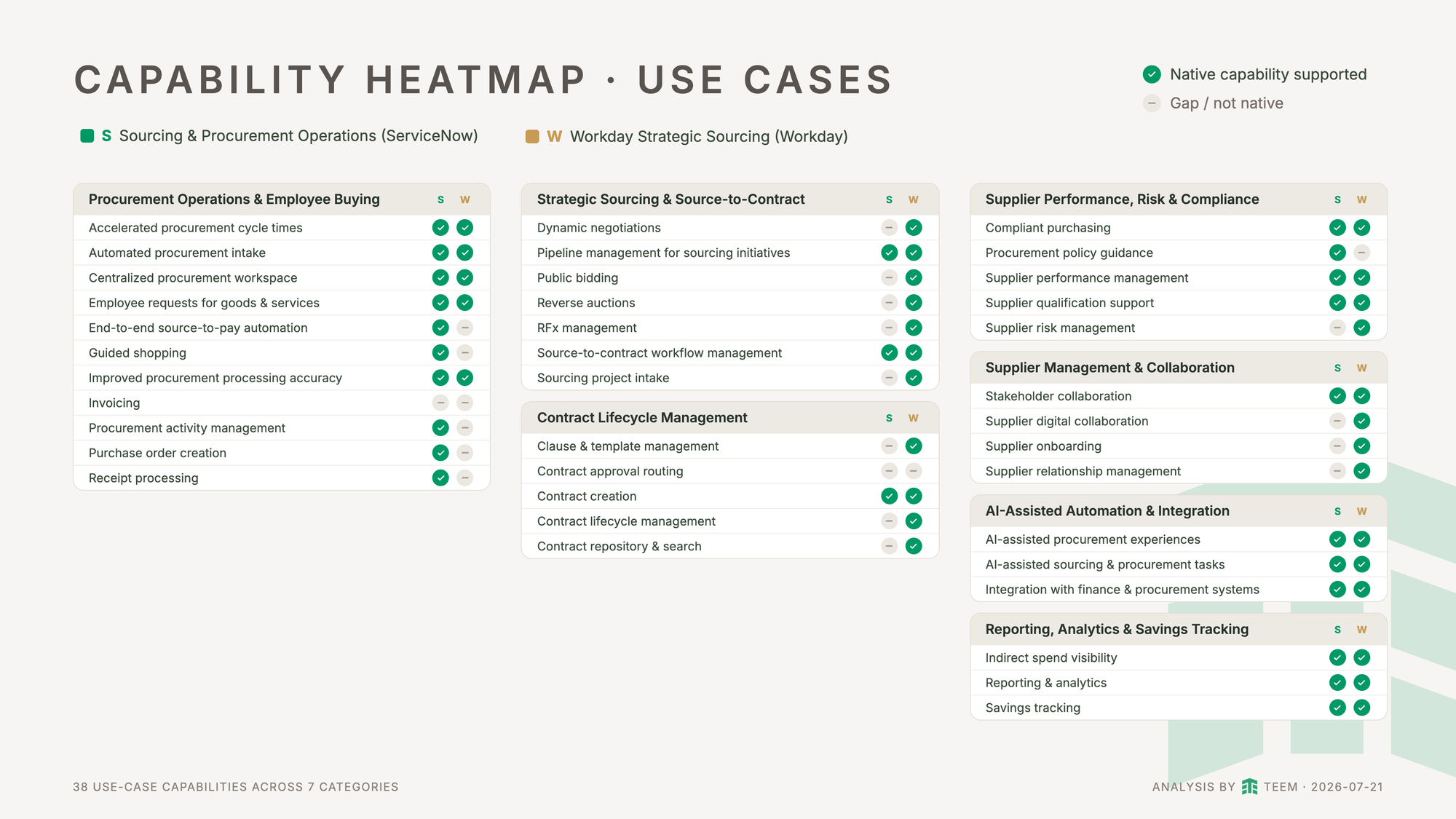
The use-case picture aligns with the broader comparison. ServiceNow covers more of the downstream journey: guided shopping, purchase order creation, receipt processing, and procurement case management. Workday covers more of the upstream: RFx, reverse auctions, contract lifecycle management, and supplier governance. On weighted score, Workday leads this dimension with 31.5 of 38 (83%), compared with ServiceNow at 29.5 of 38 (78%).
The feature view shows 31 capabilities across eight categories.
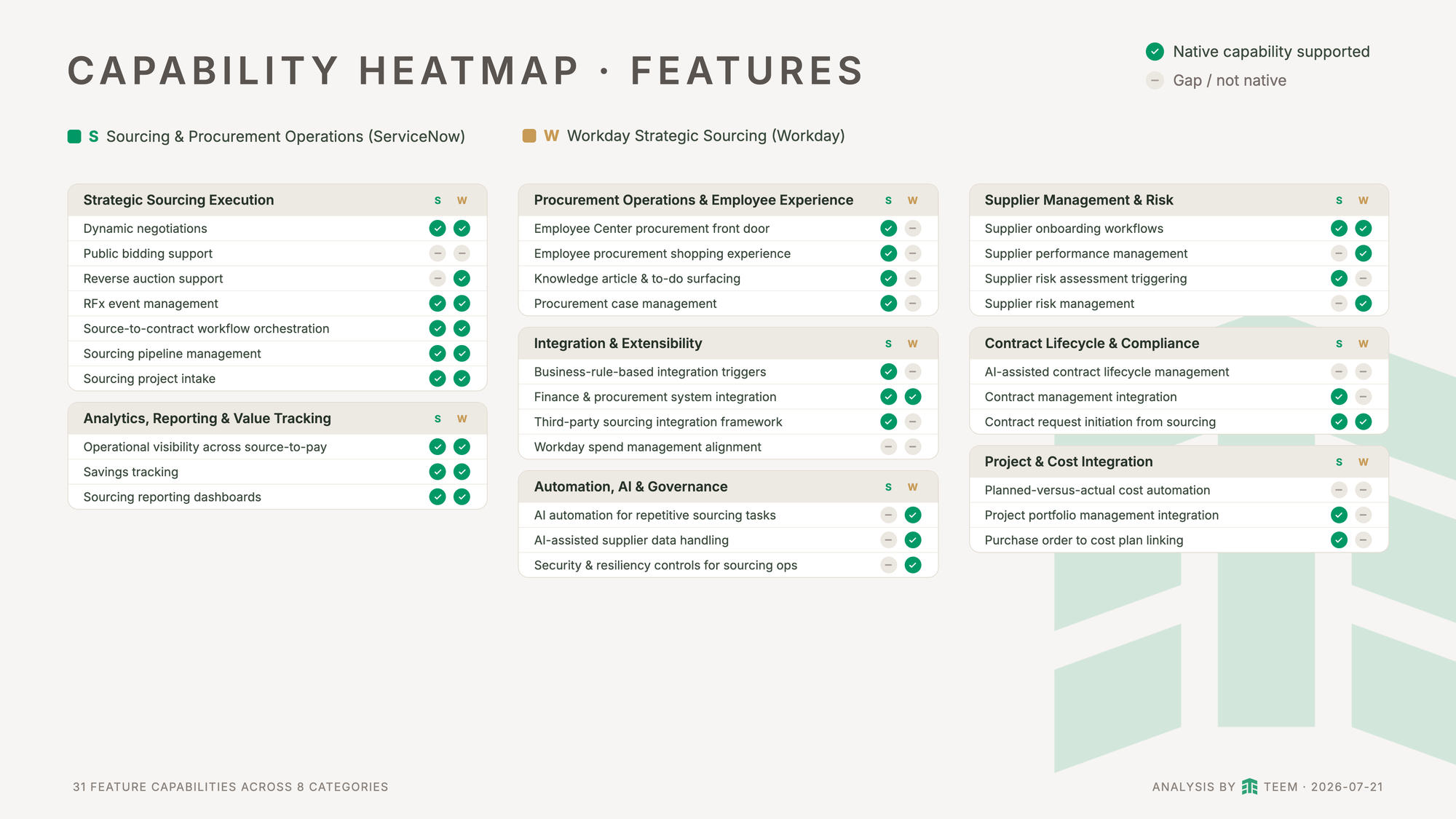
At the feature level, the advantage flips. ServiceNow leads at 25 of 31 (81%) against Workday at 23.5 of 31 (76%), on the strength of its procurement operations, employee experience, and integration coverage. Both heatmaps point back to the same conclusion. Neither product is simply the better one. Workday is the stronger strategic sourcing and source-to-contract platform, ServiceNow is the stronger operational source-to-pay platform, and the right choice comes down to which half of the lifecycle your team needs to own.
Making the Call
So the decision comes down to your own priority list. Take the capabilities you cannot do without, mark them against the heatmap, and the shortlist usually resolves quickly. Sourcing-led teams that live in RFx, negotiations, and contracts get more native depth from Workday. Operations-led teams that live in requisitions, purchase orders, and employee buying get more from ServiceNow.
What deserves as much weight as the feature fit is the platform commitment behind it. Each product reaches its full profile only with its surrounding modules in place, so the deeper question is which ecosystem you are prepared to standardize on and extend over the next few years. That answer usually matters more to the outcome than any single tick or gap in the comparison above.
This comparison is the kind of analysis Teem runs across the procurement software landscape: what each platform does natively, where the gaps sit, and what it takes to close them. If you are working through a similar decision, you can explore more capability comparisons at teem.finance.