
ZipHQ Intake-to-Pay vs Ramp Procurement: Product Comparison Report
Zip and Ramp Procurement both show up on the same shortlists, but they are built around different ends of the procurement lifecycle. Zip leads with orchestration: a clean front door for intake that coordinates work across the finance systems a company already runs. Ramp Procurement leads with depth: the downstream controls, matching, and spend intelligence that finance and AP teams lean on after a request is approved.
Zip positions itself as a tech-stack orchestration layer that sits between employees and existing ERP systems. Its center of gravity lies in the intake-to-pay backbone, paired with an unusually strong vendor-facing experience. It covers centralized intake, guided request submission, dynamic workflow-driven approvals, no-code workflow configuration, automated handoffs from intake through AP, vendor onboarding, document collection, security and compliance assessments, invoice processing, payment issuance, sourcing workflow integration, and ERP integration. The vendor app is a real differentiator here, since it supports reusable supplier profiles across customers, task-based onboarding, and document uploads. Zip is designed to work alongside a finance stack rather than replace it.
Ramp Procurement's center of gravity is operational depth. It combines broad end-to-end intake-to-pay coverage with strong confirmation for procurement-specific controls and optimization. It stands out for its customizable workflow orchestration through its Blank Canvas Builder, policy-driven and parallel approvals, integration with tools like Jira, synchronized execution of external approvals, reporting on approval efficiency and bottlenecks, and PO lifecycle management that includes change orders, partial receipts, and status progression. It also demonstrates differentiated strength in spend intelligence and renewal management, including savings and optimization recommendations, pricing benchmark surfacing, support for renewal recommendations, and contract renewal tracking. On the financial controls side, it is stronger on 2-way and 3-way matching, discrepancy flagging, automatic card transaction matching, and PO-to-budget tracking.
This comparison follows an independent capability assessment. The scores come first, then the section-by-section analysis, then the full capability heatmap.
Key differentiators
Ramp Procurement shows materially broader confirmed feature coverage across procurement orchestration, sourcing support, vendor management, approval analytics, and downstream financial controls. Both products cover the core intake-to-pay backbone: centralized purchase request intake, multi-step approvals, PO generation from approved requests, invoice processing automation, payment issuance through the platform, vendor onboarding, ERP and finance stack integration, and AI-assisted purchasing workflows.
The separation is that Ramp has stronger official confirmation for advanced operational controls and intelligence. It is clearly ahead on blank-canvas workflow design, parallel approvals, integration with collaboration and ticketing tools, external approval execution, approval bottleneck visibility, process performance reporting, payment visibility against commitments, PO-to-budget tracking, renewal reminders and alerts, renewal recommendation support, pricing benchmark surfacing, legal system integration, 2-way and 3-way matching, discrepancy flagging, partial receipt tracking, PO change requests, multi-currency purchase orders, punchouts and guided buying, automatic card transaction matching, and vendor discovery support.
Zip's most distinct advantage is its positioning as an orchestration layer between employees and existing ERP systems, plus vendor app support that explicitly includes reusable supplier profiles and document-driven onboarding tasks. Zip is competitive on core intake, approvals, vendor onboarding, invoice and payment workflows, and cross-system orchestration. The caveat is important: many of its more advanced sourcing, analytics, contract, and AP control capabilities are not clearly established in the available evidence. That is a different claim from saying they are absent.
Product strengths
Ramp Procurement's strongest profile is depth. It pairs broad intake-to-pay coverage with strong confirmation for procurement-specific controls and optimization. It is differentiated by customizable orchestration through the Blank Canvas Builder, policy-driven and parallel approvals, Jira and similar integrations, synchronized execution of external approvals, reporting on approval efficiency and bottlenecks, and robust PO lifecycle management across change orders, partial receipts, and status progression. In spend intelligence and renewal management, it provides savings and optimization recommendations, pricing benchmarking, support for renewal recommendations, and contract renewal tracking. On financial controls, it is notably stronger on 2-way and 3-way matching, discrepancy flagging, automatic card transaction matching, PO-to-budget tracking, and visibility from commitments through payments. Its AI story is also more concrete in procurement-specific tasks such as AI-assisted contract and diligence review, AI agents for compliance and review, and guided intake that helps users submit the right request.
Zip's strongest profile is breadth across the modern orchestration baseline, with a good employee and vendor experience. It clearly supports centralized intake, guided request submission, dynamic workflow-driven approvals, no-code workflow configuration, automated handoffs from intake through AP, vendor onboarding, document collection, security and compliance assessments, invoice processing, payment issuance, sourcing workflow integration, and ERP integration. The vendor-facing experience is particularly strong because the vendor app supports reusable supplier profiles across customers, task-based onboarding, and document uploads. Zip is well-positioned as an orchestration layer that works alongside existing finance systems rather than forcing a replacement.
Feature coverage gaps
The biggest concern for Zip is not the proven absence of capability. It is the number of strategically important areas that remain unconfirmed based on the available official sources. These include vendor discovery support, savings and optimization recommendations, blank-canvas workflow design, parallel approvals, integration with collaboration and ticketing tools, external approval execution, approval bottleneck visibility, process performance reporting, payment visibility against commitments, PO-to-budget tracking, forecasting visibility at the level described, contract renewal tracking, renewal reminders and alerts, renewal recommendation support, pricing benchmark surfacing, legal system integration, 2-way and 3-way matching, discrepancy flagging, automatic card transaction matching, partial receipt tracking, PO change requests, and multi-currency purchase order management. Zip also has weaker confirmation for deeper sourcing mechanics, such as RFx generation and documented RFx response scoring. These gaps matter most for buyers who need auditability, operational diagnostics, mature PO administration, or tight financial controls.
Ramp Procurement has fewer gaps, but a few areas show weaker or mixed confirmation. Card issuance from PO is not clearly confirmed despite broader payment strength. Forecasting visibility is only partially supported rather than proven as a single unified view. Dynamic intake forms with prefill are not clearly established in official documentation. Autonomous procurement orchestration is directionally supported but not fully confirmed as end-to-end with minimal manual intervention. Bulk import of purchase orders is specifically not supported based on the available evidence. Ramp also has weaker confirmation than its overall profile might suggest for RFx generation and RFx response scoring, even though its sourcing workflow positioning is strong.
Business-critical takeaways
No capabilities in the matrix are marked as stakeholder-critical business needs, so there is no separate priority tier driven by those tags. The most decision-relevant takeaway comes from the features with the clearest operational impact across the buying lifecycle.
For organizations that need strong control over procurement execution after request approval, Ramp Procurement is materially stronger. Its confirmed support for approval bottleneck visibility, process performance reporting, PO-to-budget tracking, payment visibility against commitments, 2-way and 3-way matching, discrepancy flagging, partial receipt tracking, PO change requests, and synchronized external approvals points to a more mature operating model for teams that need measurable process control and downstream accuracy.
For organizations that prioritize a clean front-door experience, vendor onboarding, cross-system orchestration, and broad intake-to-pay enablement without requiring every advanced control to be deeply proven, Zip remains a credible option. It covers the essential workflow chain from request through approvals, purchase orders, invoices, and payments, and pairs that with a strong supplier-facing app and good integration posture. The practical choice comes down to whether the buyer values advanced procurement depth and financial control more than a modern orchestration layer with strong vendor experience and solid core intake-to-pay coverage.
Recommendations
Choose Ramp Procurement if the priority is operational depth, stronger procurement controls, and richer procurement intelligence. It is the better fit for organizations that need flexible approval architecture, external approval execution in systems like Jira, stronger PO lifecycle management, detailed approval and bottleneck reporting, contract renewal intelligence, legal workflow integration, budget and commitment visibility, matching controls, and more concrete AI support for compliance and diligence tasks. Ramp suits finance-forward or control-heavy environments where procurement needs to tightly connect with budgets, AP controls, and renewal optimization.
Choose Zip if the priority is a strong intake-to-pay foundation, an orchestration-first approach, and an especially solid vendor-facing experience. It is a sensible fit for organizations that primarily need centralized intake, dynamic approvals, automated workflow handoffs, vendor onboarding, invoice and payment processing, and broad interoperability with existing ERP and finance systems, while placing less emphasis on deeply evidenced AP-matching controls, renewal intelligence, or advanced PO lifecycle administration.
If the shortlist stays between these two, the follow-up diligence differs by product. For Zip, focus on validating advanced controls and analytics in live demonstrations: parallel approvals, collaboration-tool approval execution, bottleneck reporting, PO-to-budget tracking, payment-to-commitment visibility, discrepancy handling, 3-way matching, contract renewal management, and PO lifecycle administration. For Ramp, the diligence areas are narrower and center on confirming any must-have sourcing details, such as RFx generation depth, dynamic intake prefill behavior, and any card-from-PO workflow requirements.
Strategic recommendations
- Choose Ramp Procurement if you need deeper procurement control beyond intake and approvals, especially for purchase order lifecycle management, 3-way matching, discrepancy flagging, and tracking payments against approved purchase orders.
- This matters for finance-heavy organizations because stronger downstream controls reduce overbilling risk, improve auditability, and give better visibility from request through payment.
- Choose Zip if your priority is a clean intake-to-pay orchestration layer that works alongside existing ERP and finance systems without requiring a major process overhaul.
- This matters to teams that want fast adoption and cross-system coordination, since Zip is well-supported for centralized intake, automated approvals, vendor onboarding, invoice processing, and ERP-friendly workflow orchestration.
- Favor Ramp Procurement for organizations with complex approval and cross-functional review needs, especially if approvals must run in parallel or be executed in tools like Jira while staying synced to procurement records.
- This matters because complex reviews often become the biggest source of delay, and Ramp shows stronger evidence for parallel approvals, external approval execution, ticketing integrations, and approval bottleneck visibility.
- Pick Ramp Procurement if vendor management and renewal optimization are critical, including renewal reminders, recommendations to renegotiate or cancel, and pricing benchmark surfacing during contract review.
- This matters for cost-conscious teams because these capabilities turn renewals into active savings opportunities rather than passive calendar events.
- Choose Zip when supplier experience is a major factor, and you want a stronger vendor-facing app for onboarding tasks, document uploads, and reusable vendor profiles across customers.
- This matters because a smoother supplier workflow can speed onboarding and reduce back-and-forth, especially for organizations managing large numbers of external vendors.
- Lean toward Ramp Procurement if AI-assisted procurement is a deciding factor, given more clearly evidenced AI support in contract review, security assessments, compliance checks, and guided purchasing workflows.
- This matters because AI that handles diligence and review work can reduce manual effort for procurement, legal, and security teams, not just help with request intake.
- Be cautious with Zip if your decision depends on hard proof of capabilities, such as approval bottleneck reporting, 3-way matching, card transaction matching to purchase orders, or contract renewal tracking.
- This matters because those gaps may be deal-breakers for mature procurement and AP teams, and the available evidence here is not strong enough to confirm them as native strengths.
Capability Heatmap
The heatmap splits the comparison into two dimensions. Use cases describe the tasks a procurement team needs to complete, from intake through AP coordination. Features describe the underlying capabilities that enable those jobs. Each row carries one of three marks: Native (green tick) for capability that is confirmed and built in, Partial (amber dash) for capability that is limited or add-on-dependent, and Gap (gray dash) for capability that is not confirmed as native. Use cases come first, covering 35 capabilities across 8 categories.
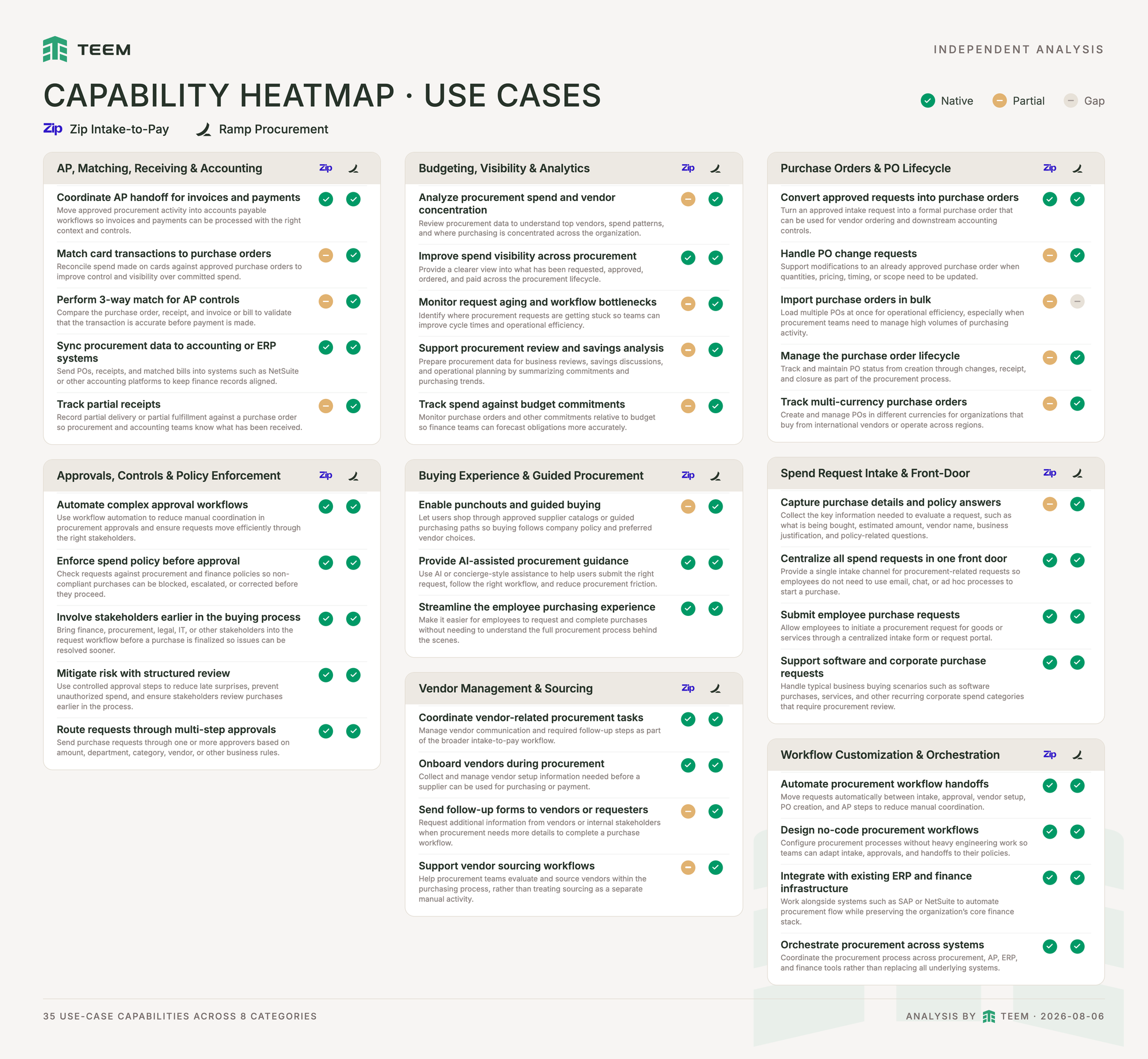
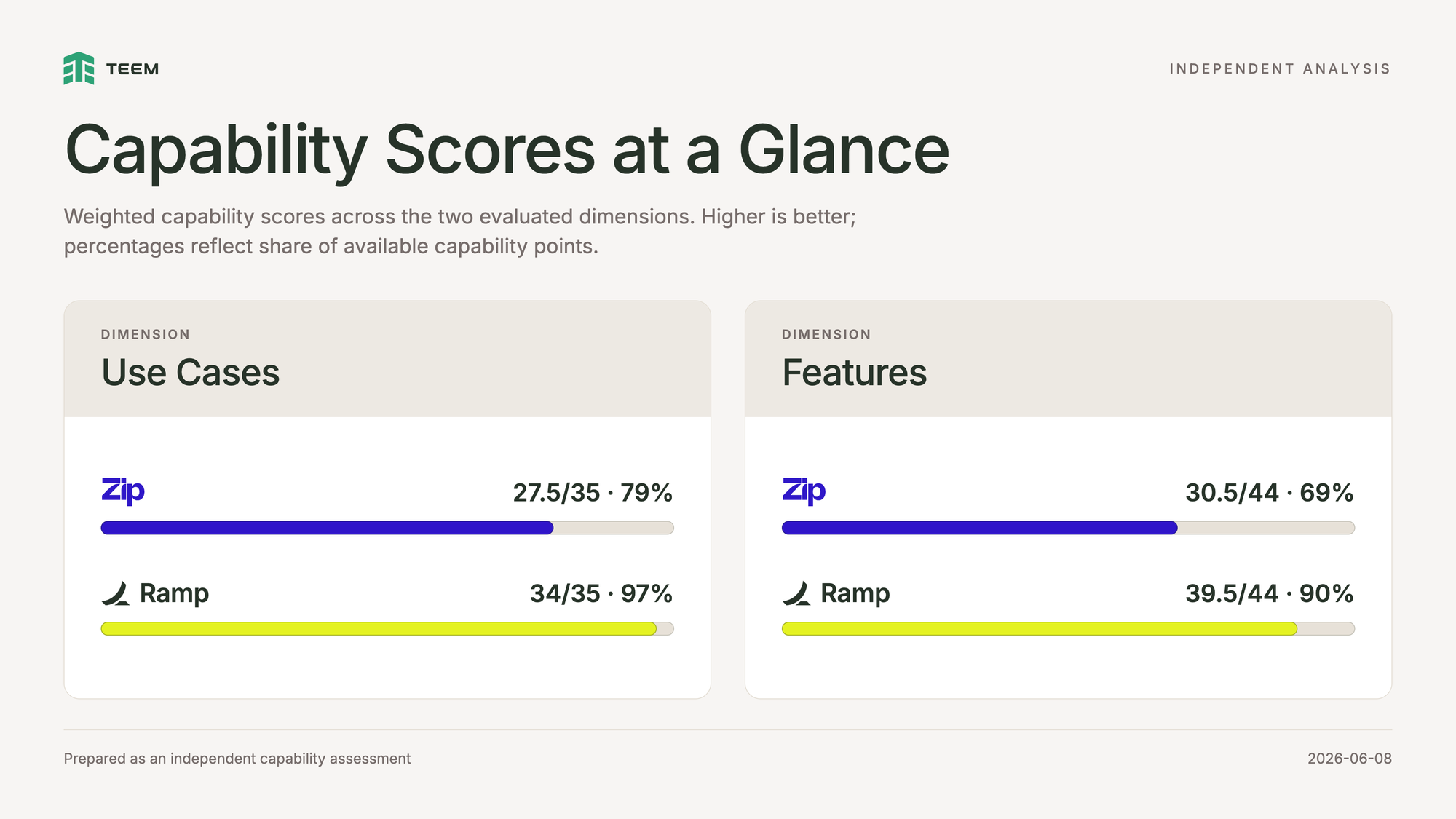
On use cases, Ramp is Native on 34 of 35 rows and scores 34/35 (97%). Zip scores 27.5/35 (79%). The two track closely on intake, approvals, vendor onboarding, and cross-system orchestration. They separate on AP matching, PO lifecycle administration, and budgeting analytics, where Ramp is Native and Zip sits at Partial. The features view makes the same split more visible.
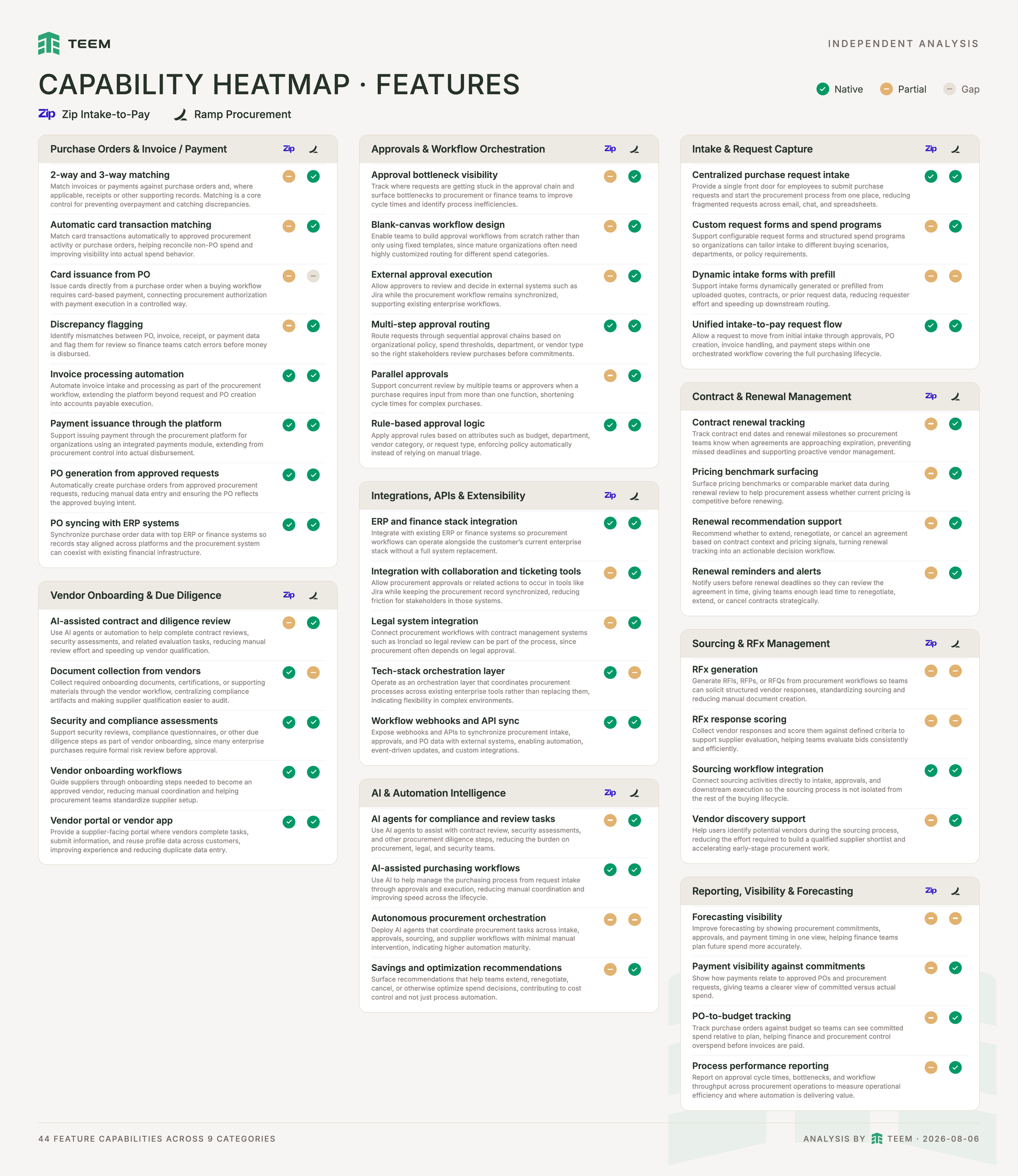
On features, Zip scores 30.5/44 (69%) and Ramp scores 39.5/44 (90%). This is the widest gap in the analysis, driven by renewal management, approval analytics, and matching controls that read Native for Ramp and Partial for Zip. These points point to a difference in scope. Zip is built as the orchestration front door that coordinates existing systems, and Ramp is built for the downstream controls and intelligence that follow approval. A team weighing the two is really deciding which end of the procurement lifecycle it needs to strengthen most.
Making the Call
Most of this decision is settled before anyone opens a feature matrix. It comes down to which end of the procurement lifecycle is already hurting.
If the pain is downstream, where invoices need matching, POs need lifecycle management, budgets need commitment tracking, and renewals keep slipping past their deadlines, Ramp is built for that work, and the evidence backs it up. If the pain is upstream, where requests scatter across email and Slack, vendors stall in onboarding, and procurement needs to sit on top of an ERP rather than replace it, Zip's orchestration-first design and its vendor app are the stronger fit. A team that already runs a mature AP stack and mainly wants a cleaner front door will read this comparison very differently from a finance team that wants controls and intelligence in one place.
Two shortcuts tend to settle it faster than a line-by-line scorecard. The first is existing ecosystem lock-in: if the finance and ERP systems are fixed and the real gap is coordination across them, that points one way. The second is the appetite for a single front door versus best-of-breed depth, and how much of the advanced control surface a buyer needs proven today rather than confirmed in a demo.
It is also worth saying that these are not mutually exclusive. Some teams run an orchestration layer for intake and a separate system for AP and spend controls, and that split can be deliberate rather than a failure to consolidate. If that is on the table, the question stops being which product wins and becomes which capabilities you most need to own natively, and whether one platform covering the whole lifecycle is worth more to you than depth at a single end.
This comparison is the kind of analysis Teem runs across the procurement software landscape: what each platform does natively, where the gaps sit, and what it takes to close them.
If you are working through a similar decision, you can explore more capability comparisons at teem.finance.