The Rise of Agentic Procurement
How AI Agents Will Reshape Procurement Organizations Over the Next Decade
Preface
It has become increasingly clear that the future of knowledge work is agentic.
We are already seeing compelling evidence of this in software engineering. AI coding tools that once struggled to generate small pieces of code can now build entire applications and fix issues on their own. But the most profound change is not the capability of these tools — it is the shift in the role of the engineer. Engineers are moving from writing every line of code themselves to directing systems that generate the code on their behalf.
It is difficult to look at this development and not wonder what it means for other knowledge professions, including procurement.
Much of procurement work consists of gathering information, analyzing options, coordinating stakeholders, evaluating suppliers, and ultimately making recommendations about how enterprise spending should be allocated. These are decision-heavy activities that require reasoning over large volumes of text, contracts, pricing models, and market information. They are precisely the types of tasks that modern AI systems are becoming increasingly capable of performing.
If that technological trajectory continues, it is reasonable to imagine a future in which a significant portion of procurement work is carried out not by us humans, but by networks of software agents operating across enterprise systems.
What would that world actually look like? How long would it take to arrive? And perhaps most importantly, what would it mean for the millions of procurement professionals working today?
This essay attempts to explore these important questions. It is not a prediction in the strict sense. No one can confidently forecast the pace at which AI will evolve or the speed at which organizations will adopt new technologies. Instead, what follows should be understood as a structured thought exercise — an attempt to extrapolate from observable trends and construct one plausible future scenario.
For this prediction, ten years seems like a convenient horizon for imagining large organizational change. Enterprise systems evolve slowly, and procurement functions in particular tend to adopt new technologies cautiously.
At the same time, the pace of AI development has proven extremely difficult to predict. The transformation described here could take a decade, or it could arrive much sooner.
The Quiet Automation of Decisions
For the better part of the last thirty years, enterprise software has focused primarily on automating transactions.
Enterprise Resource Planning systems digitized accounting records and financial ledgers. Source-to-Pay platforms streamlined procurement workflows by standardizing purchase requests, supplier onboarding, contract management, and invoice processing. These systems significantly improved operational efficiency, but they shared a common underlying assumption.
The decisions themselves would still be made by people.
Humans would determine which suppliers to engage, how to structure negotiations, what pricing models to accept, and how enterprise spending should ultimately be allocated.
The software simply recorded the result. Over the next decade, that assumption may begin to erode.
Advances in large language models and autonomous AI agents are enabling software to perform tasks that historically required human judgment. These tasks include analyzing complex documents, synthesizing market intelligence, comparing competing vendors, and modeling negotiation strategies across multiple variables.
In other words, AI is beginning to automate decisions.
To understand the implications of this shift, it is useful to consider how procurement technology is currently structured.
Today, the architecture of most procurement environments can be described in a simple sequence.
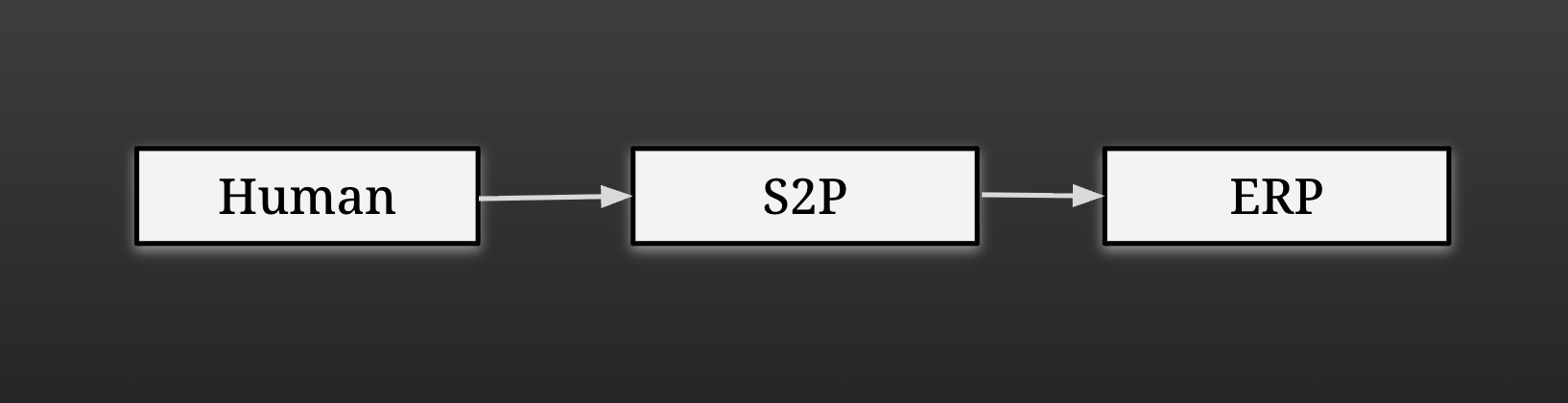
In this model, humans occupy the first position in the chain. Procurement professionals gather information, evaluate suppliers, negotiate terms, and ultimately decide which transactions should occur. The Source-to-Pay system then facilitates the workflow that operationalizes that decision — issuing purchase orders, routing approvals, and capturing contractual terms. Finally, the ERP records the financial transaction itself.
The software coordinates the process. But the thinking happens elsewhere.
Procurement professionals research suppliers in search engines, compare proposals in spreadsheets, review contracts in document editors, and negotiate terms through email or video calls. The procurement platform captures the result of these activities, but it does not generate the analysis that led to them.
For decades this division of labor has seemed natural. The future is less certain.
Today’s Procurement Orgs are Human Coordination Machines
In large enterprises, procurement organizations often resemble elaborate coordination networks. A company with ten or twenty billion dollars in annual revenue might employ eighty or more people across the procurement function. While titles and reporting structures vary, these teams typically fall into three broad operational groups.
The first is the buy desk, responsible for the transactional side of procurement. These teams manage purchase requests, route approval workflows, generate purchase orders, and ensure that supplier onboarding processes are completed correctly. Their work is essential to keeping day-to-day purchasing activities running smoothly.
The second group consists of strategic sourcing and category management professionals. These individuals spend much of their time researching supplier markets, identifying potential vendors, organizing sourcing events, negotiating contracts, and managing long-term supplier relationships. Their responsibilities require deeper analysis and strategic judgment than transactional purchasing tasks.
The third group is procurement operations (sometimes called the Center of Excellence). These teams maintain the systems and infrastructure that allow procurement to function effectively. They oversee procurement platforms, maintain supplier data, design business processes, and ensure compliance with organizational policies.
A simplified organizational structure might look something like this.
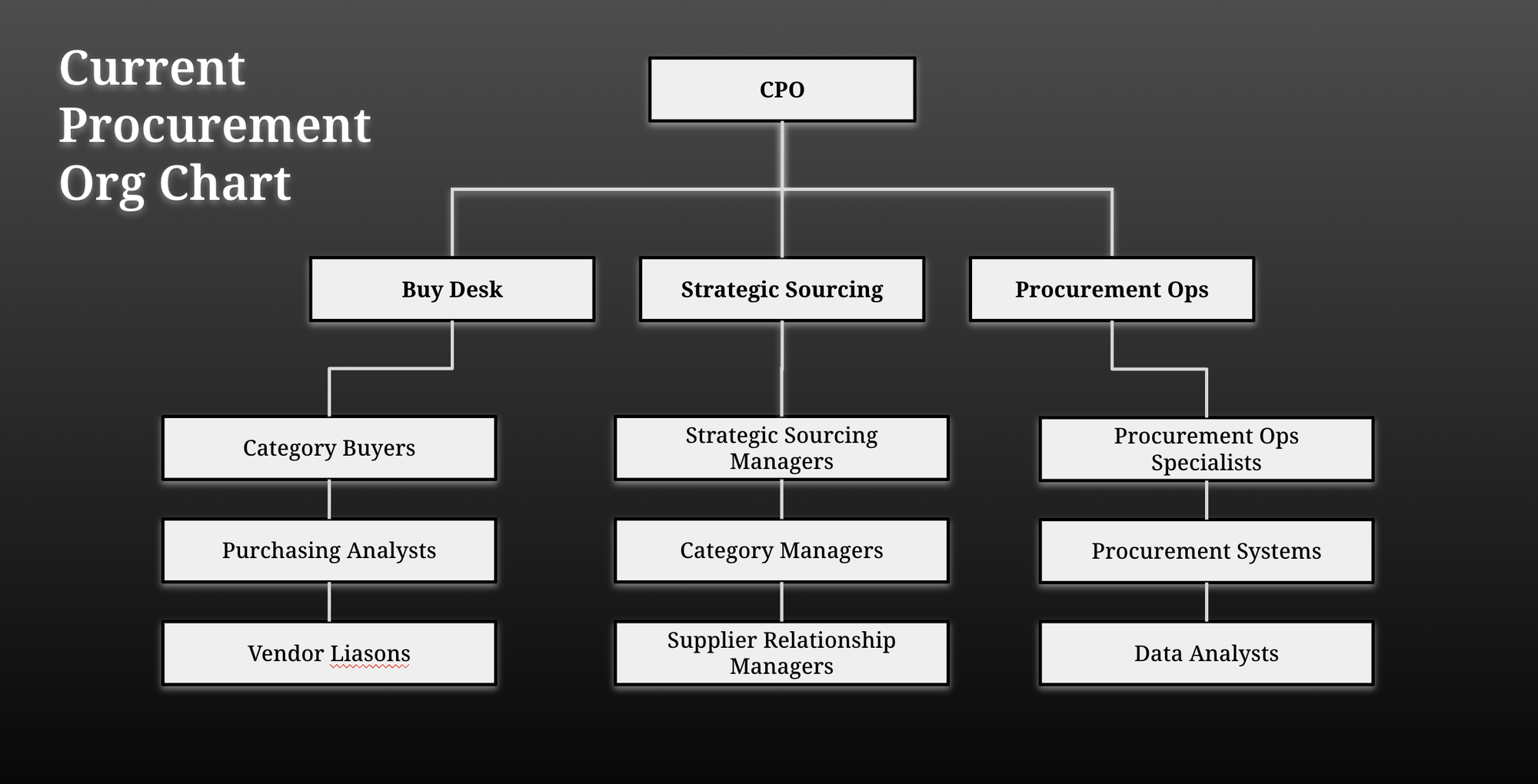
Across the function, these teams perform a wide range of responsibilities that require coordination across the business, deep market awareness, and careful evaluation of supplier capabilities. These activities require judgment, domain expertise, and an understanding of both market dynamics and internal priorities. At its core, procurement serves as a bridge between the external supplier ecosystem and the internal needs of the enterprise, translating large volumes of information into decisions that shape how organizations invest their resources.
In other words, procurement is fundamentally an information processing function. It aggregates data from many sources, synthesizes that information into decisions, and directs organizational spending accordingly.
That makes the procurement function a natural candidate for AI-assisted automation.
The AI Capability Curve
To understand how procurement might evolve over the next decade, it helps to examine the broader trajectory of AI capabilities.
Enterprise AI adoption appears to be progressing through several distinct stages.
The earliest phase, which has already arrived, involves content generation. AI tools began assisting humans by drafting documents, summarizing research, composing emails, and generating reports. These capabilities improved productivity but did not fundamentally change the structure of work.
The second phase, which many organizations are experiencing today, involves research agents. Modern AI systems can independently gather information, analyze documents, synthesize insights, and present structured conclusions. In procurement contexts, these capabilities are already being applied to supplier discovery, contract analysis, and market intelligence.
The third phase will likely involve workflow agents — systems capable of executing multi-step tasks across enterprise software environments. Rather than simply producing an analysis, these agents will begin completing actions: initiating sourcing events, comparing proposals, generating negotiation strategies, and interacting with procurement systems. (Early examples of this capability are beginning to appear, though adoption remains limited.)
The fourth phase represents a more complete transformation.
In this stage, organizations operate multi-agent systems composed of many specialized AI agents that collaborate to complete complex workflows. One agent might specialize in supplier discovery, another in pricing analysis, another in contract interpretation, and yet another in risk monitoring.
Taken together, these agents function as a digital workforce.
As these systems mature and become widely adopted, procurement will likely be among the enterprise functions most profoundly reshaped by them.
From Human Workflows to Agentic Workflows
Consider what happens today when a stakeholder requests a new supplier.
A procurement professional typically begins by gathering requirements from the requesting team. They then research potential vendors, assemble a list of candidate suppliers, evaluate their capabilities, and prepare an RFx to solicit proposals. Once responses are received, the procurement team compares pricing structures, analyzes contractual terms, prepares negotiation strategies, and ultimately recommends a vendor.
Each step in this process involves gathering information, synthesizing insights, and making decisions.
In an agentic procurement environment, much of this work would be delegated to software.
Supplier discovery agents will continuously scan global vendor ecosystems and identify relevant suppliers. Comparison agents will evaluate product capabilities across dozens of vendors simultaneously. Pricing intelligence agents will benchmark pricing and model negotiation scenarios using historical contract data. And contract agents will review legal language and identify risk exposure before a human ever reads the document.
Taken together, these systems dramatically expand the analytical capacity of procurement teams. Work that today requires weeks of research will be performed continuously and at a scale that would be difficult for even the largest procurement organizations to replicate.
The Procurement Control Layer Is Shifting
If AI agents begin performing the majority of procurement analysis, the architecture of procurement technology will shift accordingly.
The traditional model can be summarized as:
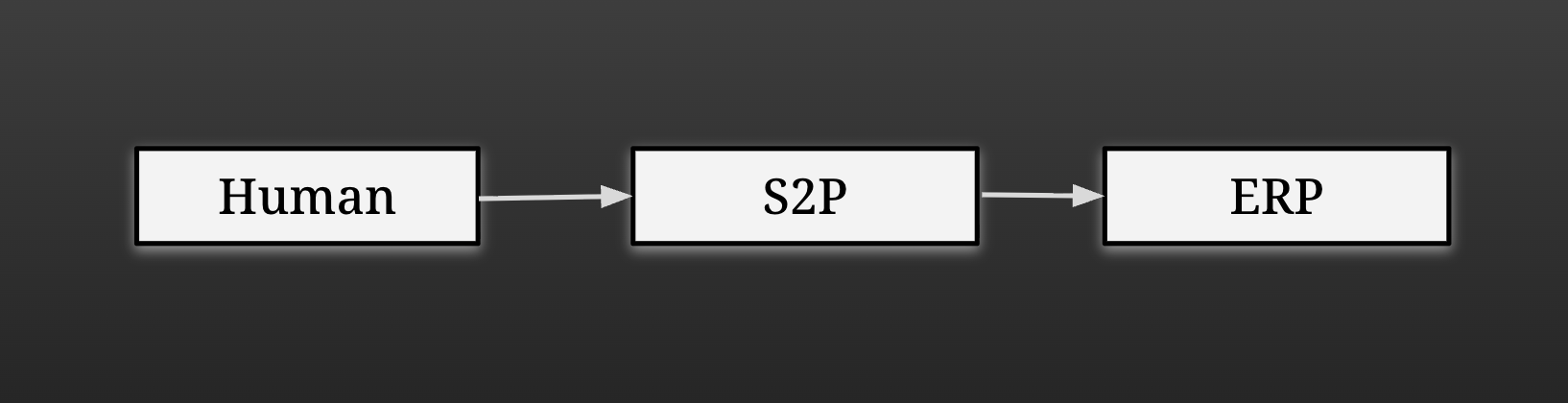
- Humans analyze and decide.
- S2P systems manage workflow.
- ERP systems record the transaction.
In an agent-driven environment, the sequence may look more like this:
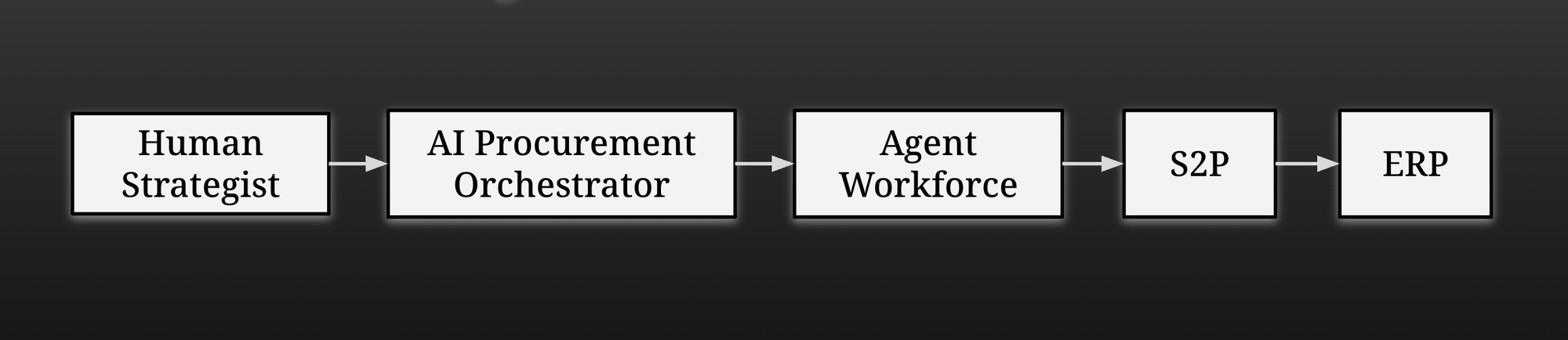
In this structure, the AI procurement orchestrator becomes the control layer of the system. It coordinates a network of specialized agents that perform research, analysis, and decision support. Once a decision has been reached, the agents interact with S2P systems to execute the workflow and with ERP systems to record the financial transaction.
The system-of-record platforms remain essential infrastructure but they are no longer the place where decisions originate.
The decision engine has moved upward.
The Next Generation of (Human) Procurement Roles
As AI systems take on more of the analytical and workflow-driven aspects of procurement, the roles performed by humans will naturally evolve. The focus of the function will shift toward strategy, system oversight, and relationship management.
Three roles in particular are likely to become central.
The first is the Procurement Portfolio Manager.
This role bears a strong resemblance to the work performed by hedge fund portfolio managers. In financial markets, portfolio managers allocate capital across investments, constantly evaluating risk, performance, and market conditions. Their job is not to execute every trade themselves but to design the strategy that determines where capital should flow.
In an agent-driven procurement environment, procurement portfolio managers would perform a similar function for enterprise spending.
Rather than allocating capital across stocks or bonds, they allocate enterprise spending across suppliers and vendor ecosystems. Their responsibilities would include designing sourcing strategies, configuring the AI agents responsible for executing those strategies, monitoring supplier performance, and continuously optimizing the organization’s supplier portfolio.
Importantly, these portfolio managers would not simply deploy agents and walk away. Just as new employees require onboarding, training, and supervision, AI agents will also require guidance. The humans who design these agents will effectively train them, teaching them how procurement decisions should be evaluated, what signals matter most when comparing suppliers, and how to interpret complex contract structures or pricing models.
In that sense, managing an agent workforce may resemble managing a human team. Portfolio Managers will refine prompts, adjust workflows, monitor outputs, and correct mistakes until the system begins producing reliable results. Over time, the agent workforce becomes more capable — not unlike a team of employees that improves as it gains experience.
The second role is the Procurement Systems Architect.
As procurement becomes increasingly agent-driven, organizations will require individuals who understand how to design and maintain the systems powering the agent workforce. These professionals will oversee agent orchestration, data pipelines, integrations with enterprise systems, and governance frameworks that ensure AI systems operate reliably and securely.
In many companies this role will sit at the intersection of procurement and technology. Procurement Systems Architects will work closely with Portfolio Managers to translate sourcing strategies into automated workflows. They will ensure that agents can access the data they need, interact with procurement platforms correctly, and operate within the compliance frameworks required by the organization.
The third role is the Procurement Partner.
Even in a highly automated procurement environment, relationships between people will remain important. Large enterprise deals often involve long-term partnerships, complex negotiations, and sensitive coordination between multiple stakeholders. These interactions require trust, context, and judgment — qualities that remain difficult to replicate with software alone.
Procurement Partners will therefore focus on the human dimensions of procurement. They will work closely with internal stakeholders to understand evolving business needs, maintain strategic relationships with suppliers, and guide negotiations when deals require human judgment or diplomacy.
In a sense, these three roles divide procurement into three complementary domains: strategy, systems, and relationships. Portfolio Managers design the spending strategy and guide the agent workforce. Systems Architects ensure the technology infrastructure functions properly. Procurement Partners maintain the human connections that ultimately make large-scale business partnerships possible.
Together, this group of professionals could oversee a procurement system that is far more automated — and potentially far more powerful — than the procurement organizations that exist today.
The Procurement Organization of the Future
As this model takes hold, procurement teams will begin to look dramatically different.
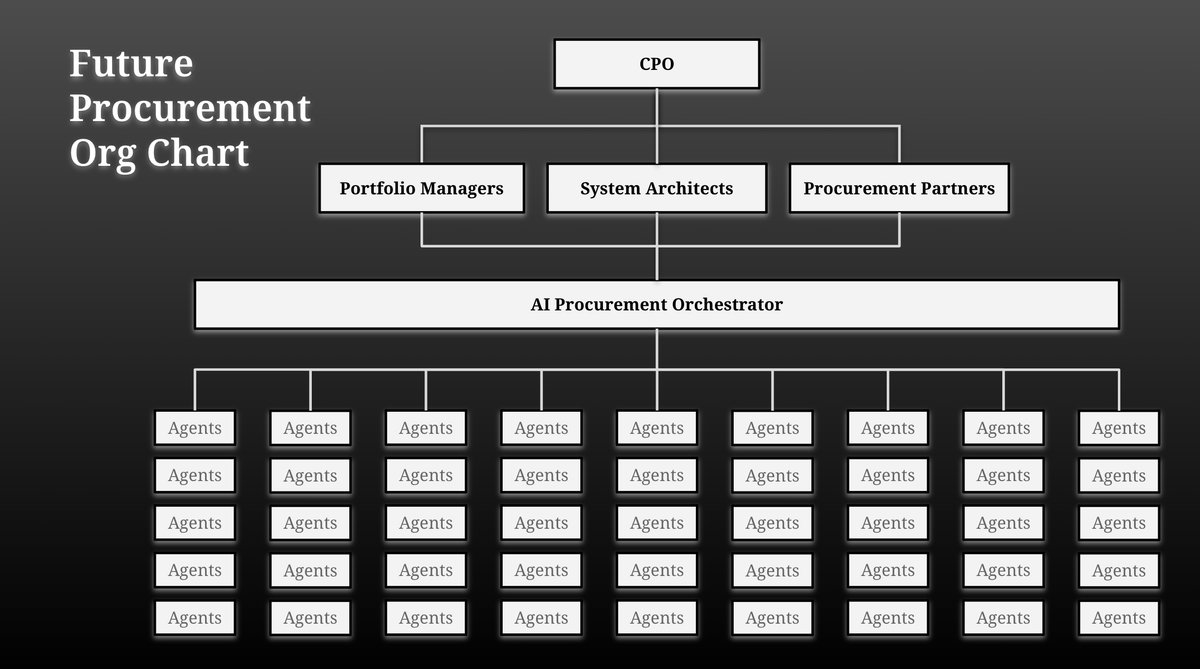
An organization that once employed eighty procurement professionals might instead operate with a much smaller human core supported by a large network of AI agents.
A simplified structure might resemble the following.
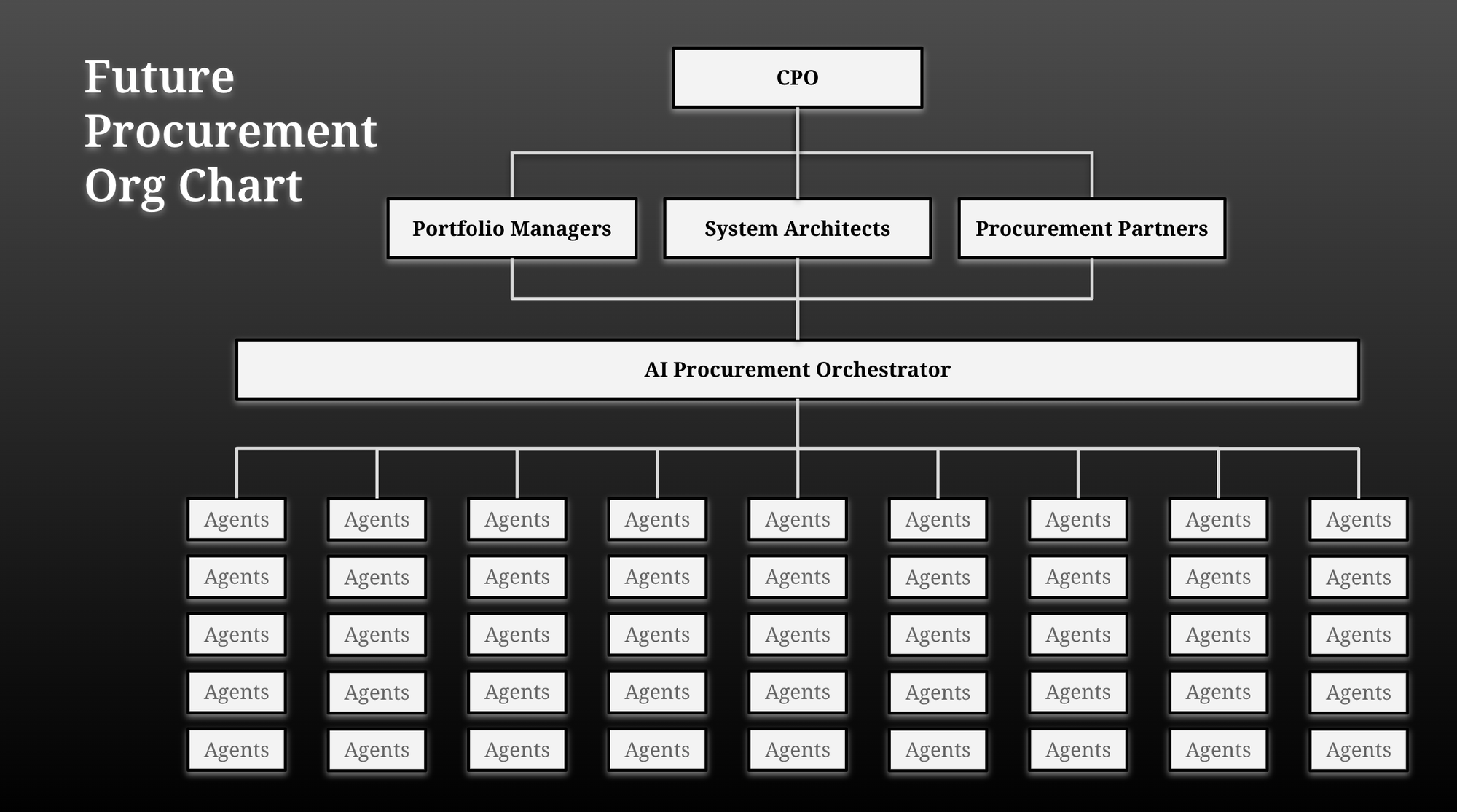
Supporting these individuals could be hundreds of AI agents responsible for supplier discovery, pricing analysis, contract interpretation, risk monitoring, market intelligence, and negotiation modeling.
The humans provide strategic direction and oversight.
The agents perform the analytical work.
Preparing for Procurement's AI Era
For procurement professionals reading this today, the future described in this essay may feel both exciting and unsettling.
Periods of technological change often raise questions about what work will look like in the years ahead. But history shows that when new tools emerge, professions rarely disappear. More often, the work evolves. The responsibilities shift, expectations expand, and the professionals who thrive are those who learn to use new capabilities to amplify their own impact.
Procurement is likely to follow a similar path.
As AI systems become more capable, the role of procurement professionals will evolve toward higher levels of strategic oversight. Rather than spending the majority of their time gathering information and managing process steps, procurement leaders will increasingly focus on guiding systems that generate insights, interpreting those insights within the broader context of the business, and shaping the strategies that determine how organizations engage with suppliers. The procurement leader of the future will combine market insight, technological fluency, and strong relationship leadership to guide increasingly sophisticated decision systems.
Those who begin developing these capabilities early will be well positioned to help shape the next generation of procurement organizations.
Several areas of expertise will become particularly valuable.
Develop Fluency with AI Systems
The most obvious shift will be the increasing importance of understanding how AI systems operate.
For example, future procurement professionals will need to know how to:
- Design agent workflows for sourcing events
- Refine prompts and instructions that guide agent behavior
- Monitor agent performance and identify errors
The professionals who become comfortable working with AI systems will have a significant advantage. Instead of viewing AI as a threat to their role, they will learn to treat it as a powerful tool that extends their capabilities.
Strengthen Strategic Market Insight
While AI agents may become extremely effective at gathering information, they will not automatically understand the broader strategic context in which procurement decisions are made.
That responsibility will continue to belong to us humans.
Procurement professionals who develop deep knowledge of supplier markets will remain valuable. Understanding how a technology category is evolving, which suppliers are gaining momentum, how pricing models are changing, and how competitive dynamics are shifting will continue to matter.
This is particularly true for portfolio management roles within procurement. Portfolio Managers will need to evaluate the outputs generated by AI agents and determine how enterprise spending should be allocated across suppliers. Doing this effectively will require a deep understanding of supplier ecosystems, cost structures, and long-term market trends.
Procurement professionals who invest time in building this strategic market knowledge will position themselves well for these emerging roles.
Become Exceptional at Fostering Strong Relationships
Large enterprise supplier relationships often extend far beyond transactional purchasing. They involve long-term partnerships, shared roadmaps, collaborative product development, and ongoing negotiation around pricing, service levels, and contractual obligations.
These interactions rely on trust, and trust is built between people.
Procurement professionals who excel at building strong relationships with both internal stakeholders and external suppliers will remain indispensable. The ability to understand business priorities, navigate internal politics, and maintain productive partnerships with suppliers will continue to be a defining characteristic of successful procurement leaders.
In the future procurement organization described earlier, Procurement Partners will play a critical role in maintaining these relationships. Their effectiveness will depend less on their ability to run procurement processes and more on their ability to understand people, manage expectations, and guide complex negotiations.
Learn to Think Like a Portfolio Manager
Perhaps the most important shift for procurement professionals will be conceptual.
Many procurement roles today are focused on managing processes — ensuring that sourcing events are executed correctly, purchase requests are approved efficiently, and supplier data is maintained accurately.
In the future, procurement leaders may need to think less like process managers and more like portfolio managers.
Instead of asking, “How do we run this sourcing event efficiently?” they may ask broader questions such as:
- How should we allocate spending across suppliers in this category?
- Which vendors represent long-term strategic partners?
- Where do consolidation opportunities exist?
- How should risk be distributed across our supplier ecosystem?
This mindset aligns closely with the responsibilities of the Procurement Portfolio Manager role described earlier.
Just as financial portfolio managers allocate capital across investments, Procurement Portfolio Managers will allocate enterprise spending across suppliers and vendor ecosystems. Their job will be to continuously optimize that portfolio based on performance, risk, and evolving business needs.
Procurement professionals who begin developing this type of strategic thinking will be well prepared for the next generation of leadership roles.
The Real Question
If the trajectory described in this essay continues, the structure of procurement organizations will look dramatically different. The question, then, is not whether AI will affect procurement. It almost certainly will. The real question is how we choose to adapt to that new environment — how procurement professionals evolve their roles, develop new capabilities, and learn to guide the systems that increasingly support their work.
Because while this essay imagines the state of procurement a decade from now, you are not reading this in 2036. You are reading it in 2026.
And that means the future of procurement is not something that simply happens to us. It is something we all have a hand in shaping together.