
SAP Ariba vs. ZipHQ: Product Comparison Report
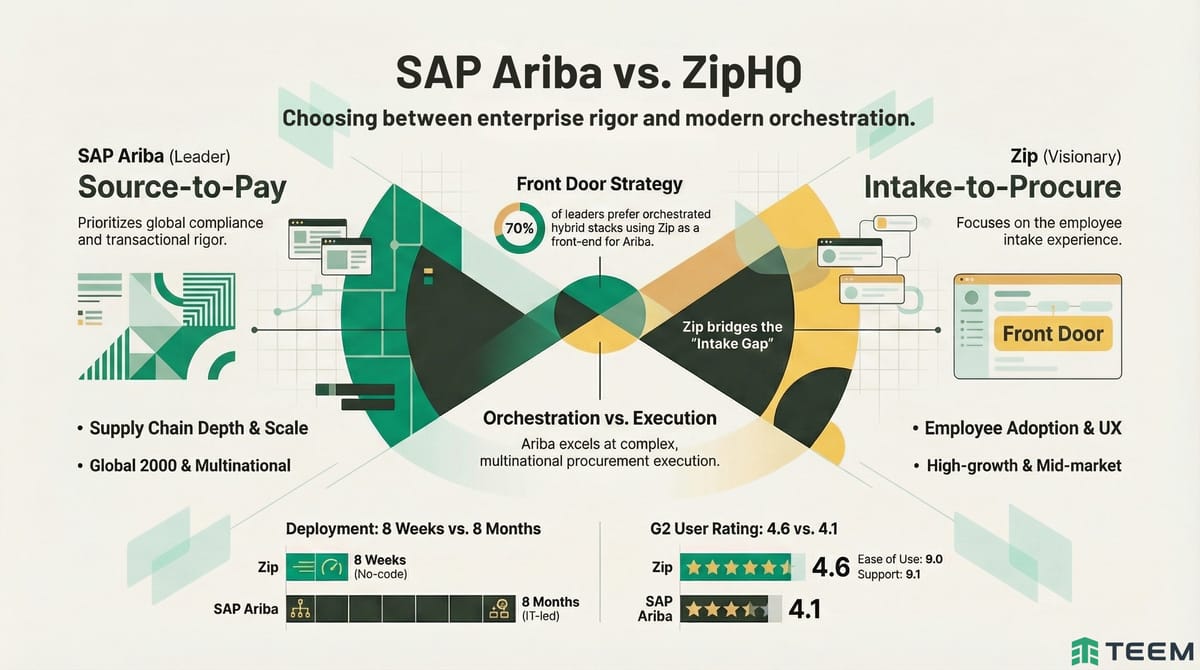
Zip and SAP Ariba solve different problems. One is a procurement orchestration layer built for adoption. The other is a source-to-pay suite built for execution. Teem's independent evaluation breaks down where each wins, where each falls short, and when running both makes more sense than choosing.
By Teem | March 2026 | Procurement | Source-to-Pay | Intake to Pay
About this analysis: This article is a condensed summary of a full Teem product comparison report, independently produced based on a structured evaluation of 18 use cases and 26 features, supplemented by external market research. No vendor has sponsored or reviewed this content.
Why This Comparison Matters
As organizations face increasing pressure to eliminate maverick spend and establish procurement controls that scale with headcount, the choice between a purpose-built orchestration tool and a traditional source-to-pay suite carries real operational and financial implications. Both Zip Intake-to-Pay and SAP Ariba address the challenge of managing indirect procurement — but from architecturally distinct starting points. The stakes of this decision are rising: Gartner's 2024 Hype Cycle assigned the procurement orchestration category a "transformational" benefit rating — the highest possible classification — while noting that current market penetration remains below 1% of the target audience. [Gartner Hype Cycle 2024, via Zip] That combination of high strategic relevance and low adoption means most organizations evaluating these platforms are doing so without established internal benchmarks to rely on. Understanding the architectural difference between these two platforms is therefore critical before committing to either.
At a Glance: Capability Scores
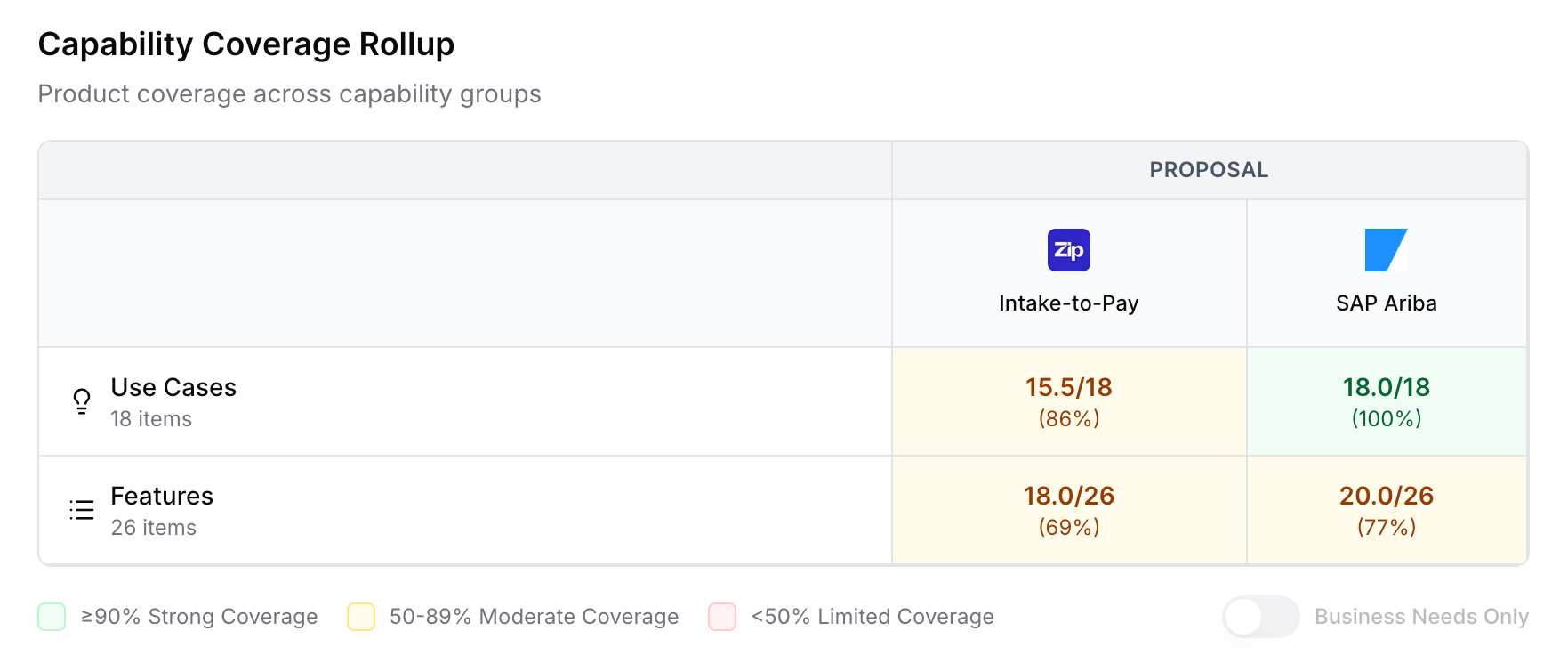
| Dimension | Zip Intake-to-Pay | SAP Ariba |
| Use Cases | 15.5/18 (86%) | 18.0/18 (100%) |
| Features | 18.0/26 (69%) | 20.0/26 (77%) |
Coverage Tiers: ✅ Strong — ≥90% ⚠️ Moderate — 50–89% ❌ Limited — <50%
Zip delivers moderate-to-strong use-case coverage, with a focus on intake orchestration and indirect procurement workflows. SAP Ariba achieves full use-case coverage — reflecting its depth as an enterprise-grade suite — though both products land in the moderate tier for features, signaling meaningful gaps in each. The Gartner MQ positioning reflects a broader market read: Ariba's established scale versus Zip's emergence as the first new globally deployable option entering this market in two decades.
Want to run this comparison for your own shortlist? See below how the Teem's comparison engine works:
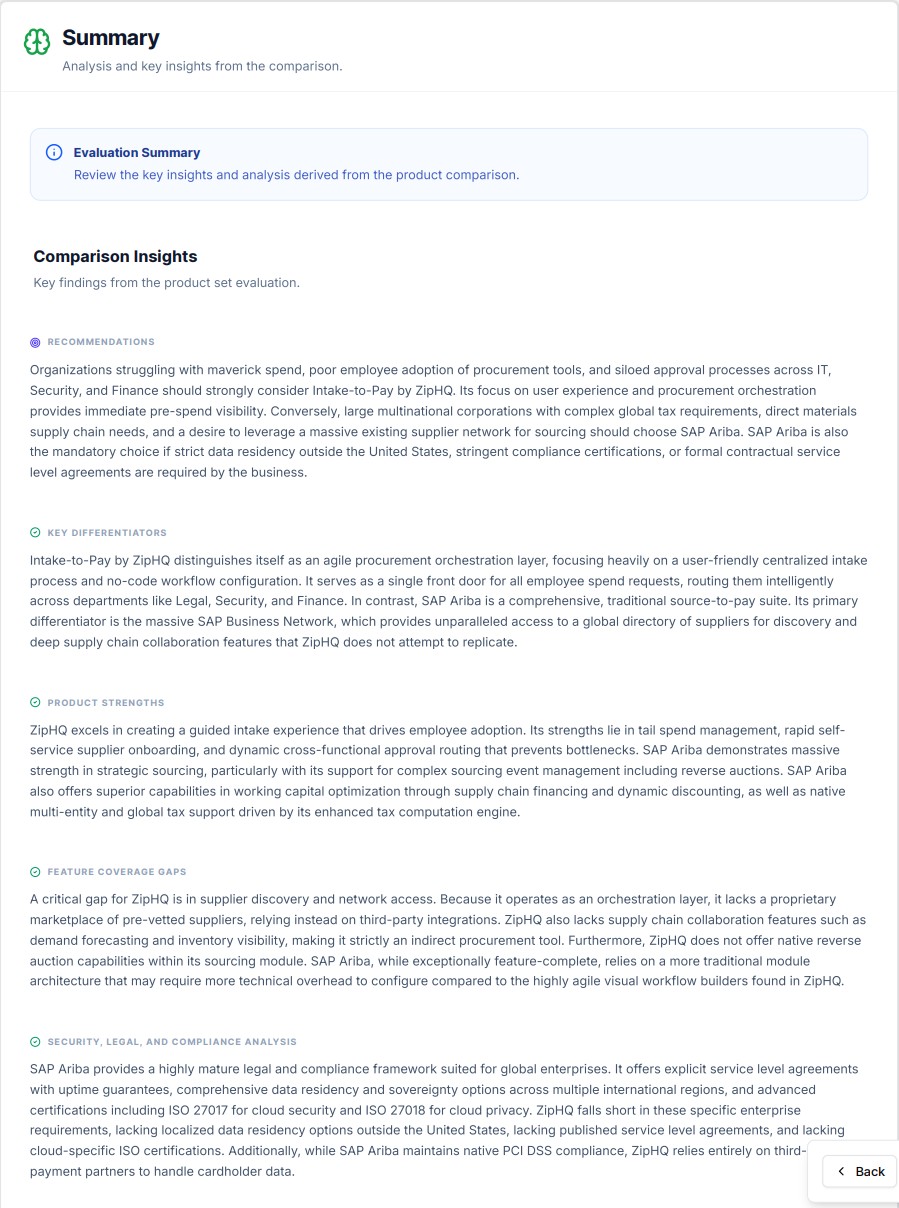
Product Comparison Quick Overview-The scores above are generated directly from Teem's structured evaluation engine. Here's what the full report looks like inside the platform.
The Core Structural Difference
Zip Intake-to-Pay is designed as a procurement orchestration layer — a single, configurable front door for all employee spend requests, routing them intelligently across Legal, IT, Security, and Finance without requiring changes to underlying ERP systems. SAP Ariba is a comprehensive source-to-pay suite built around a global supplier network and deep strategic sourcing capabilities, operating as a system of record rather than a system of orchestration. One is built to sit on top of your stack; the other is built to become your stack. That distinction shapes every capability gap and strength that follows.
Use Cases: Who Is Each Product Built For?
Zip Intake-to-Pay
Zip covers 15.5 of 18 evaluated use cases, performing strongly across centralized procurement intake, cross-functional approval orchestration, guided buying, and tail spend management. It is purpose-built for indirect procurement and works best when the primary problems are employee adoption and pre-spend visibility. The gaps emerge at the edges: supply chain collaboration, working capital optimization, and full-scope contract lifecycle management are either absent or only partially supported — reflecting Zip's deliberate scope as an orchestration layer rather than a transactional execution platform.
SAP Ariba
SAP Ariba achieves full use case coverage across all 18 evaluated scenarios — including direct materials procurement, supply chain collaboration, complex strategic sourcing, and working capital optimization through dynamic discounting and supply chain financing. Its breadth reflects a platform built for large, multinational enterprises managing procurement across multiple entities, geographies, and supplier tiers. SAP Ariba's Business Network connects buyers to over 5 million suppliers across 190 countries — a scale that has no equivalent in Zip's feature set. [G2; Zip compare page]
Features Snapshot
| Feature Category | Zip Intake-to-Pay | SAP Ariba |
| Intake & Workflow Orchestration | ✅ | ✅ |
| Platform & Ecosystem | ⚠️ | ✅ |
| Strategic Sourcing & Contract Management | ⚠️ | ✅ |
| Supplier Management & Collaboration | ⚠️ | ✅ |
| Purchasing & AP Automation | ✅ | ✅ |
| Spend Intelligence & Compliance | ✅ | ✅ |
Legend: ✅ Fully Supported ⚠️ Partially Supported ❌
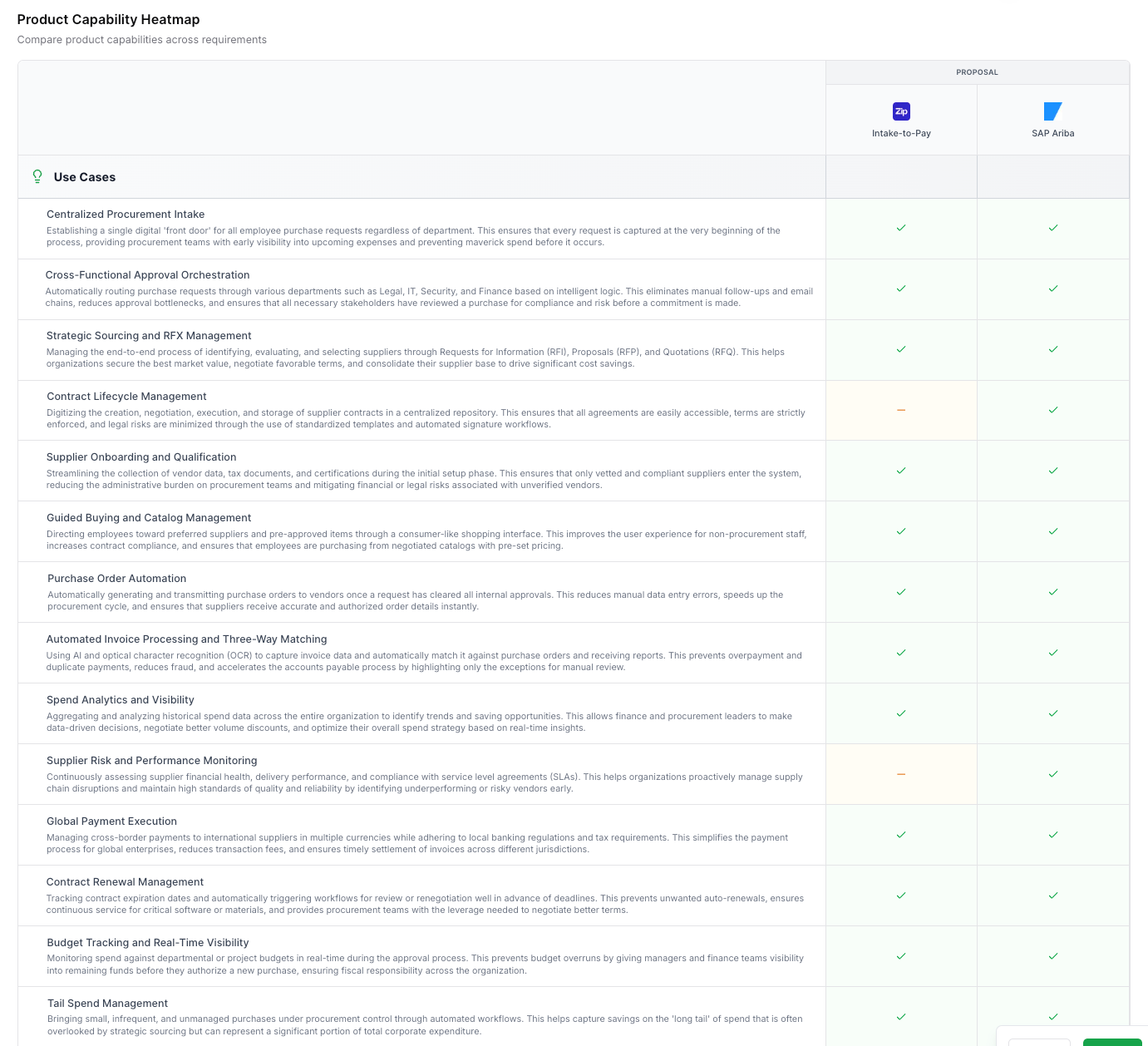
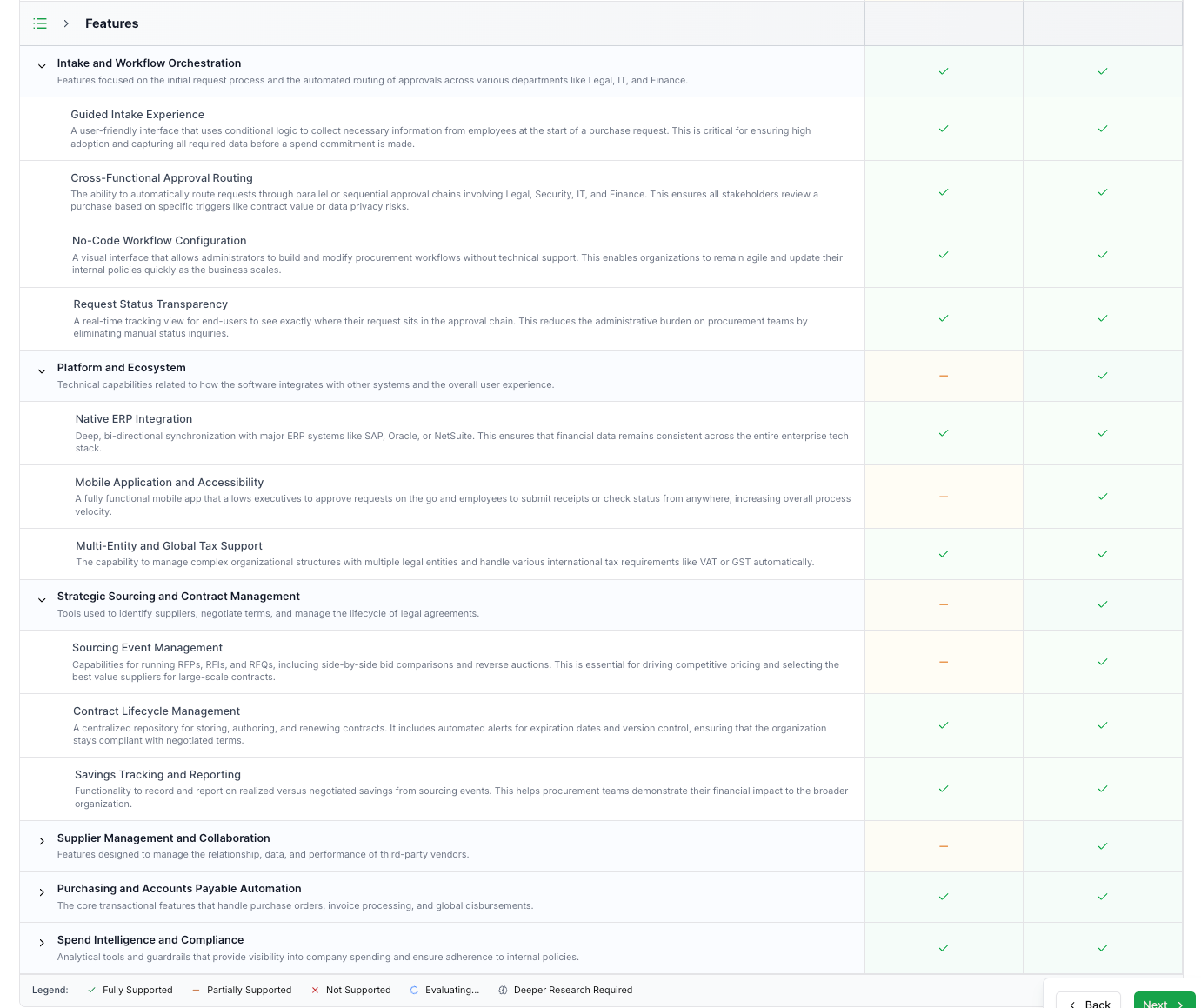
A glimpse of the Product Capability Heatmap checklist from the full report. Each of the 26 features is evaluated individually per product.
Platform Strengths
Zip Intake-to-Pay — Where It Leads
Zip's primary differentiator is its guided intake experience — a consumer-grade interface designed to drive adoption among non-procurement staff. When an employee initiates a purchase request, Zip's system automatically determines the appropriate approval workflow based on the dollar amount, vendor risk level, and purchase type, and routes it intelligently without manual intervention. Its no-code, drag-and-drop workflow configuration lets procurement teams build and modify cross-functional approval chains without IT support — a meaningful operational advantage when business policies change faster than IT can respond. Combined with strong tail spend management and rapid self-service supplier onboarding, Zip is particularly effective at eliminating maverick spend by capturing it at the point of request. Users consistently highlight the intuitive interface and customizable workflows as standout strengths.
SAP Ariba — Where It Leads
SAP Ariba's defining advantage is the SAP Business Network — one of the world's largest global supplier networks — providing unmatched access to pre-vetted suppliers for discovery, onboarding, and collaboration. Its strategic sourcing capabilities, including reverse auctions and complex RFX management, are built for organizations that run competitive bidding events at scale. SAP Ariba also leads on working capital optimization, with dynamic discounting and supply chain financing that have no equivalent in Zip's feature set, alongside superior support for direct materials procurement across multi-tier supply chains. Users in enterprise environments consistently highlight SAP Ariba's process discipline and auditability as core strengths.
Feature Coverage Gaps
Zip Intake-to-Pay — Notable Gaps
Zip's most consequential gap is supplier discovery. Operating as an orchestration layer rather than a supplier marketplace, it has no proprietary network of pre-vetted vendors — organizations must rely on third-party tools for discovery. Supply chain collaboration is absent entirely: demand forecasting, inventory visibility, and order collaboration are outside Zip's scope, limiting the platform to indirect procurement. On the compliance side, Zip lacks ISO 27001 certification, localized data residency options outside the United States, cloud-specific ISO 27017 and ISO 27018 certifications, and published Service Level Agreements.
Third-party review data surfaces two additional functional gaps. Users find Zip lacking in essential features for contract lifecycle management and change order visibility — flagged across 25 separate user mentions. Limited customization options that restrict workflow flexibility account for a further 19 mentions. At the enterprise deployment level, one verified buyer notes: "Complexity of implementation — because it's very flexible, deployment can be non-trivial. Learning curve: intake forms and workflows can be over-complicated for requesters and admins."Limited reporting, along with integration issues, causes more problems than they should.""Limited reporting, along with integration issues, causes more problems than they should." These are not disqualifying for Zip's core use case, but they are material for organizations expecting depth beyond intake orchestration.
SAP Ariba — Notable Gaps
SAP Ariba's gaps are primarily architectural and experiential rather than functional. Third-party reviews document a steep learning curve requiring significant training before staff can effectively use the platform, raised across 49 separate user mentions on G2 alone. Integration complexity and customization constraints account for a further 45 mentions, and interface frustration is cited by 37 users who describe navigation as difficult and non-intuitive compared to modern alternatives. One reviewer described the experience as "very slow operations and UI/UX that is difficult to understand, needing a lot of time to learn, and feeling outdated." The ecosystem lock-in concern is material for non-SAP environments. SAP's "Suite First" positioning means that many offerings — including AI capabilities — are focused primarily on SAP-native customers, with non-SAP ERP organizations effectively disenfranchised from parts of the product roadmap. One verified enterprise buyer states directly: "It seems that SAP wants to dictate to their smaller customers and are not listening to our needs. There is too much red tape for smaller clients." Support quality is a further concern: another buyer notes, "Where SAP Ariba currently lacks is customer support — there is a lack of urgency when tickets are filed. When system changes are made, such as service packs and hot fixes, there is a serious lack of quality control, which causes catastrophic downtimes." For organizations outside the SAP ERP environment, the implementation timeline — typically 6–12 months and requiring significant IT involvement — significantly increases the total cost of ownership.
Comparison Insights
Insight 1: Orchestration vs. Suite — This Is an Architectural Decision First
The most important framing before evaluating either product is that Zip and SAP Ariba are not competing for the same role. Zip was built to bridge what independent researchers describe as the "Intake Gap" — the chaotic window between when an employee first identifies a need and when a formal procurement transaction begins. SAP Ariba is designed to manage the execution of that transaction. Organizations running mixed ERP environments (NetSuite, Workday, Oracle) will find Zip's integration-first approach far less disruptive to implement, as it is architected to sit on top of diverse tech stacks without requiring a backend overhaul. Those already in the SAP ecosystem will find Ariba's native integration a decisive advantage that non-SAP environments cannot replicate.
Insight 2: The Supplier Network Gap Is a Strategic Constraint, Not Just a Feature Gap
Zip's lack of a proprietary supplier network has downstream effects beyond the obvious. SAP Ariba's Business Network — 5 million suppliers across 190 countries represents a procurement infrastructure that cannot be replicated through integrations. Organizations that depend on competitive sourcing events, reverse auctions, or rapid supplier discovery at scale will find this a fundamental capability advantage, not a patchable gap. Zip does not currently support reverse auction formats and relies on external tools for vendor discovery. Procurement leaders who rely on catalog breadth and supplier diversity programs should weigh this constraint accordingly before shortlisting.
Insight 3: Compliance Readiness Functions as a Hard Filter for Global Enterprises
SAP Ariba's compliance posture — ISO 27001, ISO 27017/27018, multi-region data residency, PCI DSS, and published SLAs with 99.7% uptime guarantees — places it in a separate tier from Zip for regulated industries and multinational organizations. Zip's gaps in these areas are not incremental; for businesses subject to strict data sovereignty requirements, they may be disqualifying before the feature evaluation begins. Run compliance requirements as a hard filter first.
Insight 4: SAP Ariba's Two-Sided Pricing Model Is a Decision Factor Most Evaluations Miss
SAP Ariba operates a commercially unusual two-sided model: the buying organization pays subscription fees, while suppliers transacting above defined thresholds are also required to pay. Suppliers pay a transaction fee of 0.155% of volume for most document types (rising to 0.35% where Service Entry Sheets are involved), plus annual membership subscriptions once they exceed five document transactions and $50,000 in order volume with a given buyer. Multiple users describe this structure as a pain point, with pricing not disclosed until purchase and directly proportional to transaction volume. For buyers managing large, global supplier bases, the downstream effect of this model on supplier relationships and onboarding friction is worth evaluating explicitly.
Insight 5: The Hybrid Model — Zip and Ariba as Complements, Not Just Competitors
The binary framing of this comparison obscures the fact that many large enterprises actually deploy these platforms. In practice, a common and increasingly documented pattern runs as follows: Zip handles intake and cross-functional approvals at the front end — achieving high user adoption across non-procurement staff — while approved requests automatically generate a formal Purchase Requisition in SAP Ariba, which then handles transactional execution, supplier management, and ERP integration from that point forward. Zip maintains a formal partnership with SAP Ariba precisely for this joint workflow. This posture allows organizations to maintain the deep transactional rigor, legal compliance, and ERP integration of their SAP investment while modernizing the front-end employee purchasing experience. For organizations with an established SAP Ariba deployment that are struggling with poor employee adoption and intake chaos, this hybrid model may be a more realistic path than a full platform replacement.
Insight 6: Exit Risk Is Underweighted in Most Zip Evaluations
Zip's standard legal documentation explicitly prioritizes data deletion over data export upon contract termination. Organizations selecting Zip should negotiate data portability and transition assistance terms before signing — a risk that typically surfaces only when it becomes a costly migration problem. This is not unique to Zip as a vendor type, but it is a specific contractual posture worth flagging at the procurement stage rather than at renewal.
Evaluation Summary
Zip Intake-to-Pay — Evaluation Summary
Zip Intake-to-Pay is a well-designed procurement orchestration platform that directly addresses the employee adoption problem — the most persistent failure mode in enterprise procurement transformation. Its 86% use case coverage reflects a deliberate, focused scope rather than a capability shortfall. The platform's G2 rating of 4.8/5 (vendor-stated) and Gartner's classification as a Visionary in the 2026 Magic Quadrant signal strong market momentum. The structural limitations are clear: Zip is not a source-to-pay suite, and organizations expecting native supplier discovery, supply chain collaboration, or enterprise-grade compliance certifications will need supplementary tooling or a different platform.
SAP Ariba — Evaluation Summary
SAP Ariba delivers the broadest intake-to-pay coverage in this evaluation — full use case coverage and a mature compliance framework built for global enterprises. Its Gartner MQ Leader position and 4.1/5 G2 rating reflect a platform with deep institutional adoption and broad capability, offset by well-documented UX friction and implementation complexity. For enterprises managing direct materials supply chains, running competitive sourcing events at scale, or subject to strict regulatory requirements, it remains the benchmark platform in this category. The primary constraint is the total cost of ownership — implementation timelines of 6–12 months and ecosystem dependencies that disadvantage organizations outside the SAP ERP environment.
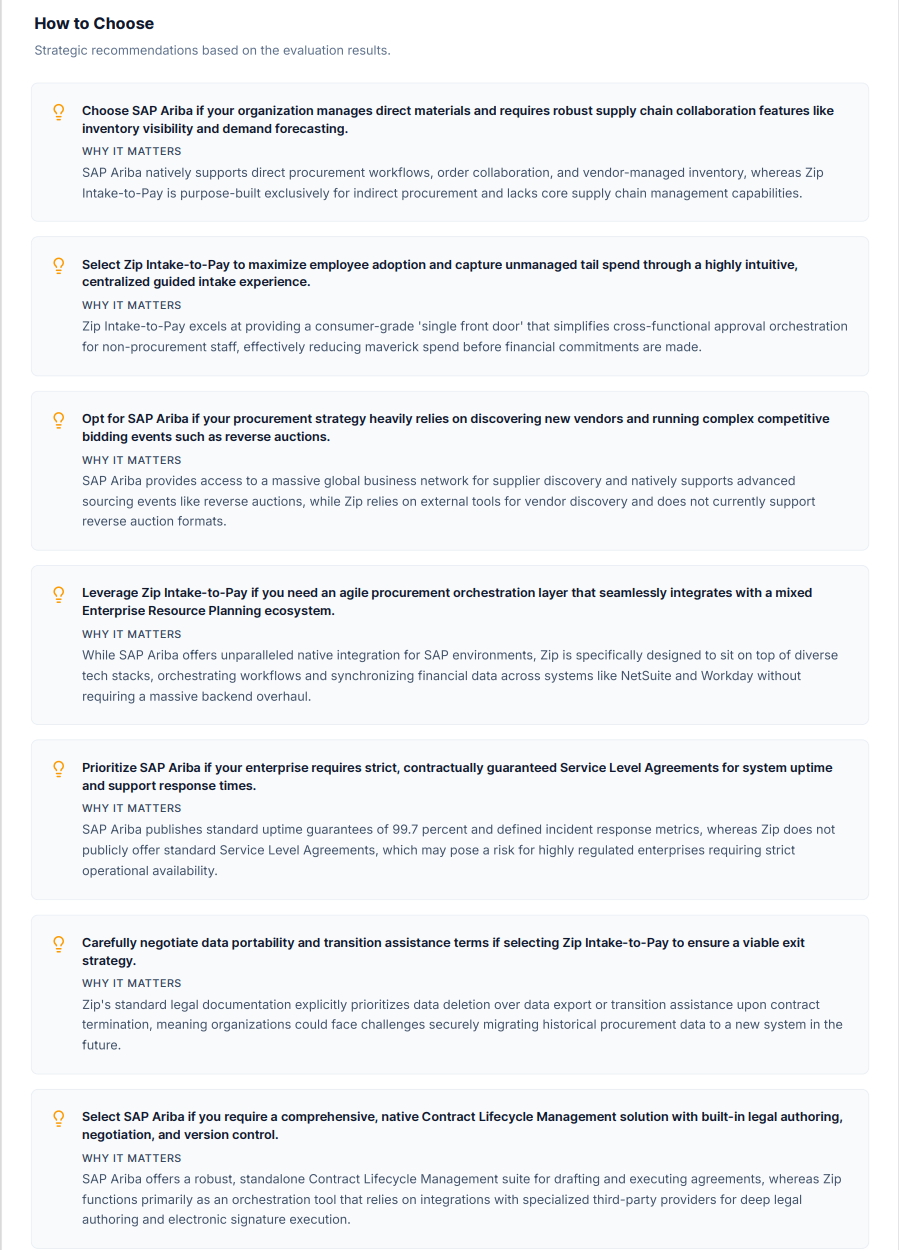
How to Choose
Choose SAP Ariba if your organization manages direct materials and requires robust supply chain collaboration features, such as inventory visibility and demand forecasting.
Why It Matters: SAP Ariba natively supports direct procurement workflows, order collaboration, and vendor-managed inventory. Zip Intake-to-Pay is purpose-built exclusively for indirect procurement and lacks core supply chain management capabilities.
Choose Zip Intake-to-Pay to maximize employee adoption and capture unmanaged tail spend through an intuitive, centralized guided intake experience.
Why It Matters: Zip's consumer-grade single front door simplifies cross-functional approval orchestration for non-procurement staff, reducing maverick spend before financial commitments are made — a problem traditional procurement platforms consistently fail to solve at the user level.
Choose SAP Ariba if your procurement strategy depends on discovering new vendors and running complex competitive sourcing events such as reverse auctions.
Why It Matters: SAP Ariba's Business Network provides access to over 5 million pre-vetted global suppliers and natively supports advanced sourcing formats, including reverse auctions. Zip relies on external tools for vendor discovery and does not support reverse auction formats.
Choose Zip Intake-to-Pay if you need an agile procurement orchestration layer that integrates with a mixed ERP ecosystem without a large-scale backend overhaul.
Why It Matters: Zip is architected to sit on top of diverse tech stacks — NetSuite, Workday, Oracle — orchestrating workflows and synchronizing financial data without requiring migration to a new ERP environment.
Choose SAP Ariba if your enterprise requires contractually guaranteed Service Level Agreements, ISO 27001 or ISO 27017/27018 certifications, or localized data residency outside the United States.
Why It Matters: SAP Ariba publishes standard uptime guarantees of 99.7% and offers comprehensive data residency options across multiple international regions. Zip does not currently offer equivalent compliance certifications or published SLAs — a hard disqualifier for many regulated industries.
If selecting Zip Intake-to-Pay, negotiate data portability terms explicitly before signing.
Why It Matters: Zip's standard legal documentation prioritizes data deletion over data export upon contract termination. Without explicit negotiation, organizations may face significant challenges migrating historical procurement data to a future system.
Choose SAP Ariba if you require a comprehensive, native Contract Lifecycle Management solution with built-in legal authoring, negotiation, and version control.
Why It Matters: SAP Ariba offers a standalone CLM suite for drafting and executing agreements. Zip functions primarily as an orchestration tool and relies on a partnership with Ironclad for deep legal authoring and electronic signature execution.
The full report includes structured recommendations tailored to your organizational profile.
Download the Full Comparison Report
This blog covers the key findings. The full Teem report goes deeper:
- ✅ Complete 18-point use case evaluation with individual scores per product
- ✅ Full 26-point feature checklist with ✅ / ⚠️ / ❌ per product
- ✅ Methodology and external research sources
- ✅ Printable PDF — ready for internal stakeholder reviews
Enter your email to get instant access. No spam. Unsubscribe anytime.
Want to see the Teem's Product comparison engine live with your own shortlist?
Book a demo, and we will walk you through it→ Demo
This report is generated by our internal platform using publicly available information, market data, and documented product capabilities. Information presented may change over time as vendors update their offerings. While efforts have been made to ensure accuracy, readers should independently verify critical claims with the respective vendors before making business decisions.
This comparison was produced independently by Teem. Neither SAP nor ZipHQ has sponsored, reviewed, or influenced this report.