
SAP Ariba vs. Coupa: Product Comparison Report
SAP Ariba vs. Coupa — two Gartner Leaders, one decision. We evaluated both across 16 use cases and 28 features. The winner depends entirely on your ERP landscape and what "unified" means to your organization.
By Teem | March 2026 | Procurement | Spend Management | Enterprise Software
About this analysis: This article is a condensed summary of a full Teem product comparison report, independently produced based on a structured evaluation of 16 use cases and 28 features, supplemented by external market research drawn from Gartner, IDC, Forrester, G2, and 54+ primary sources. No vendor has sponsored or reviewed this content.
Why This Comparison Matters
The global procurement software market was valued at $6.6 billion in 2024 and is projected to reach $8.6 billion by 2029 at a 5.3% CAGR. Within that market, SAP Ariba and Coupa are the two dominant Source-to-Pay platforms — both named Leaders in the 2025 and 2026 Gartner Magic Quadrant for Source-to-Pay Suites, and both positioned at the top of a market that touches nearly every enterprise finance and operations team on the planet.
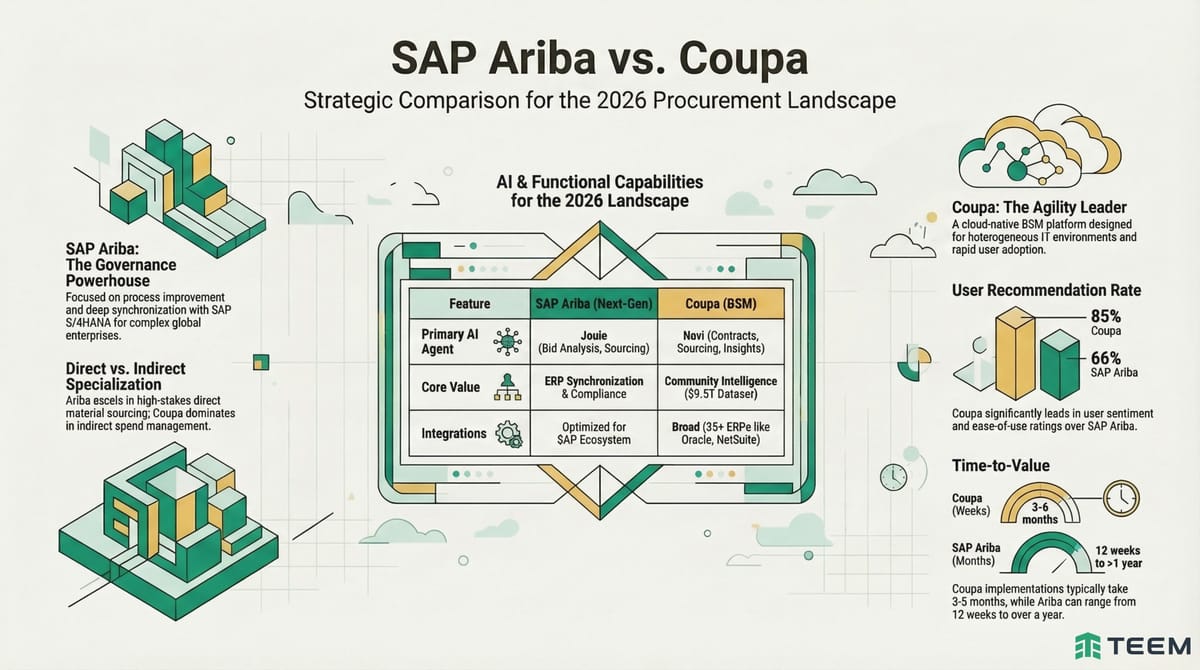
Yet choosing between them is not a straightforward product comparison. They represent fundamentally different procurement philosophies. SAP Ariba is built around a modular, ecosystem-integrated architecture tightly coupled with the broader SAP landscape. Coupa is engineered as a unified, ERP-agnostic Business Spend Management platform. That structural divergence — more than any individual feature gap — shapes implementation complexity, total cost of ownership, and long-term scalability. Understanding it clearly is the starting point for any serious evaluation.
At a Glance: Capability Scores
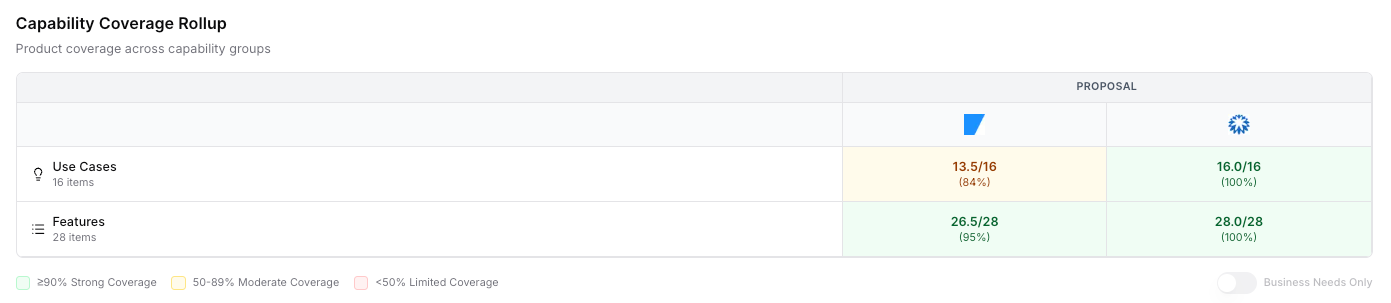
| Dimension | SAP Ariba | Coupa |
| Use Cases (16 Evaluated) | 13.5/16 (84%) | 16/16 (100%) |
| Features (28 Evaluated) | 26.5/28 (95%) | 28/28 (100%) |
Coverage Tiers: ✅ Strong — ≥90% ⚠️ Moderate — 50–89% ❌ Limited — <50%
Coupa achieves full coverage across both dimensions. SAP Ariba scores in the moderate-to-strong range on use cases, with specific functional gaps concentrated in expense management and supply chain design — areas addressed through separate SAP applications rather than native capability.
Want to run this comparison for your own shortlist? See below how the Teem's comparison engine works:
Product Comparison Quick Overview-The scores above are generated directly from Teem's structured evaluation engine. Here's what the full report looks like inside the platform.
The Core Structural Difference
SAP Ariba holds approximately 29.1% of the global procurement software market by revenue and operates the world's largest structured B2B network — 5.4 million companies across 190 countries. It is the procurement arm of SAP SE, deeply integrated with SAP S/4HANA and designed to orchestrate complex, multinational spend workflows within the broader SAP ecosystem. Its February 2026 platform rebuild on SAP Business Technology Platform represents a major architectural rebuild — delivered in phased waves through 2026 — with a redesigned UX, native AI integration, and a unified master data layer shared across S/4HANA, Ariba, and the SAP Business Network.
Coupa, taken private by Thoma Bravo in February 2023 for $8 billion, is architected as an ERP-agnostic Business Spend Management platform supporting 35+ ERP integrations, including SAP, Oracle, NetSuite, and Microsoft Dynamics 365. Its network spans 10 million buyers and suppliers, and its community-generated spend dataset — now exceeding $9 trillion — is the foundation of its AI strategy. In October 2025, Coupa launched 100+ AI-driven enhancements alongside its Clarity 2.0 redesigned interface.
This architectural divergence — SAP-native modularity versus ERP-agnostic unification — shapes every capability gap and integration requirement that follows.
Use Cases: Who Is Each Product Built For?
SAP Ariba
SAP Ariba achieves strong coverage across core procurement use cases — strategic sourcing, guided buying, contract lifecycle management, spend analysis, supplier risk, and direct materials procurement. Where it falls short natively is in employee expense management and supply chain network design, both of which require separate SAP applications (SAP Concur and SAP Integrated Business Planning, respectively). It is best suited for large manufacturing or retail enterprises already operating within the SAP ecosystem, where its modular architecture is a feature rather than a constraint.
Coupa
Coupa covers all 16 evaluated use cases natively, including Employee Expense Management and Reimbursement, Contingent Workforce and Services Procurement, and Supply Chain Design and Optimization — the last enabled by Coupa's $1.5 billion acquisition of Llamasoft in 2020, which added AI-powered supply chain planning and digital twin capabilities. It is the stronger fit for organizations seeking a single platform to consolidate all spend-related functions, or those prioritizing government compliance through its standalone FedRAMP Moderate authorization.
Features Snapshot
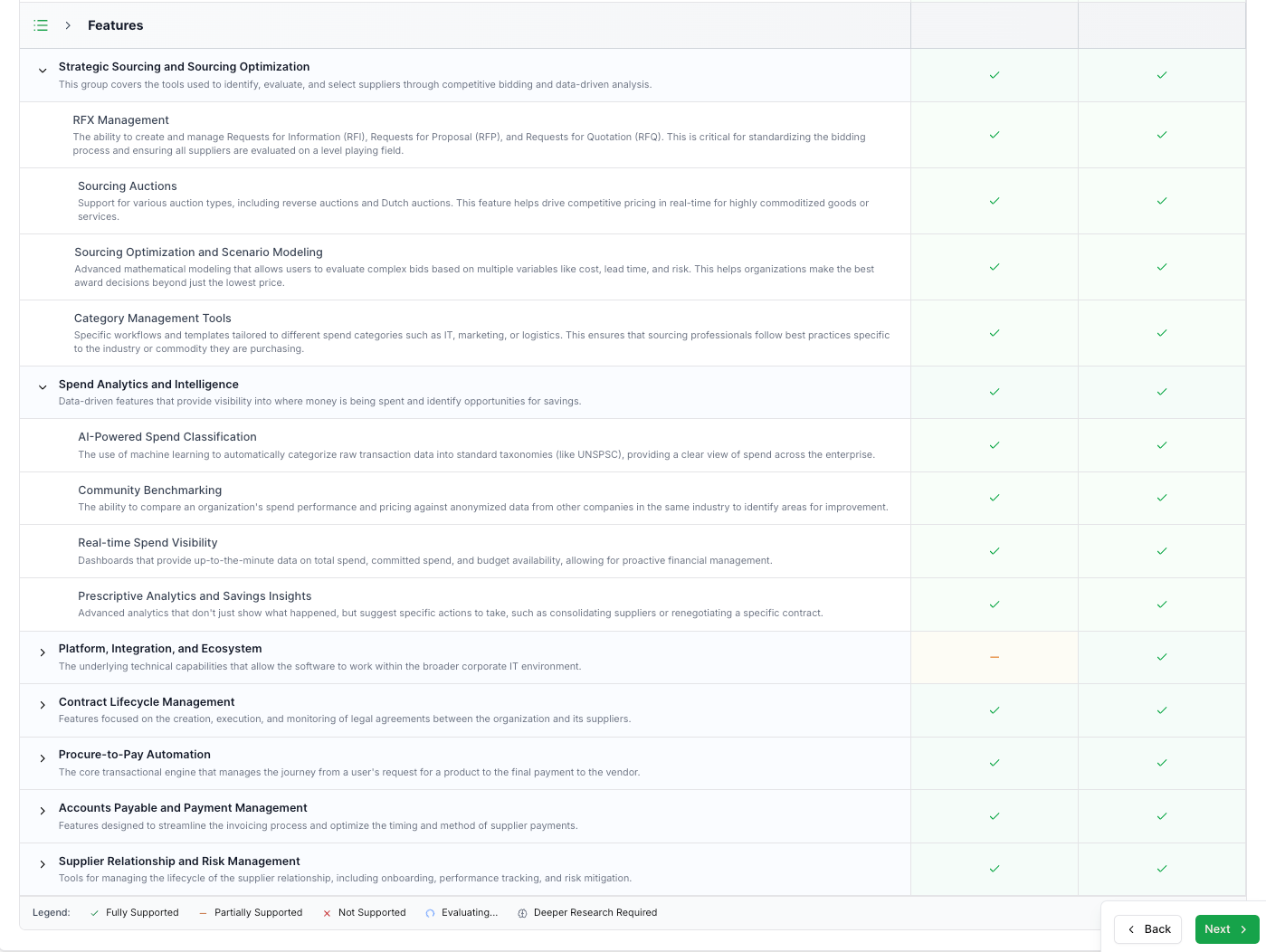
The seven most decision-relevant feature categories from the full 28-point evaluation.
|
Feature Category |
SAP Ariba |
Coupa |
|
Strategic Sourcing & Sourcing Optimization |
✅ |
✅ |
|
Spend Analytics & Intelligence |
✅ |
✅ |
|
Platform, Integration & Ecosystem |
⚠️ |
✅ |
|
Contract Lifecycle Management |
✅ |
✅ |
|
Procure-to-Pay Automation |
✅ |
✅ |
|
Accounts Payable & Payment Management |
✅ |
✅ |
|
Supplier Relationship & Risk Management |
✅ |
✅ |
Legend: ✅ Fully Supported ⚠️ Partially Supported ❌
Platform Strengths
SAP Ariba — Where It Leads
SAP Ariba's most distinct competitive advantage is its depth in Direct Materials Procurement and Supply Chain Collaboration — it offers specialized tools for managing complex bills of materials and integrates directly with manufacturing execution and material requirements planning systems. This makes it the dominant choice in manufacturing and industrial environments where procurement must synchronize tightly with production operations.
On contract management, the gap is material: SAP Ariba holds a G2 CLM score of 8.4 versus Coupa's 6.8, further strengthened by an integrated partnership with Icertis that adds authoring, obligation management, and risk monitoring. On invoice processing, Ariba scores 8.8 on G2 Invoice Approvals — and its 5.4 million-company Business Network remains the world's largest structured B2B supplier network, giving procurement teams unmatched supplier discovery and collaboration capabilities. SAP Ariba also holds ISO 27017 and ISO 27018 certifications — specific to cloud security controls and PII protection in the cloud — that carry contractual weight in certain regulated sectors.
Coupa — Where It Leads
Coupa's defining strength is its natively unified architecture — all major spend categories, including employee expenses, treasury, and contingent workforce management, are handled within a single platform without requiring third-party integrations for core functionality. Its Forrester Total Economic Impact study (2024) — vendor-commissioned by Coupa — documented 276% ROI over three years with payback within 10 months. No equivalent public study is available for SAP Ariba.
Coupa's $9 trillion+ anonymized community spend dataset powers real-time pricing benchmarks and supplier risk alerts that no ERP vendor can replicate from first-party transactional data alone. Its G2 Ease of Use score of 8.3 versus Ariba's 8.0, and G2 Mobile score of 8.0 versus Ariba's lower-rated mobile experience, reflect a consistent adoption advantage in enterprise rollouts. And its standalone FedRAMP Moderate authorization — listed directly on the FedRAMP Marketplace — makes it one of the few enterprise procurement platforms viable out-of-the-box for public sector organizations.
Feature Coverage Gaps
SAP Ariba — Notable Gaps
When evaluated as a standalone platform, SAP Ariba presents functional gaps in three areas: Employee Expense Management and Reimbursement, Unified Expense and Treasury Management, and Supply Chain Design and Optimization — all of which require separate SAP applications to achieve feature parity. Managing the full contingent workforce lifecycle similarly requires a separate integration with SAP Fieldglass, as SAP Ariba natively handles only the financial transaction side. Mobile Application Accessibility is only partially supported — a practical constraint for field-based or travel-heavy teams, reflected in lower G2 user ratings on that dimension.
Coupa — Notable Gaps
Coupa's gap is narrower but notable for security-focused buyers: it does not hold explicit ISO 27017 Cloud Security Controls or ISO 27018 PII-in-Cloud certifications, relying instead on its broader information security and privacy management frameworks. For organizations in industries where these specific certifications are contractually mandated — such as financial services or regulated multinationals — this distinction warrants direct assessment. It is unlikely to be disqualifying for most commercial enterprises, but it should be on the security diligence checklist.
AI Spotlight: Joule vs. Navi
Both platforms have made AI a central strategic bet — but they are drawing from different data wells and building toward different visions.
SAP Ariba — Joule
SAP's AI strategy centers on Joule, its AI copilot embedded across the Ariba suite, supporting 11 languages and leveraging SAP's partnerships with NVIDIA and Mistral for LLM capabilities. The February 2026 next-gen platform rebuild bakes Joule natively into every workflow — from Intelligent Contracting (auto-extraction, compliance checks, historical contract search) to AI Supplier-Response Summaries and a Sourcing Agent capable of executing autonomous workflows across sourcing, contracting, and invoicing. SAP Ariba's data advantage claim rests on its structured transactional dataset from the world's largest B2B network — what Baber Farooq, SVP of SAP Ariba, described as "the world's largest and most structured data set from a business and spend data perspective."
Coupa — Navi
Coupa's AI strategy is built on the Navi agent portfolio, launched April 2024 at Inspire Las Vegas and expanded with multi-agent capabilities in May 2025, followed by 100+ AI-driven enhancements in October 2025. Navi agents cover the full S2P lifecycle: the Analytics Agent generates custom reports 100% faster, the Bid Evaluation Agent automates supplier scoring, the Request Creation Agent converts unstructured SOWs into purchase requests, and the Assistance Agent handles routine supplier inquiries autonomously. The foundation of all of it is the $9 trillion+ community-generated spend dataset — anonymized, cross-customer intelligence that no single ERP vendor can replicate from first-party data alone. In Q3 FY26, Coupa's AI-driven platform delivered approximately $15 billion in customer savings.
The Honest Assessment
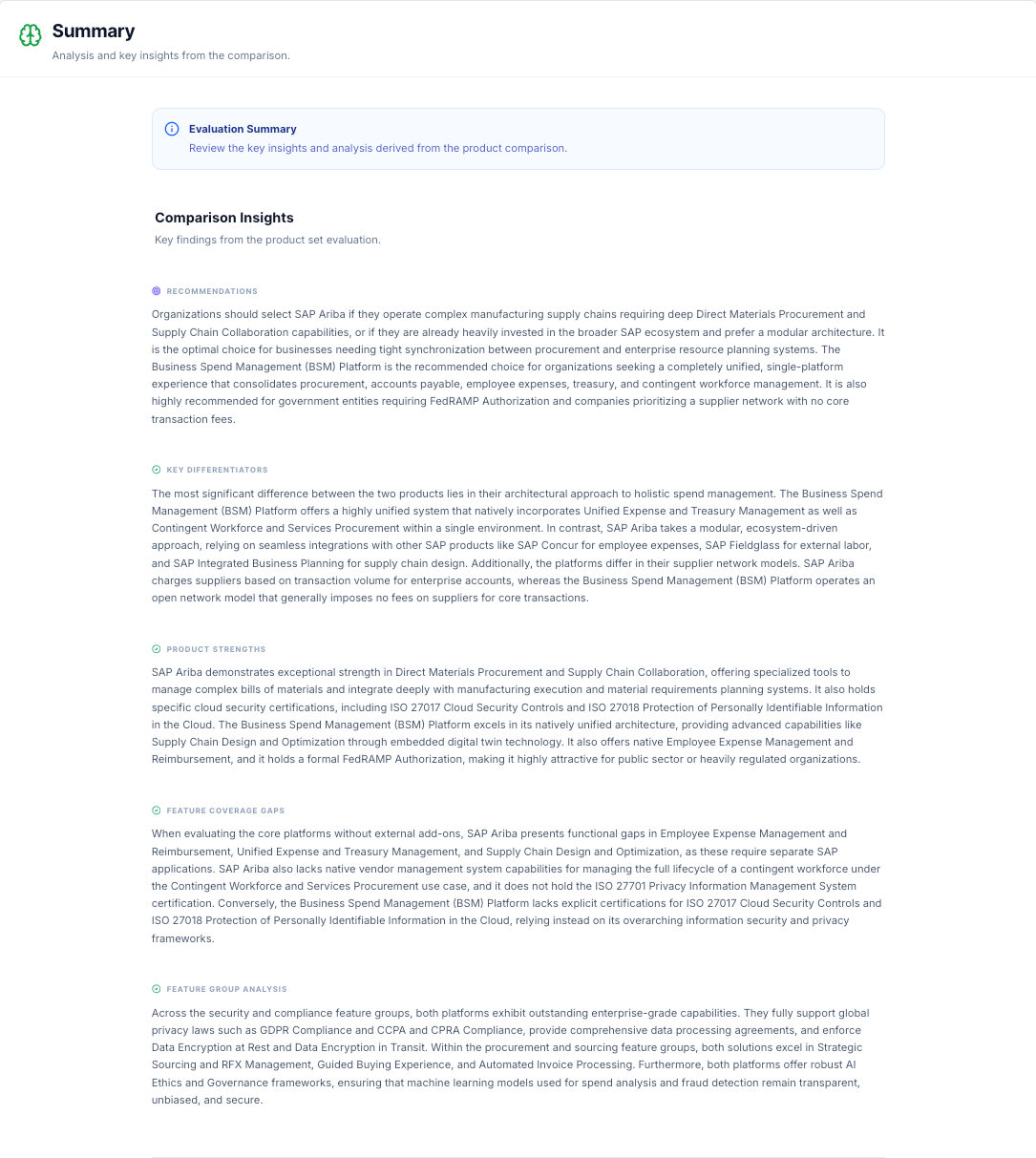
Both AI strategies are credible and well-resourced. The distinction is in the data moat: SAP's advantage is a structured ERP context and breadth across the entire business process landscape; Coupa's advantage is community-generated, anonymized spend intelligence at a scale no ERP vendor can match. Neither is clearly ahead. The more relevant question for a buyer is whether they want AI that knows their SAP master data deeply, or AI that benchmarks their spend against $9 trillion+ of real-world procurement transactions in real time.
Comparison Insights
Insight 1: Modular Architecture Is a Strategic Trade-Off — But It Has a Cost SAP Ariba's modular approach offers deep specialization for SAP-ecosystem organizations, but introduces integration complexity and cost overhead. Organizations not already running SAP S/4HANA or SAP Concur will incur additional implementation, licensing, and maintenance overhead to achieve the same functional breadth that Coupa delivers natively. For procurement leaders evaluating total cost of ownership rather than just license cost, this distinction is consequential. G2 reviewers note that integrating Ariba with non-SAP systems can present challenges requiring careful planning — a consistent theme in enterprise feedback.
Insight 2: Supplier Network Fees Create Structural Cost Asymmetry The two platforms operate fundamentally different supplier network models. SAP Ariba charges suppliers based on transaction volume for enterprise accounts, which can create friction in supplier onboarding — particularly for mid-market suppliers with thin margins. Coupa operates an open network model with no core transaction fees for suppliers, reducing this friction and improving adoption rates across the supply base. For organizations managing large, diverse supplier networks, this structural difference has downstream implications for supplier participation and data quality.
Insight 3: Security Certification Profiles Are Complementary, Not Equivalent Both platforms maintain strong enterprise-grade security postures, but their certification profiles differ in material ways. SAP Ariba holds ISO 27017 and ISO 27018 certifications specific to cloud security and PII protection. Coupa holds FedRAMP Moderate authorization — the more critical credential for public sector entities — and additionally holds PCI DSS, HIPAA, and TISAX certifications not prominently listed for SAP Ariba's core platform. Neither certification profile is objectively superior — the right answer depends on which standards are contractually operative for a given organization.
Insight 4: AI Benchmarking Approaches Reflect Different Data Philosophies Coupa's $8 trillion community data pool enables real-time transactional AI benchmarking — surfacing pricing anomalies and supplier risk signals continuously from live spend patterns across its user base. SAP Ariba's Business Network enables structured, survey-based peer performance comparisons and dynamic KPIs. The practical implication: Coupa favors organizations that want continuous, automated spend intelligence, while SAP Ariba suits those that prefer structured, benchmarked peer comparison frameworks anchored in ERP data.
Insight 5: Gartner Positions Reflect Different Execution Profiles In both the 2025 and 2026 Gartner Magic Quadrant for Source-to-Pay Suites, Coupa ranked highest for Ability to Execute, while SAP was positioned strongly on Completeness of Vision. Both are Leaders. The distinction is meaningful for enterprise buyers: Coupa's execution advantage reflects its adoption-focused, unified architecture; SAP's vision positioning reflects the depth and scope of its AI platform rebuild and ecosystem breadth. Neither ranking is a proxy for "better" — they measure different things.
Security & Compliance Spotlight
SAP Ariba — Security & Compliance Approach
SAP Ariba holds ISO 27001, ISO 27017, and ISO 27018 certifications, along with SOC 1 Type 2 and SOC 2 Type 2, full GDPR and CCPA/CPRA compliance, CSA STAR certification, and FedRAMP Moderate (via the specialized SAP NS2 enclave). It enforces data encryption at rest and in transit and provides comprehensive data processing agreements. Its AI Ethics and Governance framework ensures that machine learning models used in spend classification and fraud detection remain transparent and auditable.
Coupa — Security & Compliance Approach
Coupa holds ISO 27001, SOC I and SOC II, FedRAMP Moderate, PCI DSS, HIPAA, CSA STAR, and European ISA (TISAX equivalent) certifications, along with full GDPR and CCPA/CPRA compliance. It operates a dedicated GovCloud platform for public sector deployments and maintains personnel screening for that environment. It does not hold ISO 27017 or ISO 27018 explicitly, relying on its overarching security and privacy management frameworks.
Both platforms meet enterprise-grade security thresholds for the vast majority of commercial deployments. The distinction becomes decision-relevant only when a specific ISO certification is contractually required — or when federal government procurement standards are the operative baseline.
Implementation & Total Cost of Ownership
Implementation complexity is often where procurement platform decisions are won or lost — and where the architectural differences between these two products have the most direct financial impact.
SAP Ariba — Implementation
SAP Ariba offers an ARC Rapid Deployment option (Accelerate, Realize, Convert) promising go-live in as few as 10 weeks for fixed scope, fixed fee deployments. For standard enterprise rollouts, typical timelines are 3–6 months for a single region with a focused supplier group, and 9–18 months for global multi-entity implementations covering sourcing and contract management. Full enterprise deployment costs can reach up to $250,000. The implementation lift is significantly heavier for organizations outside the SAP ecosystem — integrating with non-SAP ERPs requires SAP BTP and meaningful technical effort. G2 Ease of Setup score: 7.8.
Coupa — Implementation
Coupa's cloud-native architecture generally enables faster time-to-value. A Forrester TEI study (2024) documented payback within 10 months and 276% ROI over three years. Jabil scaled from $2 billion to $6 billion in managed indirect spend during their Coupa implementation horizon. For organizations with heterogeneous ERP environments, Coupa's 35+ pre-built ERP connectors reduce integration complexity considerably. Common challenges include a steep initial learning curve for end users, limited customization options relative to Ariba, and variable customer support response times.
Pricing (Third-Party Benchmarks — Not Vendor-Confirmed)
Neither platform publishes pricing. Both are custom-quoted. Third-party benchmarks provide the following reference points:
SAP Ariba: TEC benchmarks suggest a mid-sized company with 500 suppliers and 5 users on the Supplier Lifecycle & Performance module starts around $25,000/year. Annual price increase caps of 3–5% are negotiable on renewals. Watch for: SAP sometimes includes separate buyer-side network access fees — buyers should audit every contract line item.
Coupa: Software Advice cites a starting price of approximately $2,500/month. ITQlick estimates range from $500/user/month (small deployments) to $400/user/month at enterprise scale. Vendr reports that buyers have secured 70% discounts on 3-year deals using end-of-year leverage, with annual uplift caps of 5% achievable.
Pricing estimates are third-party benchmarks. Verify directly with vendors before including in any internal business case.
Evaluation Summary
SAP Ariba — Evaluation Summary
SAP Ariba is a highly capable, market-proven enterprise procurement platform with exceptional depth in direct materials sourcing, complex supply chain collaboration, and ERP-integrated procurement workflows. Its ~29.1% global market share by revenue, world's largest B2B supplier network, and February 2026 platform rebuild reflect a vendor making a serious long-term investment in the category. The most significant limitation to account for is its reliance on the broader SAP ecosystem to achieve full spend management coverage — organizations without existing SAP infrastructure will incur meaningful integration and licensing overhead to close the functional gaps that Coupa addresses natively.
Coupa — Evaluation Summary
Coupa delivers comprehensive coverage across all 16 evaluated use cases and all 28 features, and leads both the 2025 and 2026 Gartner MQ for Ability to Execute. Its unified architecture, ERP-agnostic integration model, and $9 trillion+ community data asset position it as the broadest native spend management platform in this comparison. The most important limitation to note is the absence of ISO 27017 and ISO 27018 cloud security certifications — unlikely to be disqualifying for most commercial enterprises, but warranting direct assessment for organizations where those certifications are contractually mandated.
How to Choose
Choose Coupa if your organization requires natively unified employee travel and expense reporting alongside core procurement operations.
Why It Matters: Coupa natively consolidates expense reporting, procurement, and treasury management into a single system. SAP Ariba relies on SAP Concur — a separate product, separate contract, and separate integration — to handle employee out-of-pocket expenses and reimbursements.
Choose SAP Ariba if your enterprise operates complex direct materials procurement workflows and is already deeply invested in the SAP ecosystem — particularly SAP S/4HANA.
Why It Matters: SAP Ariba offers specialized Bill of Materials and Material Requirements Planning synchronization directly with SAP ERPs, making it optimal for manufacturing and retail enterprises requiring tight alignment between production schedules and supplier collaboration. The integration value for SAP shops is, as one benchmarking source described it, "impossible to replicate."
Choose Coupa if your organization wants to avoid volume-based licensing structures and supplier transaction fees.
Why It Matters: Coupa uses a user- and module-based licensing model with no supplier fees for core transactions, making total cost of ownership more predictable as transaction volumes and supplier counts scale. SAP Ariba charges buyers based on managed spend volume and requires high-volume enterprise suppliers to pay transaction fees.
Choose Coupa if active supply chain network modeling and scenario simulation is a strategic priority.
Why It Matters: Coupa's Llamasoft acquisition added native Supply Chain Design and Optimization tools with digital twin capabilities. SAP Ariba does not support this in its core platform and requires a separate SAP Integrated Business Planning deployment.
Choose Coupa if your organization is a government agency or heavily regulated public sector entity.
Why It Matters: Coupa is actively listed on the FedRAMP Marketplace as an authorized SaaS product with a dedicated GovCloud platform. SAP Ariba requires deployment through the specialized SAP NS2 enclave to meet equivalent federal standards.
Evaluate both carefully if managing the full contingent workforce lifecycle is a primary requirement.
Why It Matters: Coupa includes dedicated modules for external labor lifecycle management — recruitment, onboarding, and time-tracking — natively. SAP Ariba handles the financial transactions but requires a separate integration with SAP Fieldglass for end-to-end worker management.
Evaluate both carefully if AI-driven community benchmarking is a core buying criterion.
Why It Matters: Coupa's $9 trillion+ anonymized community data pool delivers real-time transactional pricing intelligence. SAP Ariba leverages its global Business Network for structured, survey-based peer benchmarking. The better fit depends on whether your organization prioritizes continuous AI-driven spend alerts or structured, ERP-contextual performance baselines.
Neither platform is the right answer if your organization is a small or mid-market business without dedicated procurement resources and implementation capacity. In that case, consider point solutions like Zip or Stampli before committing to an enterprise S2P suite.
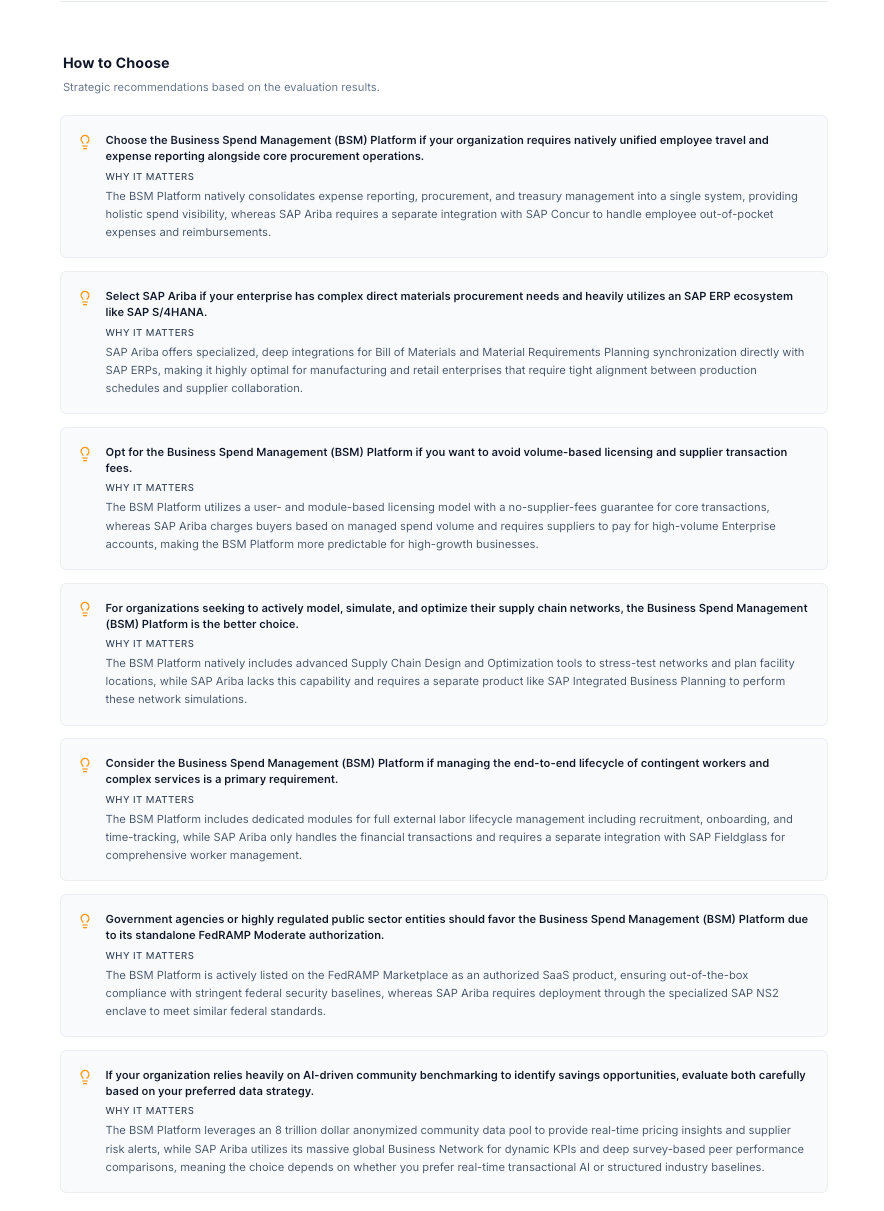
The full report includes structured recommendations tailored to your organizational profile.
The full Teem report includes a complete scoring breakdown across all 16 use cases and 28 features — structured to help you build the internal business case.
Download the Full Comparison Report
This blog covers the key findings. The full Teem report goes deeper:
- ✅ Complete 16-point use case evaluation with individual scores per product
- ✅ Full 28-point feature checklist with ✅ / ⚠️ / ❌ per product
- ✅ Methodology and external research sources
- ✅ Printable PDF — ready for internal stakeholder reviews
Enter your email to get instant access. No spam. Unsubscribe anytime.
Want to see the Teem's Product comparison engine live with your own shortlist?
Book a demo, and we will walk you through it→ Demo
This report is generated by our internal platform using publicly available information, market data, and documented product capabilities. Information presented may change over time as vendors update their offerings. While efforts have been made to ensure accuracy, readers should independently verify critical claims with the respective vendors before making business decisions.
This comparison was produced independently by Teem. Neither SAP nor Coupa has sponsored, reviewed, or influenced this report.