Ramp Procurement vs Rippling Procurement: Product Comparison Report
Put Ramp Procurement and Rippling Procurement side by side, and the scores almost cancel out: Ramp leads on use cases, Rippling leads on features. That split is the whole story, because each product is built for a different end of the procurement lifecycle. Ramp owns the finance-operations end, where the work is disciplined purchase order execution and downstream reconciliation. Rippling owns the front end and the surrounding context, where approvals need to reflect who someone is in the org and what a vendor relationship actually looks like.
Ramp Procurement's center of gravity is operational depth and purchase-order-centric control. It handles the full PO lifecycle, including automatic PO generation, updates through change orders, real-time status tracking, and bulk import. Its native strengths cluster around matching procurement records to bills, receipts, and card transactions; standardized intake; accurate coding support; three-way matching; spend visibility; and vendor onboarding. For finance teams that run heavy on PO administration and reconciliation, that is the profile.
Rippling Procurement's center of gravity is intelligence and cross-functional orchestration. Because it sits within a broader people and systems platform, it routes approvals based on employee and organizational signals such as seniority, department, risk level, and live org structure, with approver assignment tied to HR data. It also has stronger documented coverage for legal and contract oversight, including contract red-flag detection and surfacing issues to both the legal approver and the requester, and for renewal management, where multi-interval alerts sit alongside a vendor history view spanning contracts, payments, usage, SSO logins, and active seats.
This comparison follows an independent capability assessment. The scores come first, followed by the section-by-section analysis, and then the full capability heatmap.
Key differentiators
Both products cover the core of procurement well: structured intake, custom approval workflows, PO creation after approval, invoice matching, payment automation, auditability, pre-purchase controls, and end-to-end workflow support from request through payment. The separation starts with approval intelligence and organizational context. Rippling is more clearly documented for routing based on seniority, department, risk level, and vendor type, and for the live organizational structure, with approver assignments tied to employee and HR data. Ramp supports configurable workflows and vendor-type-based routing, but several advanced routing criteria are not clearly documented, particularly seniority-based, department-based, risk-level, and live org-chart-aware approvals.
The second major differentiator is contract and renewal intelligence. Rippling shows clearer evidence for contract red-flag detection, for surfacing legal issues to both the requester and the legal approver, and for renewal workflows that include 30-, 60-, and 90-day alerts alongside a vendor history view covering contracts, payments, usage, SSO logins, and active seats. Ramp supports renewal reminders and legal review at a broader level, but the available evidence is less explicit on full 90-day renewal alert coverage, unified vendor history for renewals, contract red-flag detection, and requester-facing issue surfacing.
Ramp differentiates more strongly in operational purchase order management and downstream reconciliation. It has clearer evidence for handling PO changes through change orders, bulk PO import, matching card transactions to purchase orders, vendor sourcing within procurement, and historical PO and bill cross-checking. These are areas where Rippling is either unverified or less explicitly documented.
Product strengths
Ramp's strengths are operational depth and strong purchase-order-centric controls. It is especially capable for procurement teams that need detailed PO lifecycle management: automatic PO generation, PO updates via change orders, real-time status tracking, bulk import, and matching procurement records to bills, receipts, and card transactions. Ramp also shows strength in standardized intake, accurate coding support, three-way matching, spend visibility, vendor onboarding, and workflow-driven control from request to payment. For organizations with mature finance operations that lean heavily on PO administration and reconciliation, Ramp looks particularly strong.
Rippling's strengths are intelligence, context, and cross-functional orchestration. It is better evidenced for routing approvals based on employee and organizational signals such as seniority, department, risk level, and live org structure. It also carries stronger documented coverage for legal and contract oversight, including detecting red flags such as auto-renewal clauses and logical inconsistencies, and surfacing issues to both legal approvers and requesters. Rippling stands out in renewal management too, combining multi-interval alerts with rich vendor history and broader HR and IT context. For organizations that want procurement decisions to reflect people data, ownership, and software usage context, Rippling is the more differentiated option.
Feature coverage gaps
The main gaps are not in core procure-to-pay coverage, since both products perform well there. They appear in advanced controls and the surrounding context. Ramp has the larger set of unverified items in approval intelligence and contract analysis. The available evidence does not clearly confirm routing by seniority, department, or risk level; live organizational context in approvals; unified vendor history for renewals; contract red-flag detection; or requester-facing surfacing of contract issues. This does not mean Ramp lacks these capabilities, only that they are not strongly substantiated in the material reviewed.
Rippling's main gaps are in purchase-order operations and some finance-administration details. The available evidence does not clearly confirm handling PO changes after creation, bulk PO import, direct reconciliation of card transactions to purchase orders, explicit coding assistance, vendor sourcing during procurement, or historical cross-checking of new purchasing activity against prior purchase orders and bill payments. For a team that expects procurement to function as a deeply configurable PO operations hub, these are the areas where Rippling appears less proven based on the documentation reviewed.
A few nuanced differences run the other way, where both products are positive, but one is more complete. On renewal deadlines, both support reminders, but Rippling is explicitly documented for 30, 60, and 90 days, while Ramp is clearly evidenced only for 30 and 60 days. On unified spend visibility, both are strong, but Rippling is more explicit about linking procurement to HR, approval hierarchy, and IT context within a single system of record.
Business-critical decision areas
No feature in the matrix is explicitly marked as a stakeholder-designated business need, but the most decision-critical areas in practice are approval routing, intake quality, procure-to-pay automation, legal risk handling, renewal control, and spend visibility. On intake and end-to-end workflow automation, both products are strong. Each supports structured request submission, validation of request completeness, automated PO creation, invoice matching, payment workflow support, and centralized procurement operations. Either one can satisfy the foundational need of controlling business spend through a guided procurement process.
The more important decision point is whether the organization prioritizes policy precision and organizational context or operational PO control. If approval governance needs to mirror company hierarchy, change employee attributes, and use nuanced risk logic, Rippling has the stronger evidence base. Its advantage is especially meaningful for companies where procurement relies on HR data, legal review, and cross-functional ownership. If the priority is ensuring that every approved purchase moves through rigorous PO administration, reconciliation, and finance operations, Ramp has stronger evidence, particularly around change orders, bulk PO handling, and purchase-to-card or bill reconciliation.
For software renewals and contract review, Rippling has the clearer advantage. Its ability to combine renewal timing, vendor usage data, seat visibility, and legal issue detection gives it a stronger position to control recurring vendor spend and reduce renewal risk. Ramp supports parts of this process, but the documentation is less complete and less unified.
Recommendations
Choose Rippling Procurement when the buying process needs to be tightly connected to employee data, org structure, and cross-functional governance. It is the better fit when approval routing must adapt to seniority, department, risk level, and live reporting context, or when legal review and software renewal oversight are central to procurement success. It also suits organizations that want vendor and spend decisions framed in a broader HR, IT, and software-usage context.
Choose Ramp Procurement when the highest priority is disciplined purchase order execution and financial control after approval. It is a better fit for teams that need strong PO management, change orders, bulk PO operations, detailed reconciliation, and clear linkage between procurement records and downstream bills or card transactions. It is also a strong option for organizations that want robust intake, matching, spend visibility, and request-to-payment control without depending as heavily on HR-native approval context.
If both products meet the baseline workflow needs, the final decision should hinge on which operating model is more important. Rippling is stronger as a context-aware procurement layer embedded in a broader people and systems platform. Ramp is a stronger, finance-operations-focused procurement engine with better-documented PO administration and deeper reconciliation.
Strategic recommendations
- Choose Rippling Procurement if your approval process relies on live HR data such as department, seniority, reporting lines, or risk level.
- Rippling is consistently stronger in dynamic approval routing and org-aware workflows, which matters if you want approvals to follow the real company structure automatically rather than relying on more static rules or manual upkeep.
- Choose Ramp Procurement if purchase order operations are a core workflow and you need stronger day-to-day PO management.
- Ramp stands out for purchase order change orders, bulk PO import, card-to-PO matching, and clear PO status handling, which matters for teams running higher-volume procurement or needing tighter control after approval.
- Pick Rippling Procurement for renewal-heavy SaaS and vendor oversight use cases.
- Rippling offers clearer support for renewal alerts at 30, 60, and 90 days, plus a richer vendor history view that includes contracts, payments, usage, SSO logins, and active seats, helping teams make better renewal and cost-cutting decisions.
- Favor Rippling Procurement if legal and contract risk review is a major buying requirement.
- Rippling more explicitly supports contract red-flag detection and surfaces legal issues to both the requester and legal approver, which matters for shortening contract review cycles and reducing the chance of risky terms slipping through.
- Choose Ramp Procurement if you want stronger evidence of procurement-to-spend reconciliation inside finance operations.
- Ramp has better-confirmed support for matching card transactions to purchase orders, historical PO and bill cross-checking, and accurate coding-related workflows, which matters for downstream accounting control and audit readiness.
- If your top priority is a tightly unified people-plus-spend platform, lean toward Rippling Procurement.
- Rippling more clearly connects procurement with HR, permissions, org structure, and broader spend context within a single system of record, which matters for companies that want procurement decisions tied directly to employee and department data.
- If both tools meet your core procure-to-pay needs, use your decision to weigh workflow complexity against operational depth.
- Both products cover structured intake, approvals, PO creation, invoice matching, payment automation, and auditability, so the practical difference is that Rippling is stronger for context-aware routing and risk governance, while Ramp is stronger for PO operations and transaction reconciliation.
Capability Heatmap
The heatmap breaks the comparison into two dimensions. Use cases describe what a team is trying to accomplish, like routing a request to the right approver or reconciling a card charge to a purchase order. Features describe the specific capability that does the work. A product can be strong in one dimension and thinner in the other, as is the case here. In the tables below, a green check means the capability is supported natively, an amber dash means it is partial or depends on an add-on, and a gap means the available evidence does not confirm native support. Start with use cases, where the report scores 23 requirements across approval routing, matching and reconciliation, PO management, intake, vendor sourcing, and procurement operations.
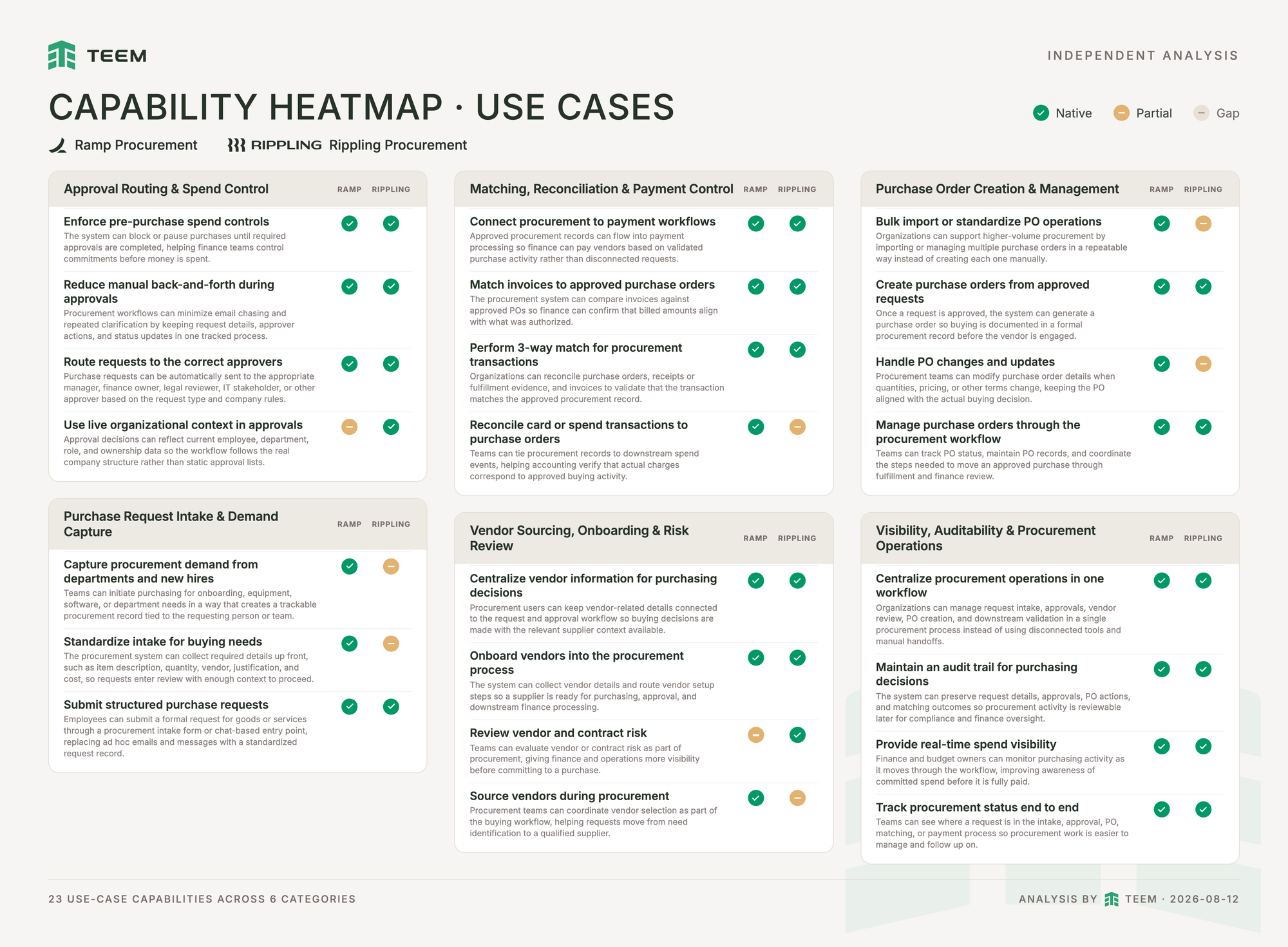
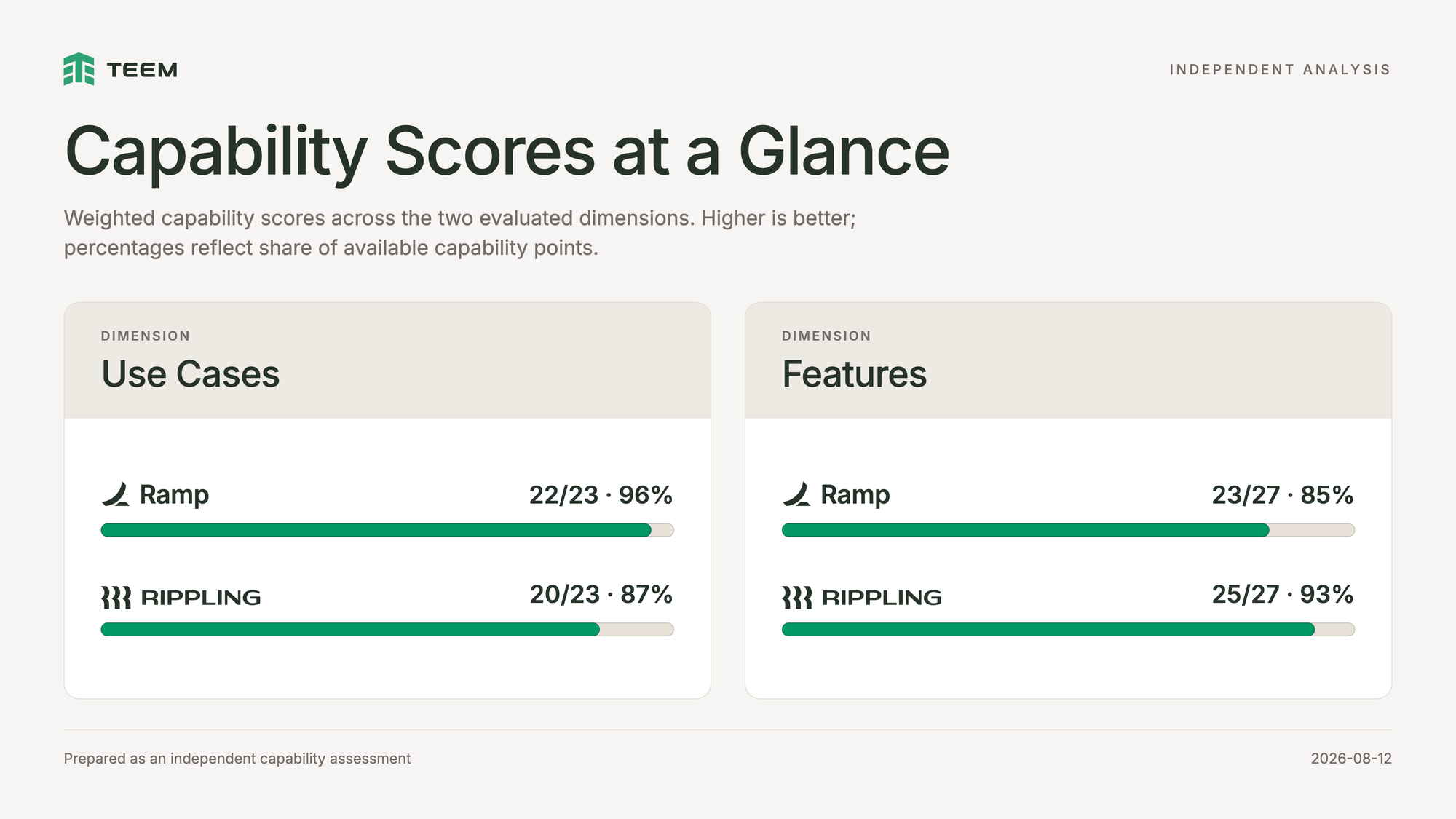
On use cases, Ramp leads 22 to 20 against Rippling's 23. The pattern under that number is the more useful part: Ramp's advantage sits in PO operations and reconciliation, where it covers bulk PO import, PO changes, and card-to-PO matching that Rippling does not clearly confirm, while Rippling's one edge is using live organizational context in approvals. Features tell a different story. Here, the report scores 27 requirements spanning AI review agents, approval orchestration, procure-to-pay automation, renewal oversight, and spend governance.
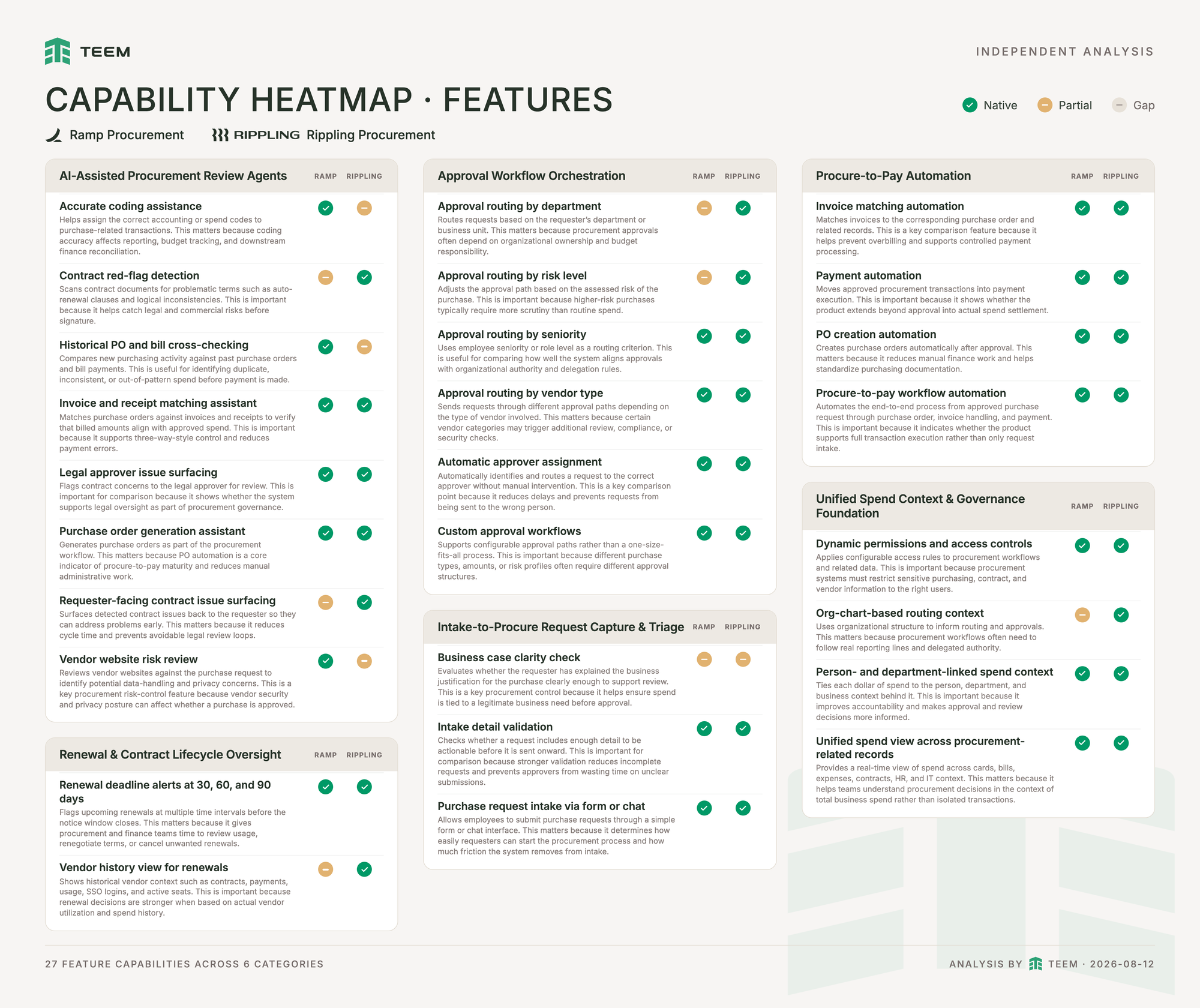
On features, the order flips: Rippling leads at 25 of 27 against Ramp's 23 of 27. Rippling's gains come from approval intelligence and contract oversight, including department, risk-level, and org-chart routing; contract red-flag detection; and requester-facing issue surfacing, while Ramp holds the edge in coding assistance, historical PO and bill cross-checking, and vendor website risk review. Read together, the two boards make one thing clear: these products are not interchangeable. Ramp wins on the execution side, Rippling wins on the intelligence side, and the split is close enough on totals that the right choice depends on which side of the workflow your team actually lives on.
Making the Call
Most buyers do not need to work through all 50 requirements to reach a decision. Two shortcuts usually settle it.
The first is your existing stack. If your company already runs on Rippling for HR and IT, procurement that reads live employee data, department, seniority, and reporting lines, without a separate integration project, is a genuine advantage, and it is the case Rippling makes most convincingly. If your finance team already lives in Ramp for cards and bill pay, extending into procurement keeps reconciliation and PO administration in one place, which is where Ramp is strongest.
The second is the shape of the problem you are actually solving. If the recurring pain is approvals that do not match how your company is structured, or contracts and renewals slipping through unwatched, that is an intelligence problem, and Rippling has the deeper evidence. If the pain is PO volume, change orders, and tying every charge back to an approved purchase, that is an execution problem, and Ramp has the deeper evidence.
Some teams end up running both, a people-platform layer for governance and a finance engine for PO operations, though that means paying for and maintaining two systems that overlap in the middle. For everyone else, the honest question is not which product is better. It is whether your next twelve months of procurement work will be mostly about controlling how decisions are made or mostly about executing and reconciling the purchases that follow.
This comparison is the kind of analysis Teem runs across the procurement software landscape: what each platform does natively, where the gaps sit, and what it takes to close them.
If you are working through a similar decision, you can explore more capability comparisons at teem.finance.