
Oro Labs vs. ZipHQ: Product Comparison Report
OroLabs and Zip both solve procurement fragmentation. One is an AI-driven orchestration layer built to sit on top of your existing ERP. The other is a suite that consolidates intake, AP automation, and vendor payments into a single platform. Teem evaluated both across 16 use cases and 37 features.
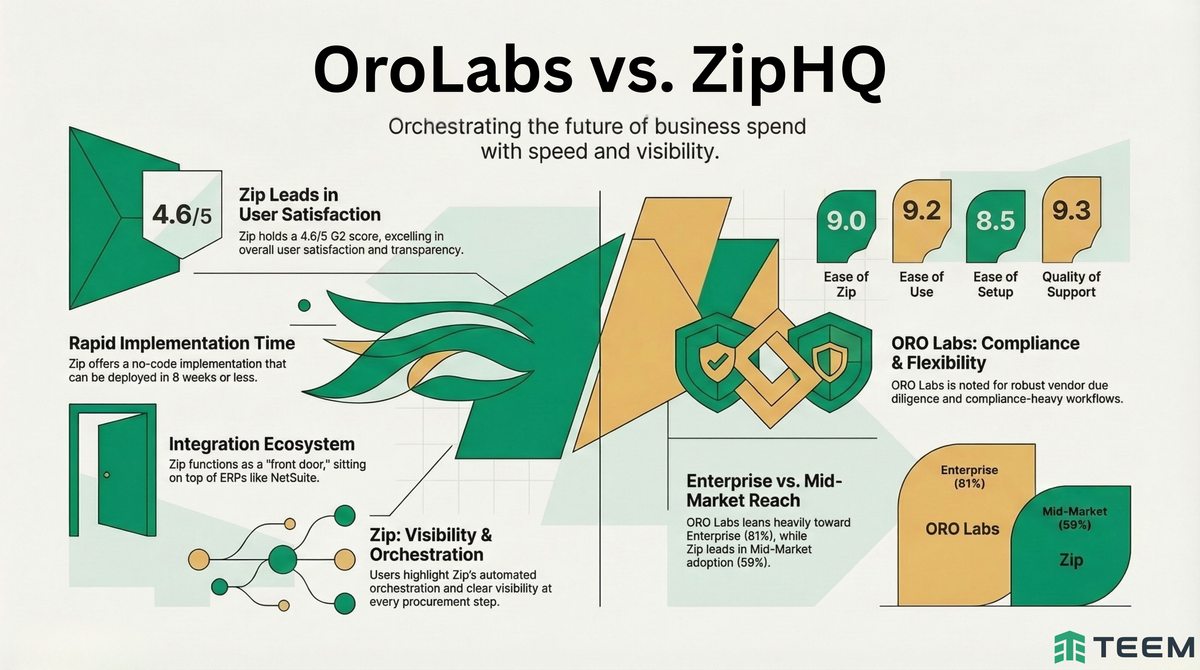
By Teem | March 2026 | Procurement / Intake-to-Pay / Procure-to-Pay
About this analysis: This article is a condensed summary of a full Teem product comparison report, independently produced based on a structured evaluation of 16 use cases and 37 features across Oro Labs & Zip, supplemented by external market research. No vendor has sponsored or reviewed this content.
Why This Comparison Matters
As procurement organizations move beyond simple intake tooling toward end-to-end workflow control, the architectural decision between an orchestration layer and a unified suite carries lasting financial and operational consequences. Oro Labs and Zip Intake-to-Pay both address procurement fragmentation — but from fundamentally different design philosophies. ORO is built to sit on top of your existing financial systems; Zip is built to consolidate and replace the workflow entirely. Understanding that structural difference before committing to either platform is the most consequential decision this evaluation surfaces.
At a Glance: Capability Scores
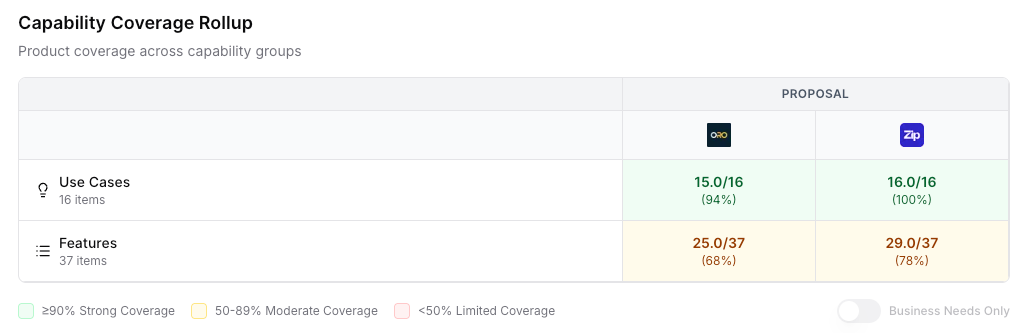
|
Dimension |
OroLabs |
Zip Intake-to-Pay |
|
Use Cases (16 Evaluated) |
15/16 (94%) |
16/16 (100%) |
|
Features (37 Evaluated) |
25/37 (68%) |
29/37 (78%) |
Coverage Tiers: ✅ Strong — ≥90% ⚠️ Moderate — 50–89% ❌ Limited — <50%
Oro Labs earns Strong coverage for use cases but drops to Moderate for features—a pattern consistent with its deliberate scope as an orchestration platform rather than a financial execution suite. Zip Intake-to-Pay achieves Strong use-case coverage and Moderate feature coverage, with gaps concentrated in administrative flexibility rather than functional breadth.
Want to run this comparison for your own shortlist? See below how the Teem's comparison engine works:
Product Comparison Quick Overview-The scores above are generated directly from Teem's structured evaluation engine. Here's what the full report looks like inside the platform.
The Core Structural Difference
Oro Labs is an agnostic procurement orchestration layer — an AI-driven front door designed to sit on top of complex legacy systems like SAP or Oracle, enforcing compliance and routing requests without replacing the financial execution layer beneath. Zip Intake-to-Pay, by contrast, is a unified platform that captures the full lifecycle from initial employee request through to vendor payment, including native AP automation and global payment settlement. This architectural fork shapes every capability gap and strength that follows: when ORO's evaluation shows a gap, it is almost always a deliberate boundary; when Zip shows a gap, it typically reflects depth or configuration constraints rather than a design exclusion.
Use Cases: Who Is Each Product Built For?
Oro Labs
Oro Labs covers 15 of 16 evaluated use cases (94%), earning Strong coverage. Its single gap is Global Payment Execution — a direct consequence of its orchestration-only design, which delegates financial settlement to connected ERP or Procure-to-Pay systems. ORO performs at full strength across intake orchestration, cross-functional approvals, supplier lifecycle management, risk and compliance, and contract renewal workflows. It is purpose-built for enterprises with entrenched financial infrastructure that need a smarter engagement layer without a rip-and-replace commitment. G2 reviewers reflect this positioning: 81.4% of ORO's verified reviews come from Enterprise-segment buyers.
Zip
Zip covers all 16 evaluated use cases (100%), including the full AP and global payment stack that ORO explicitly excludes. Founded in 2020 and backed by $371 million in total funding — including a $190 million Series D at a $2.2 billion valuation — Zip has built a platform that has processed hundreds of billions in customer spend across more than 7 million suppliers. Its customer base spans Snowflake, Databricks, Sephora, OpenAI, T-Mobile, and Prudential. In 2026, Gartner recognized Zip as a Visionary in its Magic Quadrant for Source-to-Pay Suites, specifically citing strengths in orchestration, innovation, and business-user administration.
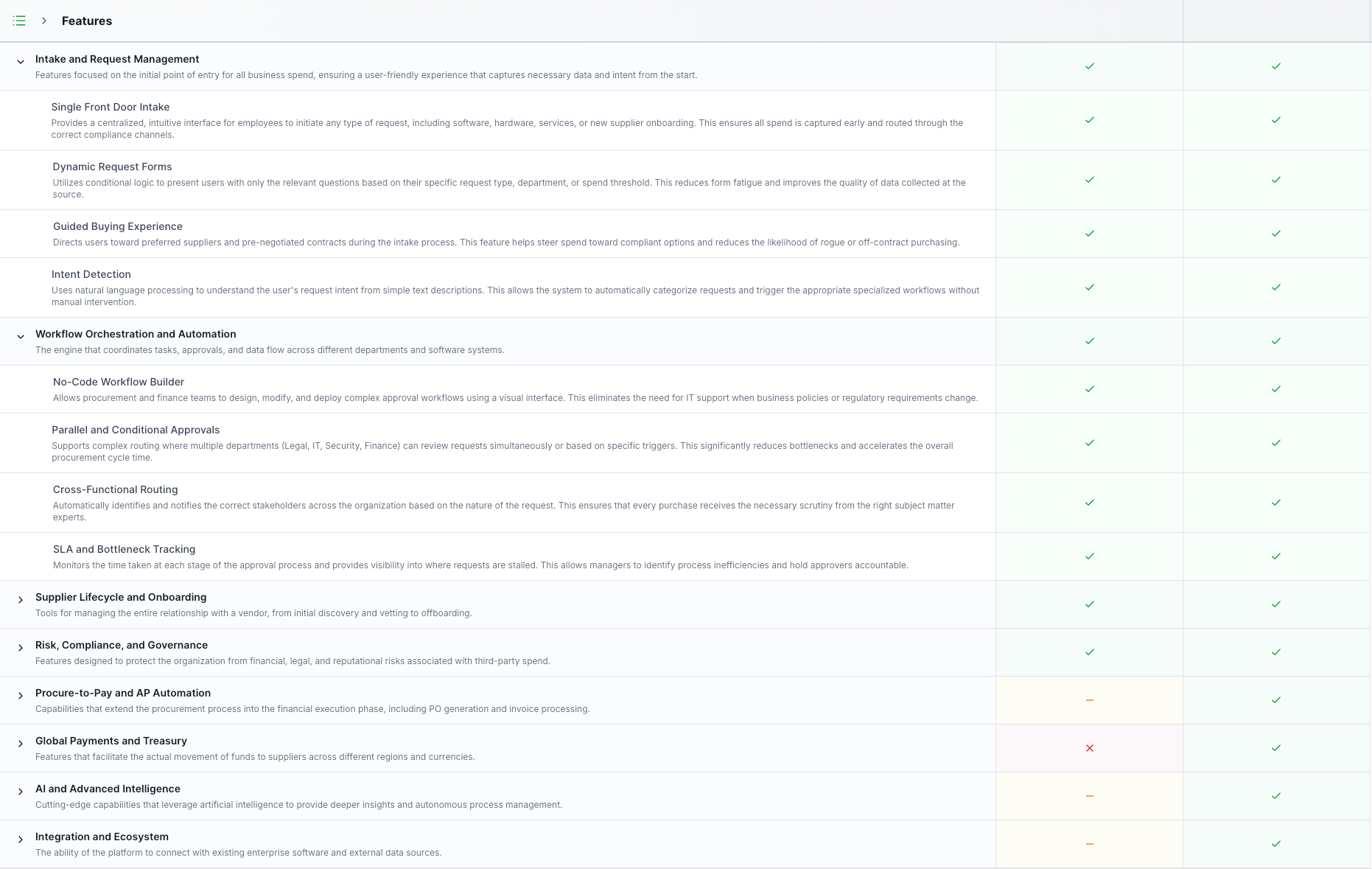
Features Snapshot
|
Feature Category |
OroLabs |
Zip |
|
Intake and Request Management |
✅ | ✅ |
|
Workflow Orchestration and Automation |
✅ | ✅ |
|
Supplier Lifecycle and Onboarding |
✅ | ✅ |
|
Risk, Compliance, and Governance |
✅ | ✅ |
|
Procure-to-Pay and AP Automation |
⚠️ | ✅ |
|
Global Payments and Treasury |
❌ | ✅ |
|
AI and Advanced Intelligence |
⚠️ | ✅ |
|
Integration and Ecosystem |
⚠️ | ✅ |
Legend: ✅ Fully Supported ⚠️ Partially Supported ❌
Platform Strengths
Oro Labs — Where It Leads
ORO's core strength is its flexibility as an enterprise orchestration layer. It is purpose-built to integrate deeply with legacy ERP environments — SAP, Oracle, NetSuite — using bi-directional data synchronization that keeps the ERP as the financial system of record while ORO handles the engagement and compliance layer above it. ORO's Custom AI Agent Builder, which allows organizations to bring their own large language models, gives enterprise IT teams a level of AI customization that off-the-shelf platforms cannot match. Its advanced process mining capability — tracking bottlenecks and cycle times at each approval stage — makes it a strong fit for organizations that need procurement visibility without disrupting their existing financial architecture. G2 reviewers specifically highlight ORO's advantages in vendor due diligence and handling highly regulated compliance environments.
Zip — Where It Leads
Zip's core strength is breadth. It delivers a single platform that eliminates the need for a separate AP system, payment processor, and intake tool, covering the full lifecycle from the first employee request to final cross-border vendor payment. Its native Global Payments module handles multi-currency settlement and local payment rails (SEPA, ACH), capabilities ORO does not offer natively. Zip also provides granular Spend Analytics with line-item savings tracking — a direct input for procurement teams to optimize vendor terms and demonstrate financial impact. With 50+ native integrations and 50 purpose-built AI agents covering tasks from contract scanning to DORA screening, Zip has built significant workflow-level automation.
Feature Coverage Gaps
Oro Labs — Notable Gaps
ORO's gaps are concentrated in financial execution. It does not offer native Three-Way Matching — while ORO's Invoice Intake workflow includes PO matching and GL coding, it stops short of the goods receipt verification layer required by three-way matching, meaning inventory-intensive enterprises must rely on a downstream ERP or AP system to complete that reconciliation. Similarly, Multi-Currency Cross-Border Payments and Local Payment Rail Support are deliberately outside ORO's scope: the platform routes approved data to downstream financial systems rather than executing transactions itself. Organizations running ORO must maintain a separate P2P or ERP layer to handle final payment processing and reconciliation. Additionally, ORO's API availability is assessed as partial: based on available documentation, access does not appear to include a publicly self-serve developer portal, with integration pathways oriented toward enterprise implementation teams and partner platforms — a consideration for organizations planning custom internal integrations. Spend Analytics is also flagged as partial — ORO surfaces process analytics and bottleneck data, but stops short of the line-item financial insights available in native AP platforms.
Zip — Notable Gaps
Zip does not present major functional gaps within the evaluated criteria, though patterns from user reviews surface recurring operational friction. G2 reviewers consistently flag limited administrative autonomy — configuration changes often require vendor support rather than being accessible to internal admins. Reporting dashboards are cited as inflexible relative to the breadth of data the platform captures. Zip also lacks robust, native Contract Lifecycle Management (CLM) capabilities, requiring integration with dedicated CLM tools such as Ironclad to achieve full contract workflow coverage. ERP integration implementations have been noted as a source of delays and data silos for some customers — a notable consideration given that seamless ERP sync is a core value proposition of intake-to-pay platforms.
Comparison Insights
Insight 1: Financial Execution Is the Dividing Line The most operationally consequential difference between these platforms is not intake or workflow — both products are functionally strong there — but what happens after an invoice is approved. Zip natively reconciles POs, invoices, and receiving reports through Three-Way Matching and settles payments across borders in local currencies. ORO captures and routes that data but relies entirely on the connected ERP or P2P system to move the money. For organizations evaluating platform consolidation, this gap determines whether ORO can serve as a standalone procurement layer or whether a parallel AP system is required to remain functional.
Insight 2: Enterprise Depth vs. Mid-Market Breadth The two platforms serve distinct buyer profiles. ORO's G2 reviewer base is 81.4% enterprise — consistent with a platform designed for organizations with complex, layered financial infrastructure. Zip's base skews toward mid-market (59.1% of reviewers), reflecting a platform optimized for adoption speed and end-user experience over deep ERP customization. Organizations in heavily regulated industries or with entrenched SAP/Oracle environments will find ORO's compliance and integration depth more directly aligned; growth-stage and mid-market enterprises looking for rapid deployment and a unified spend view will find Zip's breadth more practical.
Insight 3: Zip Carries Significant Market Momentum. Zip's trajectory should be factored into a long-term platform decision. Processing hundreds of billions in customer spend across more than 7 million suppliers, a $2.2 billion valuation, and 3x growth across large enterprises in 2024 signals sustained investment in product depth. Recognition as a Value Leader in Spend Matters' inaugural 2025 SolutionMap for Intake and Orchestration, earning the highest technical scores among nine evaluated vendors and inclusion in the Forbes Fintech 50 adds analyst validation. ORO has raised approximately $60 million across two funding rounds (Series A 2022, Series B 2023 led by Felicis Ventures) and holds Gartner Hype Cycle recognition as a Sample Vendor in Procurement Orchestration and Intake Management (2024, 2025). Its G2 rating of 4.7/5 across 43 reviews and its narrower reviewer base reflect a more selective, enterprise-focused customer-acquisition strategy, not a lack of market validation.
Insight 4: Both Platforms Are Betting on Agentic AI — With Different Architectures. Both ORO and Zip have committed to agentic AI, but through structurally different approaches. Zip has deployed over 50 purpose-built AI agents trained for specific procurement tasks — contract scanning, tariff analysis, and DORA screening — and embedded them directly into approval nodes. ORO's Custom AI Agent Builder takes a more flexible, enterprise-configurable approach: organizations can bring their own large language models and build agents tailored to proprietary business rules or industry-specific compliance requirements. For enterprises with bespoke AI governance requirements, ORO's approach offers more control; for teams that want pre-built intelligence without configuration overhead, Zip's agent library provides faster time-to-value.
AI Capabilities Spotlight
Oro Labs — AI Approach
ORO's AI architecture is built for enterprise configurability. Its Custom AI Agent Builder allows procurement teams to define specialized agents using their own LLMs, enabling compliance-specific logic that reflects internal policies rather than generic procurement heuristics. Paired with Agentic AI Workflows — autonomous agents capable of data validation, document review, and cross-system synchronization without human intervention — ORO positions AI as an extensible layer that adapts to the enterprise rather than the enterprise adapting to the AI. Spend Analytics at the AI intelligence layer is rated partial, reflecting ORO's focus on process intelligence rather than financial outcome tracking.
Zip — AI Approach
Zip has productized AI into discrete, task-specific agents embedded throughout the procurement lifecycle. Its AI Procurement Concierge coaches employees through requests in real time, while specialized agents handle granular compliance checks — DORA screening, contract clause analysis, tariff monitoring — directly within approval workflows. Zip's agentic orchestration framework, which connects these agents to 50+ external systems, enables procurement automation that spans well beyond the platform's own data layer. The trade-off is customization depth: Zip's agents are purpose-built for standard procurement patterns, which may limit adaptability for highly specialized or regulated workflow requirements.
Zip's deployment of packaged AI versus ORO's bring-your-own-LLM model represents a genuine architectural choice, not a capability gap on either side. The right answer depends on whether your procurement team needs speed-to-deployment or configuration depth.
Evaluation Summary
Oro Labs
Oro Labs is a well-constructed procurement orchestration platform with genuine strength in enterprise environments where ERP and financial system complexity makes a rip-and-replace approach impractical. Its coverage of 15 of 16 use cases and its deep bi-directional ERP integration confirm its fit as a system of engagement layered above legacy infrastructure. The single most important limitation to be aware of: ORO does not execute financial transactions natively. Organizations that need native AP automation, Three-Way Matching, or global payment settlement will require a complementary financial system to remain operational.
Zip
Zip Intake-to-Pay is the broader-coverage platform in this evaluation, achieving full use-case coverage and a stronger feature score. Its native AP automation, global payments infrastructure, and purpose-built AI agent library make it a genuine end-to-end option for organizations looking to consolidate procurement and accounts payable into a single platform. The limitations most worth monitoring are administrative configurability — users consistently report needing vendor support for configuration changes — and reporting depth, which lags behind the breadth of data the platform captures.
How to Choose
Choose Zip Intake-to-Pay if your organization requires native global payment execution and multi-currency vendor settlement directly within the procurement platform.
Why It Matters: Zip's built-in Global Payments module processes cross-border payments in local currencies and supports payment rails like SEPA and ACH. ORO orchestrates the approval workflow but relies on your existing ERP or P2P system to move the money, making it a non-starter for teams seeking to consolidate financial settlement into a single tool.
Choose Zip Intake-to-Pay if your AP team needs native Three-Way Matching to reconcile invoices, purchase orders, and receiving reports.
Why It Matters: Zip handles the full reconciliation process natively to prevent overpayment. ORO captures and routes invoice data but delegates the final three-way financial match to the downstream system of record — requiring a separate tool to close the AP loop.
Choose Zip Intake-to-Pay if your procurement team relies on granular Spend Analytics and line-item savings tracking to optimize vendor terms and demonstrate financial impact.
Why It Matters: Zip provides detailed financial insights and savings tracking directly within its dashboards. ORO's analytics focus is on process performance — cycle times, bottleneck identification, approval routing — rather than financial outcome measurement.
Choose OroLabs if your primary goal is deploying an AI-driven intake layer on top of complex existing systems — SAP, Oracle, or NetSuite — without replacing their core financial functions.
Why It Matters: ORO is purpose-built to act as a system of engagement that abstracts the complexity of legacy infrastructure. It excels at routing requests, enforcing compliance policies, and synchronizing data across systems while letting the ERP handle transactional execution — minimizing implementation risk for enterprises that cannot afford a financial system disruption.
Choose OroLabs if your technical team requires highly customized AI agents built to proprietary business rules or industry-specific regulatory requirements.
Why It Matters: ORO's Custom AI Agent Builder allows organizations to bring their own large language models and configure agents to internal specifications. Zip's AI agents are purpose-built for standard procurement patterns — powerful out of the box, but less adaptable to bespoke compliance logic.
Evaluate both platforms equally if your primary requirement is No-Code Workflow Customization and cross-functional approval orchestration.
Why It Matters: Both ORO and Zip deliver strong, user-configurable workflow environments. Procurement professionals on either platform can design and modify complex approval chains — including parallel Legal, IT, Finance, and Security reviews — without IT support. This is not a differentiating factor in this evaluation.
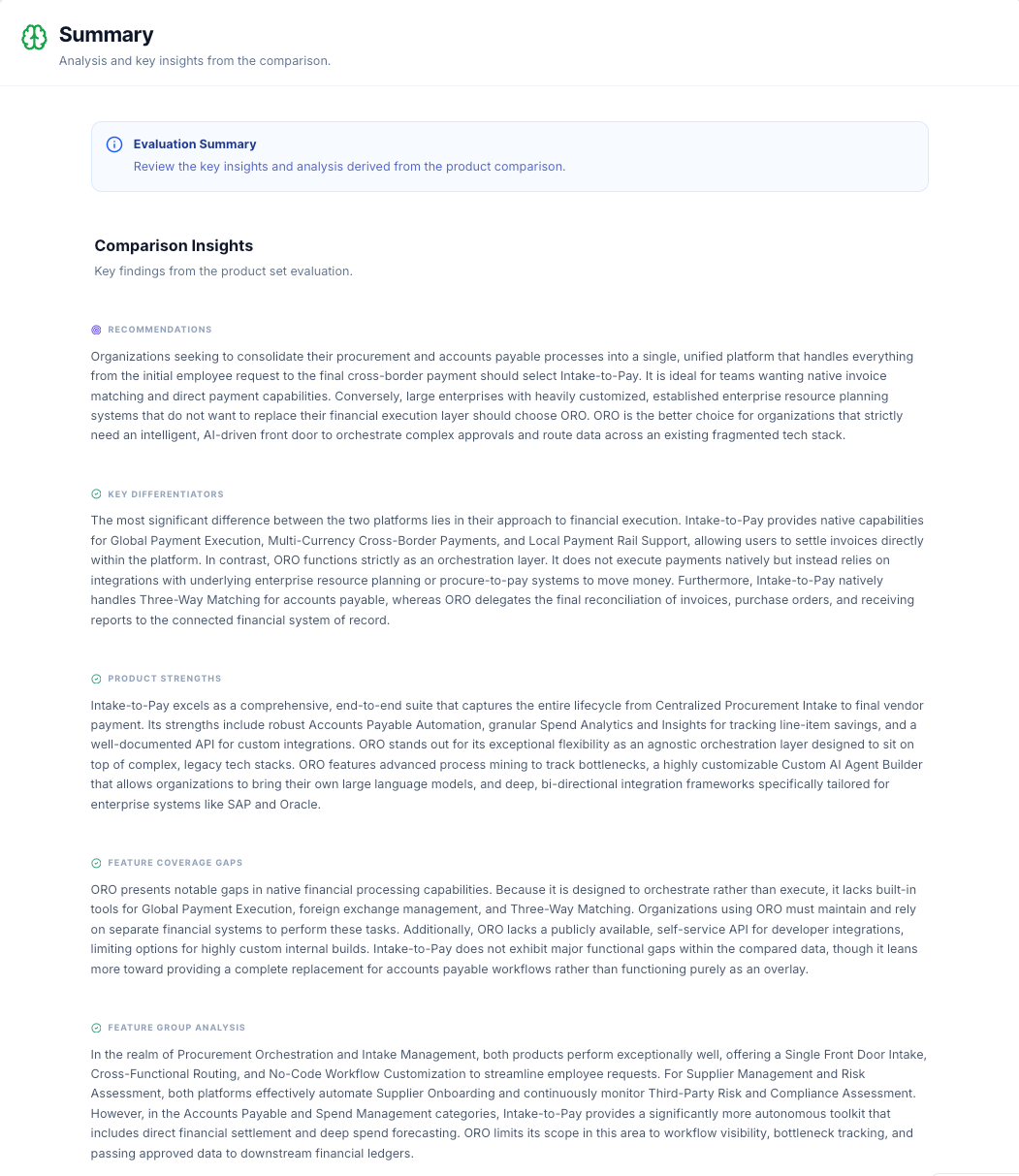
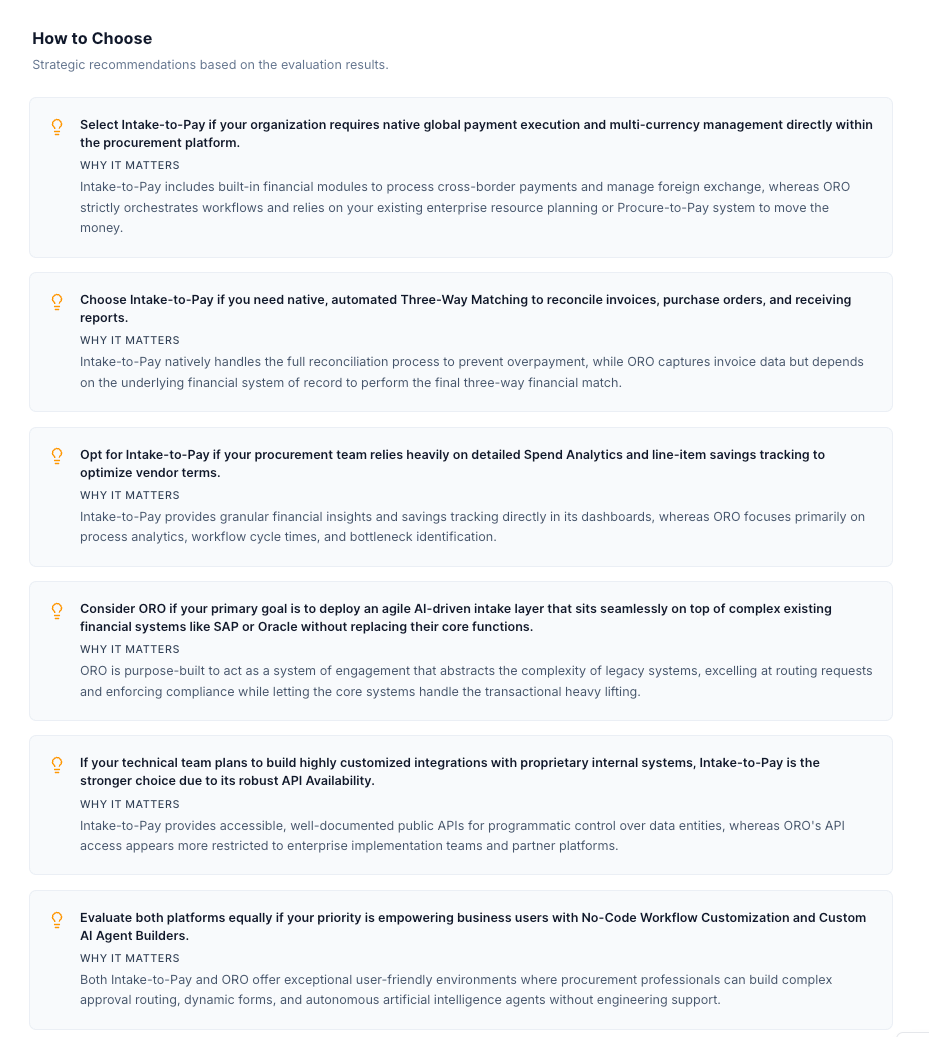
The full report includes structured recommendations tailored to your organizational profile.
The full Teem report includes a complete scoring breakdown across all 16 use cases and 37 features — structured to help you build the internal business case.
Download the Full Comparison Report
This blog covers the key findings. The full Teem report goes deeper:
- ✅ Complete 16-point use case evaluation with individual scores per product
- ✅ Full 37-point feature checklist with ✅ / ⚠️ / ❌ per product
- ✅ Methodology and external research sources
- ✅ Printable PDF — ready for internal stakeholder reviews
Enter your email to get instant access. No spam. Unsubscribe anytime.
Want to see the Teem's Product comparison engine live with your own shortlist?
Book a demo, and we will walk you through it→ Demo
This comparison was produced independently by Teem. Neither OroLabs nor ZipHQ has sponsored, reviewed, or influenced this report.