Ironclad vs. Evisort: Product Comparison Report
Ironclad and Evisort both solve CLM — but they are built differently. This independent Teem analysis evaluates both platforms across 18 use cases and 35 features, maps their structural differences, and gives stakeholders a clear framework for making the right architectural decision.
By Teem | March 2026 | Legal Operations / Contract Management / CLM
About this analysis: This article is a condensed summary of a full Teem product comparison report, independently produced based on a structured evaluation of 18 use cases and 35 features across Ironclad CLM and Evisort, supplemented by external market research. No vendor has sponsored or reviewed this content.
Why This Comparison Matters
Contract lifecycle management has become a strategic priority across legal, procurement, and finance functions. As organizations face mounting pressure to compress contract cycle times, extract post-signature intelligence from existing repositories, and reduce vendor sprawl, the CLM platform they select has real operational and financial consequences.
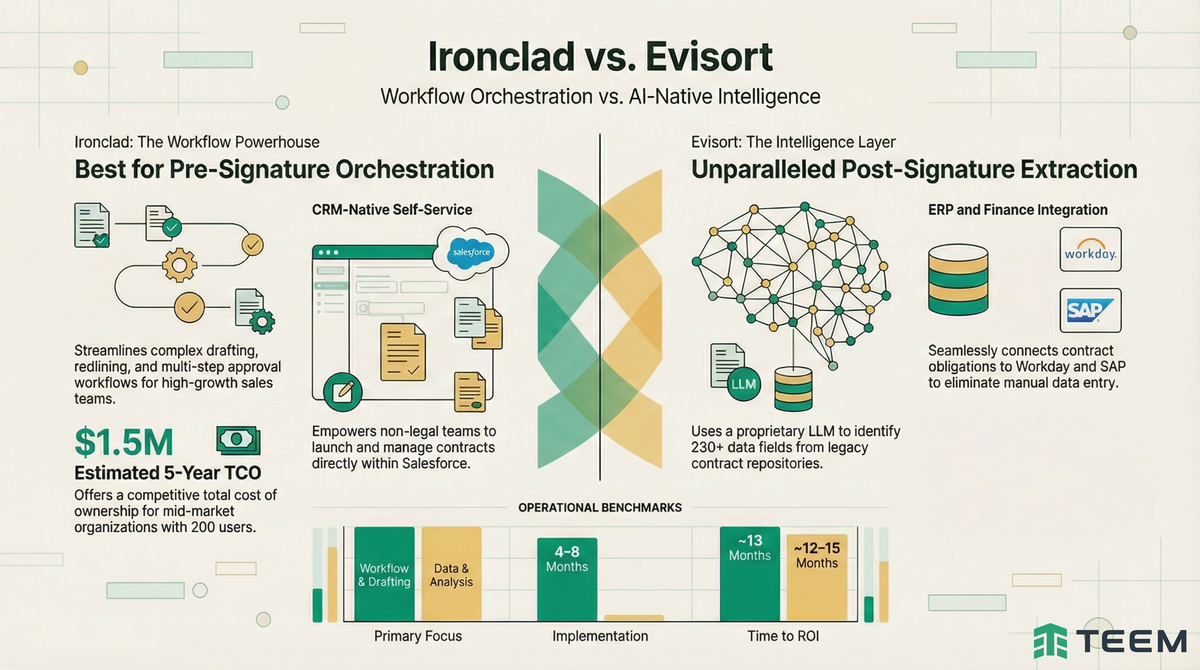
Ironclad and Evisort both provide full-lifecycle contract lifecycle management solutions. Historically, Ironclad emphasized configurable pre-signature workflow orchestration, while Evisort differentiated itself as an AI-native contract intelligence platform focused on post-signature analysis. Today, both vendors offer capabilities across the full contract lifecycle, including workflow automation and AI-driven contract analytics. Understanding that distinction is critical before committing to either.
At a Glance: Capability Scores
|
Dimension |
Ironclad CLM |
Evisort |
|
Use Cases (18 Evaluated) |
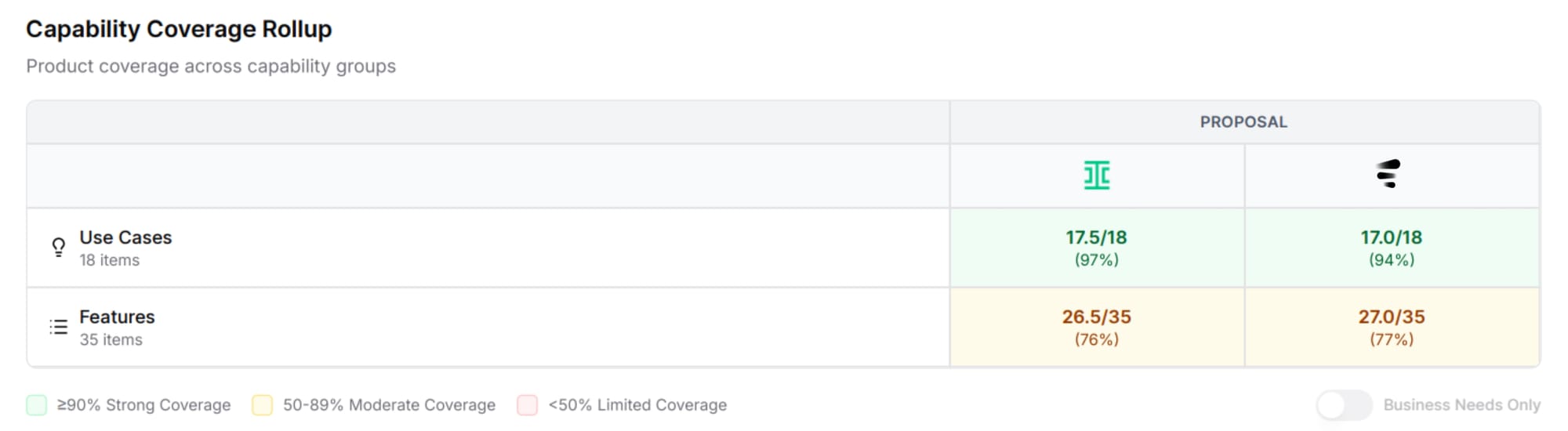
17.5/18 (97%) |
17.0/18 (94%) |
|
Features (35 Evaluated) |
26.5/35 (76%) |
27.0/35 (77%) |
Coverage Tiers: 🟩 Strong — ≥90% 🟨 Moderate — 50–89% 🟥 Limited — <50%
Both platforms achieve strong use-case coverage, with Ironclad scoring marginally higher at 97% compared to Evisort's 94%. At the feature level, the two platforms are effectively equivalent — 76% versus 77% — signalling that the real differentiation lies not in breadth of coverage, but in where each platform concentrates its depth.
Want to run this comparison for your own shortlist? See below how the Teem's comparison engine works:
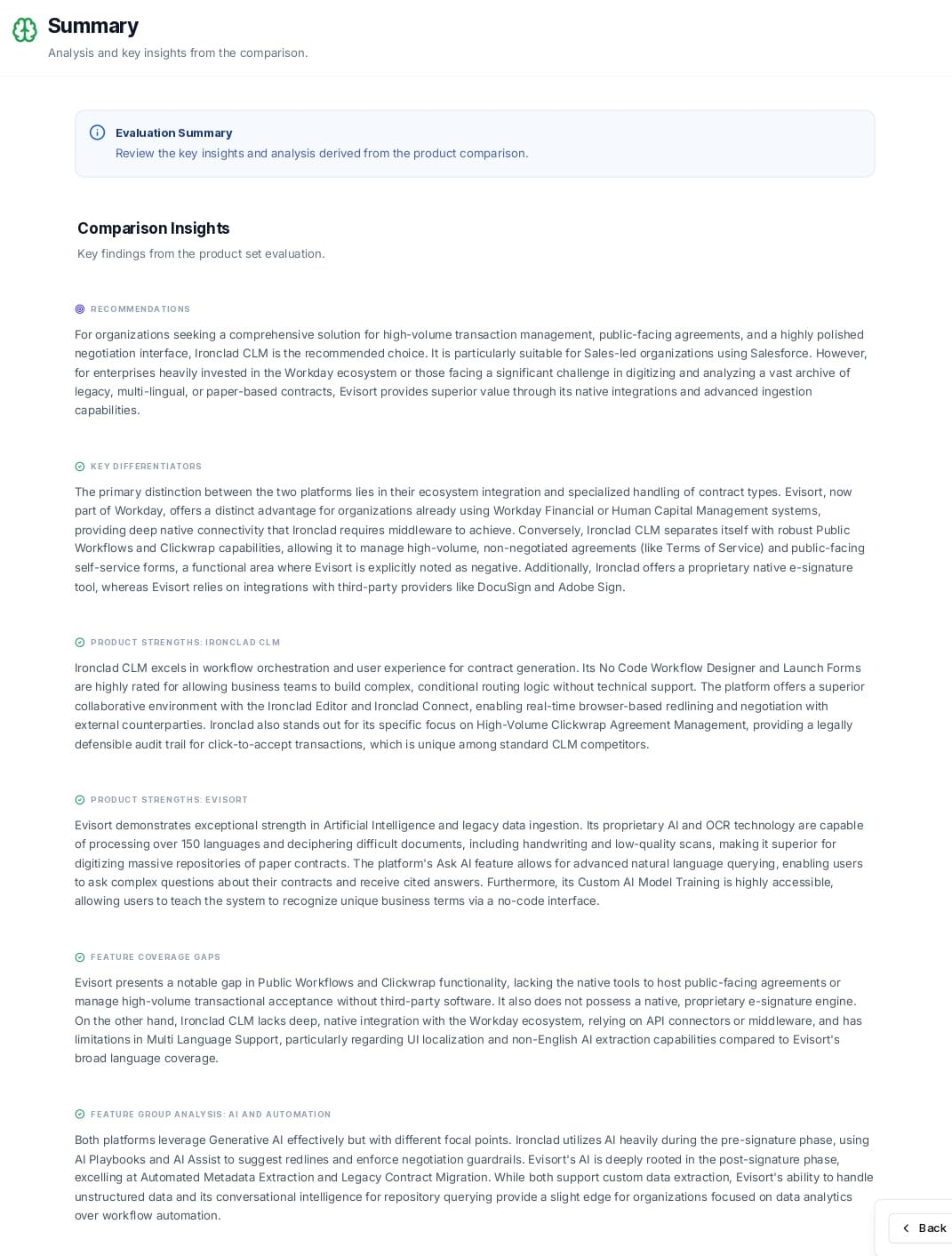
Product Comparison Quick Overview-The scores above are generated directly from Teem's structured evaluation engine. Here's what the full report looks like inside the platform.
The Core Structural Difference
Ironclad CLM, founded in 2014 and backed by over $333 million in venture funding, is built around the pre-signature experience — its architecture prioritizes contract creation, workflow orchestration, and collaborative negotiation. Evisort, founded by Harvard Law and MIT graduates and now part of Workday following its acquisition, takes the inverse approach: its architecture is optimized for what happens after a contract is signed, applying a proprietary AI engine to extract intelligence from existing repositories and surface actionable insights at scale. This structural difference — workflow-first versus intelligence-first — shapes every capability gap and strength that follows.
Use Cases: Who Is Each Platform Built For?
Ironclad CLM
Ironclad achieves 97% use-case coverage (17.5/18) with strong performance across the full contract lifecycle. Its clearest differentiation is in high-volume transaction management: it is the only platform in this evaluation with native support for Public Workflows and Clickwrap, enabling organizations to deploy and track click-to-accept agreements for online Terms of Service, privacy policies, and standard NDAs at scale. Its deep Salesforce integration — part of an ecosystem of 30+ pre-built integrations — makes it the natural fit for Sales-led contracting environments. The platform surpassed $200 million in ARR in February 2026, with over 2,000 customers, including OpenAI, Salesforce, and L'Oréal.
Evisort
Evisort achieves 94% use-case coverage (17.0/18), with a single notable gap in High-Volume Clickwrap Agreement Management: it lacks native infrastructure for unauthenticated, public-facing signing events. Where Evisort leads is in the intelligence layer: its proprietary AI engine processes up to 450,000 contracts per day, or unstructured contracts. Customers include Microsoft, BNY Mellon, McKesson, and NetApp — organizations with complex, data-heavy contract portfolios at enterprise scale.
Features Snapshot
|
Feature Parent Category |
Ironclad CLM |
Evisort |
|
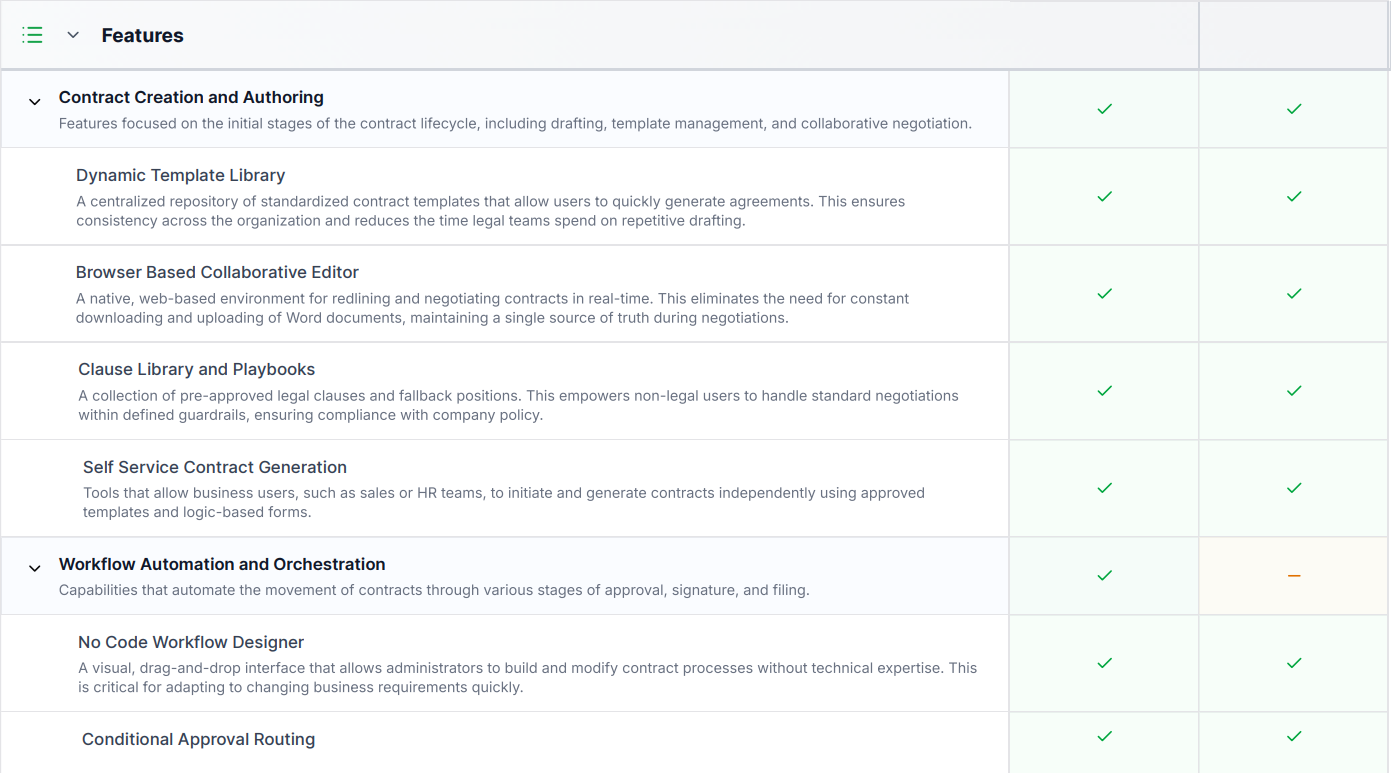
Contract Creation & Authoring |
✅ |
✅ |
|
Workflow Automation & Orchestration |
✅ |
⚠️ |
|
AI & Contract Intelligence |
✅ |
✅ |
|
Repository & Search |
✅ |
✅ |
|
Post-Signature Management & Analytics |
✅ |
✅ |
|
Integration & Ecosystem |
⚠️ |
✅ |
|
Security & Administration |
⚠️ |
✅ |
Legend: ✅ Fully Supported ⚠️ Partially Supported ❌
Platform Strengths
Ironclad CLM — Where It Leads
Ironclad's market-leading strength is its no-code Workflow Designer — a visual, drag-and-drop interface that allows legal operations teams to build complex, conditional approval routing without IT support, and which earned Ironclad recognition as a Leader in the Forrester Wave™ for CLM Platforms, Q1 2025 with the top score in the Current Offering category, and as a Leader in the 2025 Gartner Magic Quadrant for CLM for the third consecutive year. The platform's collaborative contracting environment — combining the Ironclad Editor with its "Jurist" AI Playbooks for real-time redline suggestions — enables browser-based negotiation with external counterparties without the version-control overhead of email-based Word document exchanges. Ironclad further differentiates with a proprietary native e-signature tool (Ironclad Signature), allowing organizations to consolidate contract execution costs without a third-party provider.
Evisort — Where It Leads
Evisort's core advantage is the intelligence depth of its proprietary contract LLM — the first of its kind in the CLM category(Per Evisort) — capable of extracting over 230 pre-built data points and applying predictive risk scoring across a contract portfolio. Its AI and OCR technology supports processing and extraction across more than 150 languages(Per Evisort), including handwriting and low-quality scans, making it superior for multinational organizations with historically unstructured repositories. As a Workday-native solution, it routes contract data directly into Workday Financial and HCM workflows without middleware. Evisort holds a 4.7/5 on G2 and 4.8/5 on Capterra — among the highest user satisfaction ratings in the CLM category (note: the Capterra rating is based on a limited review sample).
Feature Coverage Gaps
Ironclad CLM — Notable Gaps
Ironclad's most significant limitation is its lack of native Workday ecosystem integration — organizations embedded in Workday workflows will require API connectors or middleware, adding implementation complexity and ongoing maintenance overhead. Ironclad's AI extraction features — including Smart Import metadata extraction and custom AI properties — are currently limited to English-language contracts. The platform supports multilingual UI for contract requestors across 11 languages and text search across 20+ languages in the repository, but AI-powered extraction and redline suggestions operate in English only. At the feature level, the Security and Administration group scored moderate rather than strong, warranting scrutiny for enterprises with stringent data governance requirements. Additionally, user reviews note that once a workflow is launched, it cannot be edited mid-flight without restarting — a rigidity that can create friction in fast-moving contract cycles. Some users report reduced accuracy in legacy metadata extraction via Ironclad's Smart Import tool, per independent user reviews.
Evisort — Notable Gaps
Evisort's most clearly documented gap is in Public Workflows and Clickwrap functionality — it explicitly lacks native infrastructure for unauthenticated, public-facing click-to-accept agreements, a hard requirement for organizations distributing high-volume non-negotiated agreements at scale. Evisort also lacks a proprietary e-signature engine, relying on third-party providers such as DocuSign and Adobe Sign for contract execution — a cost that compounds at enterprise scale. The Workflow Automation and Orchestration feature group scored moderate, and user reviews indicate that pre-signature workflow creation is considered less intuitive than competing CLMs. Some users also report that the OCR engine can struggle with low-quality PDF scans, a limitation worth validating during a proof of concept if legacy document quality is a concern.
Comparison Insights
Insight 1: The Pre-Signature vs. Post-Signature Divide Is the Real Decision. The most actionable finding from this evaluation is that the two platforms are not competing for the same primary use case. Ironclad is optimized for contracting velocity — the speed of getting agreements drafted, routed, negotiated, and signed. Evisort is optimized for contract intelligence — the ability to extract structured data from a large existing repository and integrate it into financial or HR systems. Evaluators should identify which of these represents their most acute operational pain point before shortlisting, as choosing the wrong architecture creates problems that are difficult to remediate post-implementation.
Insight 2: Analyst Recognition Diverges in a Meaningful Way Ironclad holds a 2025 Gartner Magic Quadrant Leader position (for the third consecutive year) and earned the top score in the Forrester Wave Current Offering category for Q1 2025 — reflecting strength in product completeness and market execution. Workday, powered by Evisort AI, is recognized as a Gartner Visionary in the 2025 CLM Magic Quadrant — a positioning that reflects innovation depth alongside acknowledged distance from the Leaders quadrant in execution maturity. However, Evisort's G2 rating of 4.7/5 outpaces Ironclad's 4.5/5, suggesting that end users experience greater day-to-day satisfaction with Evisort's outputs despite Ironclad's stronger analyst profile. Both signals are worth weighing.
Insight 3: Ecosystem Lock-In Is a Genuine Differentiator — Not a Marketing Claim. For Workday-invested enterprises, Evisort's native integration fundamentally changes the implementation calculus — contract data flows directly into existing Workday Financial and HCM workflows without custom development. Ironclad's Workday connectivity requires middleware, adding integration overhead that procurement and IT teams should price into the total cost of ownership. This is not a marginal difference at enterprise scale; it is a multi-year operational cost consideration.
Insight 4: Pricing Reflects Architectural Priorities — Build Your TCO Accordingly. Ironclad's pricing is not publicly disclosed. Third-party buyer data suggests annual costs typically range from approximately $60,000 to $150,000+, with a median buyer paying approximately $38,000–$40,000 per year likely reflects older buyer cohorts. All figures are estimates based on reported buyer transactions. API access pricing is not separately disclosed; buyers should request itemized add-on costs during the sales process. Evisort's pricing is no longer disclosed following its acquisition by Workday and is now governed by Workday's enterprise pricing model. The range of approximately $50,000 to $300,000+ annually is an estimate based on no verified buyer transaction data; treat it as directional only, and weigh it against the additional cost of third-party e-signature licensing that Ironclad includes natively. Total cost of ownership calculations should account for integration middleware, e-signature vendors, and the scope of legacy ingestion before comparing sticker prices.
AI Capabilities: A Thematic Spotlight
Ironclad CLM — AI Approach
Ironclad applies AI primarily at the pre-signature stage. Its "Jurist" AI assistant and AI Playbooks analyze counterparty redlines in real time and suggest edits or alternative clauses based on a company's established legal playbooks and historical negotiation preferences. This makes Ironclad's AI most valuable during active contract negotiation — where speed-to-position and guardrail enforcement are the operational priorities.
Evisort — AI Approach
Evisort's AI is rooted in the post-signature phase, orchestrating multiple models — including its proprietary contract LLM — through its "Document X-Ray" feature to analyze contracts, score risks, and extract customized metadata. The Ask AI conversational interface enables natural language queries across the full contract repository — democratizing access to contract intelligence for non-legal stakeholders. Its Custom AI Model Training is accessible via a no-code "Automation Hub," allowing business users to teach the system to recognize unique business terms without data science resources.
Both platforms support custom data extraction. The meaningful difference is scope: Ironclad's AI enforces negotiation guardrails; Evisort's AI illuminates a contract portfolio. For organizations focused on data analytics and post-signature visibility over workflow automation, Evisort's AI provides a more immediate and broader return.
Evaluation Summary
Ironclad CLM — Evaluation Summary
Ironclad CLM is a workflow-first platform that delivers market-leading capability in pre-signature contract orchestration, collaborative negotiation, and high-volume clickwrap management. Its no-code Workflow Designer, native e-signature engine, and deep Salesforce integration reduce operational overhead for Sales-led organizations. Recognized as a 2025 Gartner Magic Quadrant Leader and Forrester Wave Leader, it carries strong institutional credibility. The primary limitations — English-only AI, the absence of native Workday integration, and mid-flight workflow rigidity — are consequential primarily for multinational or Workday-invested enterprises.
Evisort — Evaluation Summary
Evisort is an intelligence-first CLM platform with exceptional strength in AI-powered legacy contract ingestion, multilingual extraction, and Workday ecosystem integration. Now part of Workday following its acquisition and marketed as Workday Contract Lifecycle Management powered by Evisort AI, it carries institutional backing and deep enterprise integration credibility. It is the structurally superior choice for organizations prioritizing post-signature analytics, retroactive repository digitization, or M&A due diligence. Its explicit gap in Public Workflows and Clickwrap functionality, reliance on third-party e-signature providers, and less mature pre-signature workflow UX make it a less complete solution for organizations where contracting velocity is the primary operational priority.
How to Choose
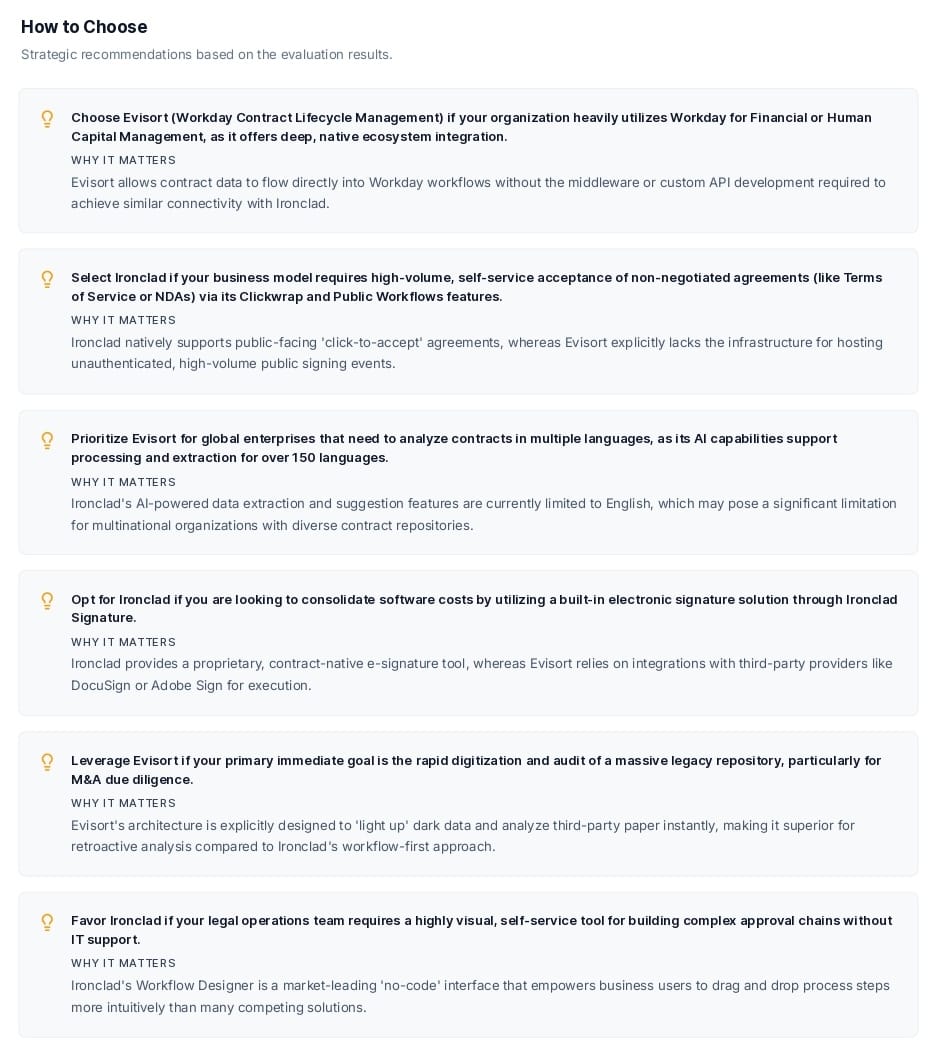
Choose Ironclad CLM if your organization manages high-volume, public-facing, non-negotiated agreements such as online Terms of Service, privacy policies, or standard NDAs.
Why It Matters: Ironclad natively supports unauthenticated, public-facing click-to-accept agreements with a legally defensible audit trail. Evisort explicitly lacks the native infrastructure to host this type of high-volume signing event — organizations that require it would need to build or buy a separate solution.
Choose Evisort if your organization is heavily invested in Workday Financial Management or Human Capital Management.
Why It Matters: Evisort's native Workday integration routes contract data directly into existing financial and HR workflows without middleware or custom API development — a TCO advantage that Ironclad cannot match natively and that compounds in cost and complexity over a multi-year contract term.
Choose Evisort if your primary immediate goal is the rapid digitization and analysis of a large legacy contract repository, particularly in the context of M&A due diligence.
Why It Matters: Evisort's architecture is explicitly designed to process unstructured, paper-based, and multi-lingual contracts at scale — including handwriting and low-quality scans — making it structurally superior for retroactive analysis compared to Ironclad's workflow-first approach.
Choose Ironclad CLM if your legal operations team needs a highly visual, self-service tool for building complex approval chains without IT support.
Why It Matters: Ironclad's no-code Workflow Designer is a market-recognized interface that empowers business users to construct conditional, multi-stakeholder approval processes more intuitively than most competing solutions — a capability that earned it the top score in the Forrester Wave Current Offering evaluation.
Choose Ironclad CLM if you are looking to consolidate software costs by eliminating a separate e-signature vendor.
Why It Matters: Ironclad Signature provides a proprietary, contract-native e-signature tool within the platform. Evisort requires ongoing reliance on third-party providers like DocuSign or Adobe Sign — an additive licensing cost that should be factored into any total cost of ownership comparison, particularly at enterprise volume.
Choose Evisort if your organization operates across multiple geographies and requires AI-powered contract analysis in languages other than English.
Why It Matters: Ironclad's AI extraction and redline features are currently limited to English-language contracts. For multinational organizations requiring AI-powered metadata extraction from non-English contracts, Evisort's AI and OCR capabilities support extraction across 150+ languages (per Workday/Evisort) — making it the stronger option for multilingual legacy repositories. Note: Ironclad does support multilingual requestor UI and repository text search across 20+ languages; the English limitation applies specifically to AI extraction.
The full report includes structured recommendations tailored to your organizational profile.
The full Teem report includes a complete scoring breakdown across all 18 use cases and 35 features — structured to help you build the internal business case.
Download the Full Comparison Report
This blog covers the key findings. The full Teem report goes deeper:
- ✅ Complete 18-point use case evaluation with individual scores per product
- ✅ Full 35-point feature checklist with ✅ / ⚠️ / ❌ per product
- ✅ Methodology and external research sources
- ✅ Printable PDF — ready for internal stakeholder reviews
Enter your email to get instant access. No spam. Unsubscribe anytime.
Want to see the Teem's Product comparison engine live with your own shortlist?
Book a demo, and we will walk you through it→ Demo
This comparison was produced independently by Teem. Neither Ironclad CLM nor Evisort has sponsored, reviewed, or influenced this report.