Teem Launches Performance & SLA Tracking for Supplier Management
Most procurement teams can't say with confidence whether a supplier met its SLA commitments last year. Teem's new Performance & SLA dashboard tracks it automatically, so the data is ready before the renewal conversation starts.
Most enterprise technology contracts include SLA language. Many also include service credit provisions if the supplier fails to meet those commitments.
But those credits often go unclaimed.
The reason is simple: tracking SLA terms against supplier uptime is manual, tedious, and rarely owned by procurement or IT. Teams would need to extract SLA language from contracts, monitor supplier status pages, identify breaches, calculate credit eligibility, and preserve the evidence before renewal or QBR discussions.
Teem now automates that work.
Teem extracts SLA commitments from supplier contracts, monitors public status-page uptime, identifies potential breaches, and reports where service credits may be owed.
For large enterprises, this can uncover hundreds of thousands of dollars in unclaimed credits while creating a clear performance record for renewals, QBRs, and supplier negotiations.
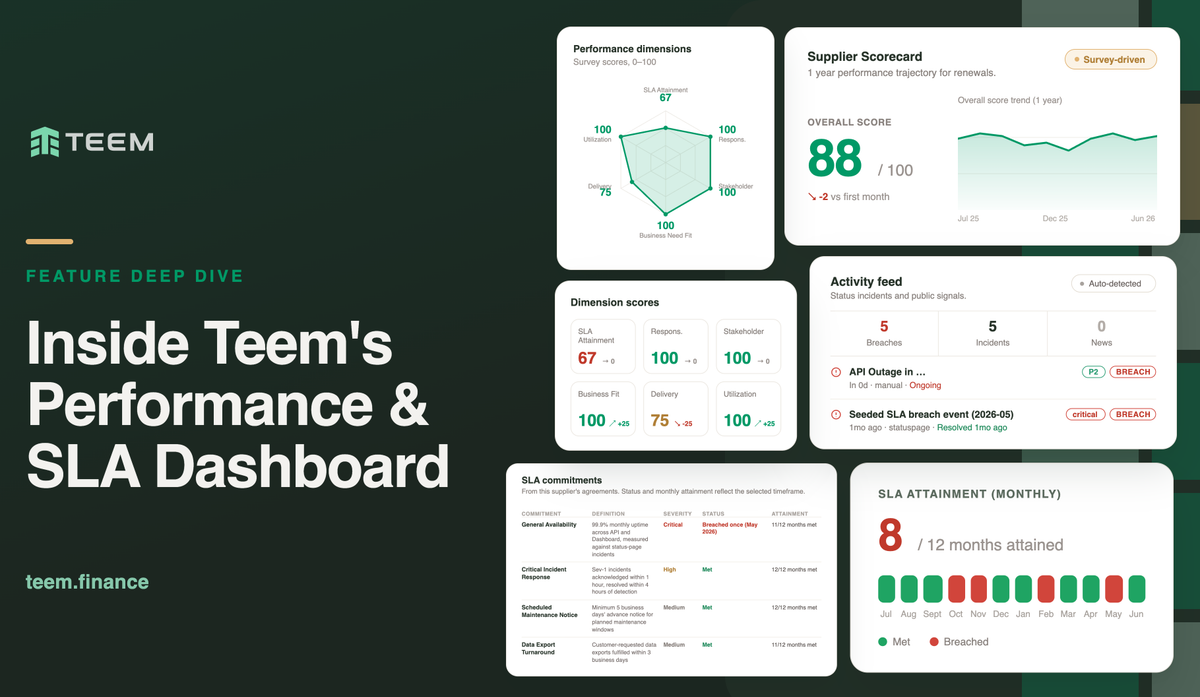
Performance & SLA tracking adds four sections to each supplier profile: a performance scorecard, month-by-month SLA attainment, extracted SLA commitments and service credit terms, and an activity feed of supplier incidents.
Together, these answer three simple questions:
- Is this supplier meeting its commitments?
- Are we owed service credits?
- Do we have the evidence we need before the next renewal or QBR?
What the dashboard does
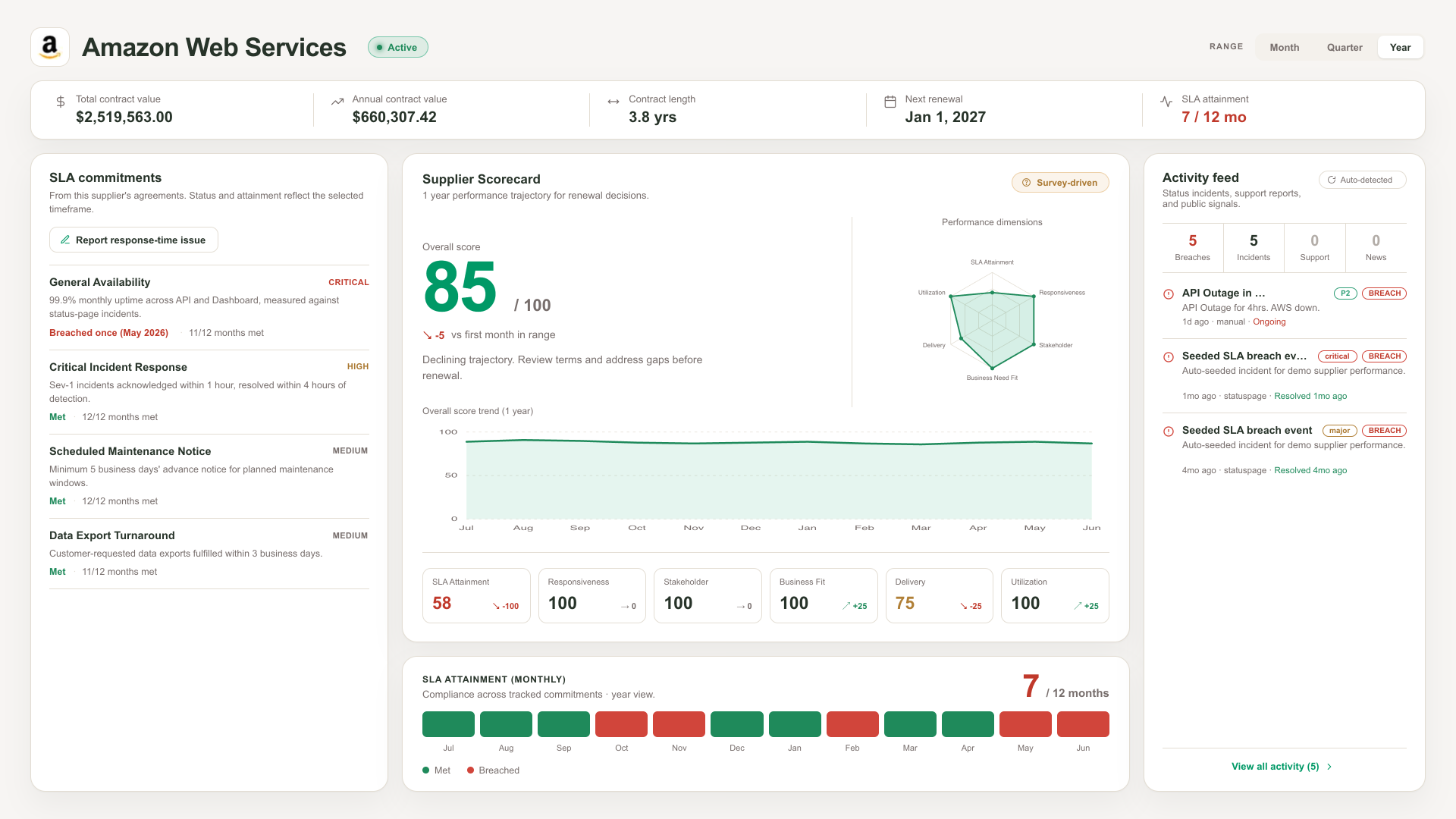
Performance & SLA adds four sections to each supplier's profile: an overall performance scorecard, a month-by-month SLA attainment record, a list of SLA commitments extracted from the contract, and an activity feed of incidents tied to that supplier. Together, they answer the specific question customers kept asking: Is this supplier meeting its commitments, and is there a record to prove it either way?
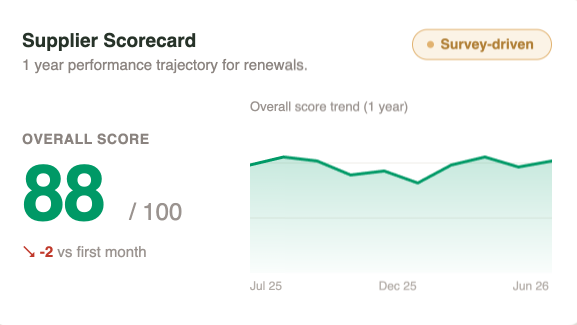
1. The Supplier Scorecard
Most supplier "scorecards" are a single number someone updates during an annual review, based on whatever they remember about the relationship that year. There's no way to see whether the score is driven by reliability, communication, or general goodwill, and no record of how it moved month to month.
Why it's needed: A renewal decision based on "I think they're fine" doesn't hold up when someone asks why. One based on six tracked dimensions and a year of trend data does.
How we solve it: The scorecard splits the overall score (out of 100) into six tracked inputs:
- SLA Attainment
- Responsiveness
- Stakeholder Sentiment
- Business Need Fit
- Delivery Effectiveness
- Utilization
SLA Attainment is calculated from contract terms checked against status-page incidents. The other five come from your own team's survey responses about that supplier, normalized to a 0–100 scale. A trend line shows the score over the past month, quarter, or year, and a breakdown shows which of the six dimensions is pulling the average up or down.
2. SLA Attainment (Monthly)
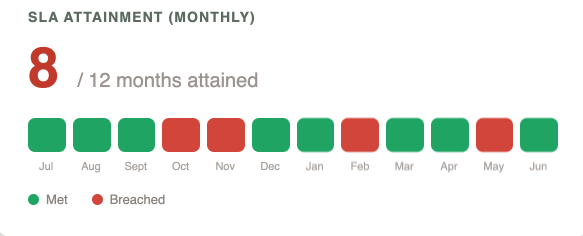
Even when SLA terms exist on paper, almost nobody checks them against actual performance every month. By the time anyone looks, a year has passed, and reconstructing which months had breaches means going through old incident reports one by one.
Why it's needed: If a supplier breached SLA in two non-consecutive months last year, that pattern matters for a renewal conversation, and it's easy to miss if nobody's looking for it specifically.
How we solve it: This section shows a 12-month calendar, with each month marked as attained or breached. A month counts as attained only if no tracked SLA commitment was breached during it — no averaging, no partial credit. The calendar surfaces the pattern without anyone having to go digging.
3. SLA Commitments
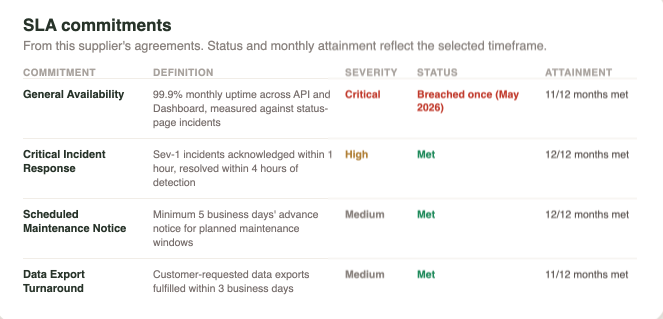
SLA terms are usually buried somewhere in a master subscription agreement or DPA, written in language that doesn't map cleanly to "did they meet it or not." Even procurement teams that read their contracts carefully tend to lose track of the specific obligations once the deal is signed.
Why it's needed: A general "this supplier is reliable" impression isn't the same as knowing they committed to 99.9% uptime and missed it twice. Specific commitments are what actually get enforced or renegotiated.
How we solve it: This section lists the SLA commitments extracted directly from a supplier's uploaded agreements, with the same month-based attainment view applied to each commitment rather than at the overall level. If no agreement has been uploaded yet, the dashboard explicitly states this and prompts for one — an MSA, subscription agreement, or DPA — rather than just showing an empty chart with no explanation.
4. Activity Feed
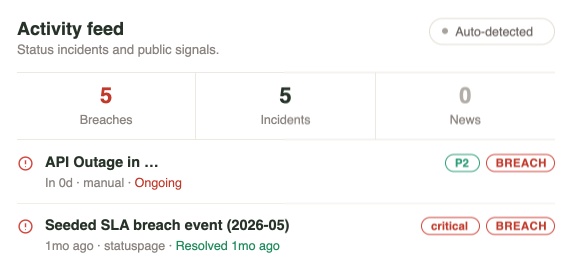
Incidents that affect a supplier's reliability don't neatly appear in one place. Some get posted to a public status page. Some get communicated privately and never go public at all.
Why it's needed: A single bad incident from eight months ago — the kind that gets mentioned once in a meeting and then forgotten — can be the difference between renewing and not. Having it logged, dated, and tied to a specific SLA means it's available when it matters.
How we solve it: The activity feed auto-detects incidents from public status pages and tags each one with severity, affected components, and resolution time, matched to the SLA it breached. For incidents that don't show up on a status page, there's a manual entry option: upload a breach notice or incident email, and the relevant fields auto-fill instead of requiring someone to retype everything by hand.
Summary
Performance & SLA gives procurement and IT teams a permanent record of supplier performance.
It shows the commitments made, whether they were met, where service credits may be owed, and what evidence is available before a renewal, QBR, or negotiation.
This turns SLA tracking from a manual afterthought into a source of savings and leverage.
The supplier profile now shows the supplier's costs, available alternatives, commitments made, whether those commitments are being met, and whether the customer may be entitled to credits when they are not.
Learn more at www.teem.finance