Teem Now Covers Professional Services Categories
Teem now covers Professional Services Procurement Categories. Discover service suppliers, evaluate proposals and vendors, and plan for supplier risk across consulting, legal, staffing, and agencies. The same intelligence you trust for software, now for services.
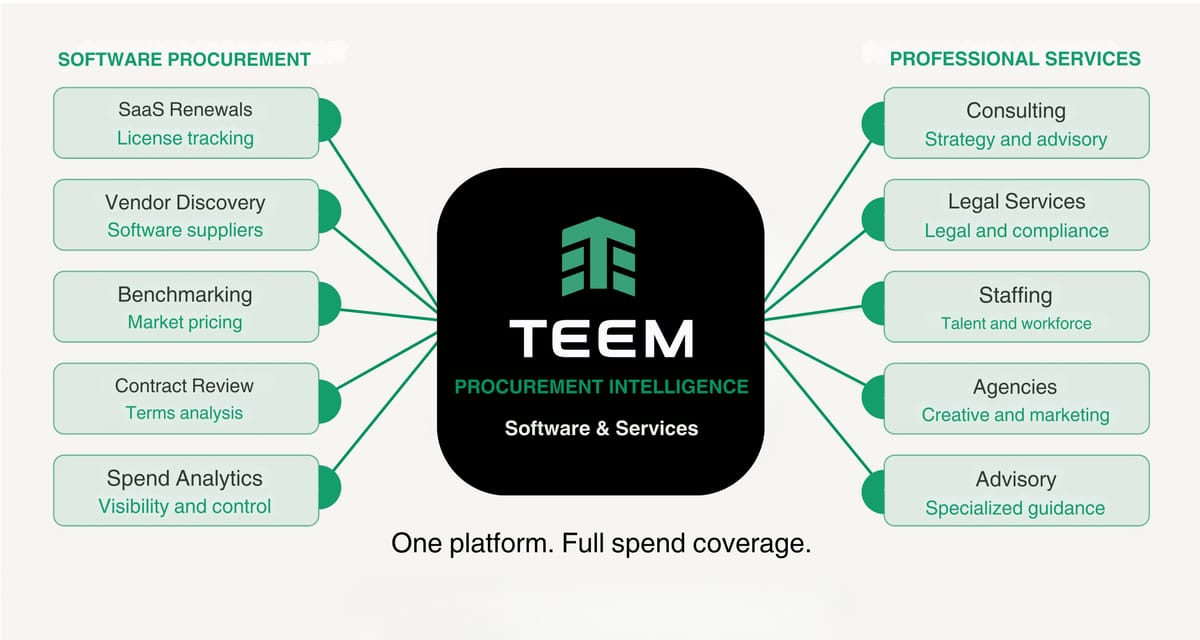
Today we launched Professional Services categories within Teem.
Our Professional Service Intelligence covers the full procurement lifecycle across three stages — Discover, Evaluate, and Plan. Under Discover, Service Supplier Discovery gives procurement teams a structured way to find and shortlist the right vendors. Evaluate brings three capabilities together: Proposal Review, Stakeholder Feedback, and Service Comparison — so every engagement decision is grounded in evidence. And under Plan, Service Supplier Redundancy gives teams visibility into concentration risk before it becomes a problem.
Discover
Finding the right services vendor has always relied on who you already know or who someone in your network recommends. There is no structured way to surface alternatives, assess market options, or build a shortlist with any objectivity. In most organizations, service spending is buried under a broad category label, lumped together with legal, audit, and IT, making it impossible to distinguish what is actually being spent on.
Service Supplier Discovery changes that. You start by describing what you need — in plain language, a rough draft, or a project scope — and the AI refines your requirements and identifies best-fit categories. From there, a market analysis surfaces relevant suppliers, flagging those you already work with, those whose contracts have lapsed, and those new to your network. Once the picture is clear, you move directly into evaluation.
Evaluate
This is where professional services procurement typically falls apart. Proposals arrive in different formats. Stakeholder input is scattered. No consistent framework exists to compare vendors on equal terms, so decisions default to whoever made the strongest impression or held the existing relationship.
- Proposal Review: Brings structure to how incoming submissions are evaluated — analyze specific pricing and contract terms for a selected service provider
- Stakeholder Feedback: Deploy RFI surveys to shortlisted providers, validate capabilities against your requirements, and centralize opinions from across the organization in one place
- Service Comparison: Side-by-side evaluation of shortlisted service providers against your key requirements — so decisions are made on evidence, not familiarity
Plan
Professional services relationships carry real concentration risk. A firm you depend on for critical work can become unavailable, unaffordable, or simply no longer the right fit. Most organizations do not think about this until they have to — and by then, the options are limited, and the pressure is high.
Service Supplier Redundancy gives procurement teams visibility into that risk before it becomes urgent, and supports planning for alternatives while there is still time to act.
What This Means for Your Team
Professional services procurement touches finance, legal, IT, and the business units requesting the work. It has always been a cross-functional challenge. What it has not had, until now, is a cross-functional tool.
Now it does.
The categories, workflow structure, and evaluation framework in this launch reflect years of expertise and direct feedback from procurement professionals in the field. We built it to fit how services procurement actually happens, not an idealized version.
If you manage software procurement on Teem today, this is the same intelligence applied to the other half of your indirect spend. And if you are still managing services procurement through spreadsheets and email, this is where that changes. Either way, if you want to talk through what this means for your team, we would love to chat. Schedule a demo.
Nearly 60% of organizations struggle to forecast professional services spend accurately due to the project-based nature of their work. Between 40% and 60% of that spend happens entirely outside approved procurement channels. And when engagements move forward without structure, 45% exceed their initial budgets by at least 15%. This was not a niche problem. It was widespread, costly, and accepted as normal.
Part of the reason is a longstanding belief that professional services are too intangible and too politically sensitive to be sourced through a structured procurement process. We have heard this from customers and the industry as well. We understood why that belief existed, but we also knew from building the software side of Teem that structure does not have to mean rigidity. The right workflow, built around how procurement teams actually operate, can change the way a category looks.
Working closely with industry experts and drawing on everything we learned maturing the software procurement side of the platform, we kept hearing the same thing from customers: what Teem does for software is exactly what they need for services. Not a watered-down version, but something purpose-built for how professional services procurement actually works. We are proud to bring it to you today.