Zycus vs. GEP: Product Comparison Report
Zycus Source-to-Pay and GEP SMART are both 2026 Gartner Magic Quadrant Leaders for Source-to-Pay — yet they're built around fundamentally different philosophies. Teem evaluated both across 15 use cases and 13 features to help you find the right fit.
Zycus Vs. GEP Product Comparison Report
By Teem | April 2026 | Source-to-Pay | Procurement
About this analysis: This article is a condensed summary of a full Teem product comparison report, independently produced based on a structured evaluation of 15 use cases and 13 features. Market intelligence from Gartner, IDC, and Spend Matters has been incorporated to provide additional context. No vendor has sponsored or reviewed this content.
Why This Comparison Matters
Source-to-pay consolidation is one of the highest-stakes technology decisions a procurement organization can make. Both Zycus Source-to-Pay and GEP SMART compete directly for this mandate — and both are recognized as Leaders in the 2026 Gartner® Magic Quadrant™ for Source-to-Pay Suites (GEP announcement). That shared positioning makes the evaluation harder, not easier: when two platforms clear the same analyst bar, the decision comes down to fit, not pedigree. What separates them is not breadth of capability, which is near-equivalent in this evaluation, but the architectural philosophy each platform is built around. Getting that distinction wrong has real consequences for user adoption, ERP integration complexity, and long-term TCO.
At a Glance: Capability Scores
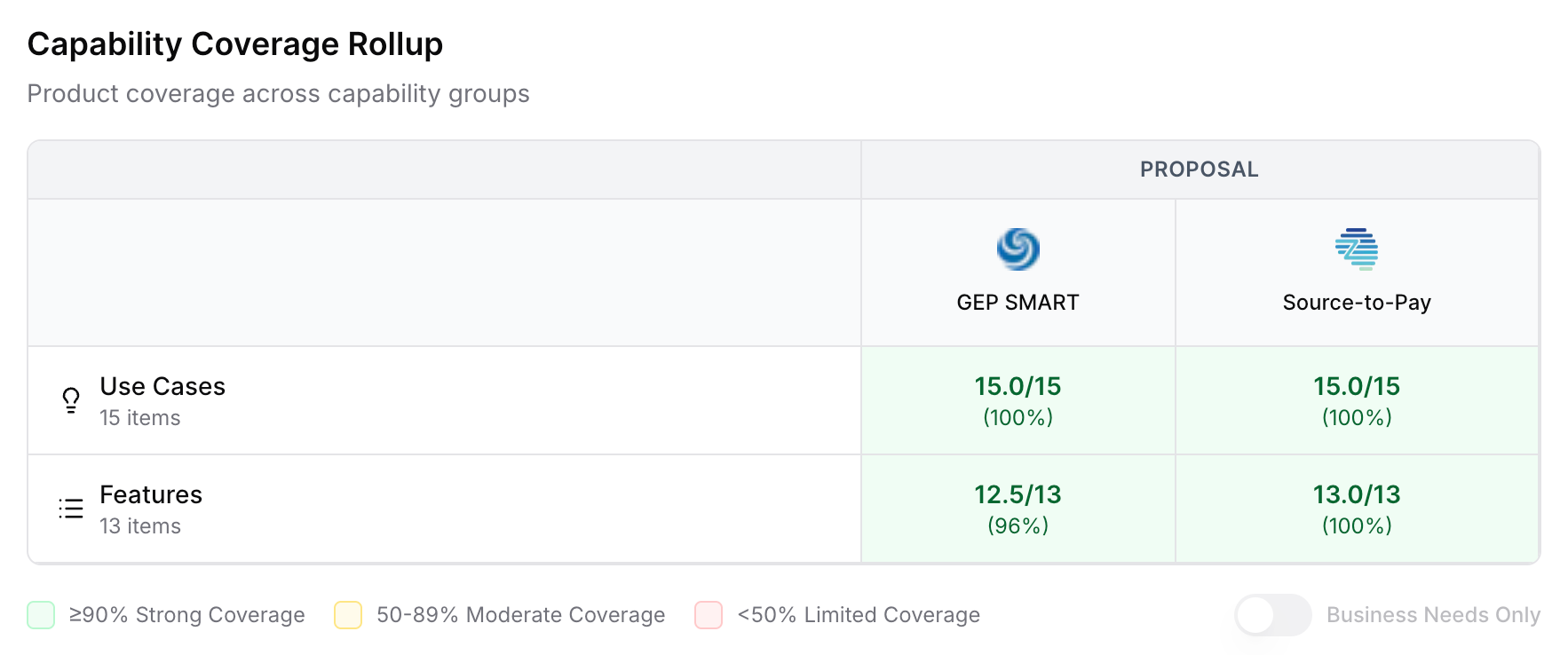
| Dimension | Zycus | GEP |
| Use Cases | 15/15 (100%) | 15/15 (100%) |
| Features | 13/13 (100%) | 12.5/13 (96%) |
Coverage Tiers: ✅ Strong — ≥90% · ⚠️ Moderate — 50–89% · ❌ Limited — <50%
Both platforms achieve full use-case coverage at 100%. The single point of separation occurs at the feature level, where GEP scores 96% due to partial support for Collaboration Tool Integration—the only scored gap in an otherwise highly competitive evaluation.
Want to run this comparison for your own shortlist? See below how the Teem's comparison engine works:
Product Comparison Quick Overview-The scores above are generated directly from Teem's structured evaluation engine. Here's what the full report looks like inside the platform.
The Core Structural Difference
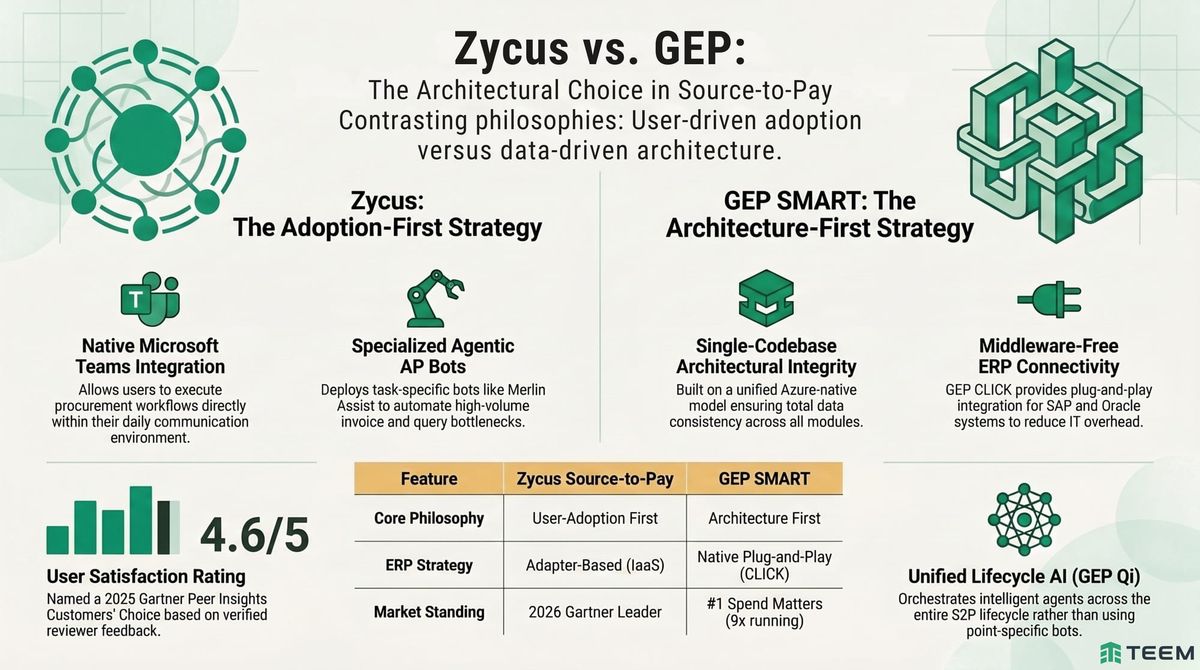
Zycus Source-to-Pay is built around a user-adoption-first philosophy. Its Merlin Assist application acts as a conversational front door to procurement, and the platform integrates natively with Microsoft Teams, allowing users to execute workflows without leaving their daily communication environment. GEP SMART takes the opposite approach — architecture first. Built on a single codebase on Microsoft Azure, it prioritizes data consistency across all modules and middleware-free connectivity to major ERP systems. Which philosophy fits your organization depends almost entirely on where your adoption and integration risks actually sit.
Use Cases: Who Is Each Product Built For?
Zycus Source-to-Pay
Zycus covers all 15 evaluated use cases at 100%, with particular native depth in ERP and Finance System Integration, Contract Compliance and Enforcement, and Savings Tracking. It is well-suited for enterprises that need a conversational intake layer to drive procurement adoption across decentralized business units, or those running complex AP operations that benefit from specialized autonomous bots. Organizations with legacy ERP environments will find Zycus's Integration as a Service model, with purpose-built adapters, directly relevant. Zycus has aligned its product roadmap around what it calls an Intake-to-Outcomes (I2O) framework, which centers on simplifying how work enters procurement and orchestrating execution through agentic AI — a focus that Gartner cited as a key factor in its 2026 Magic Quadrant Leaders placement.
GEP SMART
GEP SMART also covers all 15 use cases at 100%, with Full Native Support across Mobile Procurement Access, AI-Driven Spend Classification, and Savings Tracking. It is the stronger fit for organizations where the priority is a unified, single-vendor data architecture — one where every module shares the same codebase and data model, eliminating the reconciliation overhead that often comes with platforms assembled through acquisition. Enterprises running SAP or Oracle at scale will benefit from GEP CLICK's plug-and-play connectivity. Spend Matters ranked GEP SMART the highest-rated S2P solution suite in its Fall 2025 SolutionMap across 115 vendors — its ninth consecutive top ranking — citing functional depth across sourcing, supplier risk, contract lifecycle management, and intake and orchestration.
Features Snapshot
| Feature Category | Zycus | GEP |
|---|---|---|
| Procure-to-Pay Automation | ✅ | ✅ |
| Strategic Sourcing & eSourcing | ✅ | ✅ |
| Contract Lifecycle Management | ✅ | ✅ |
| Platform Architecture & Integration | ✅ | ⚠️ |
| AI & Cognitive Automation | ✅ | ✅ |
| ESG & Sustainability | ✅ | ✅ |
| Spend Intelligence & Analytics | ✅ | ✅ |
Legend: ✅ Fully Supported ⚠️ Partially Supported ❌
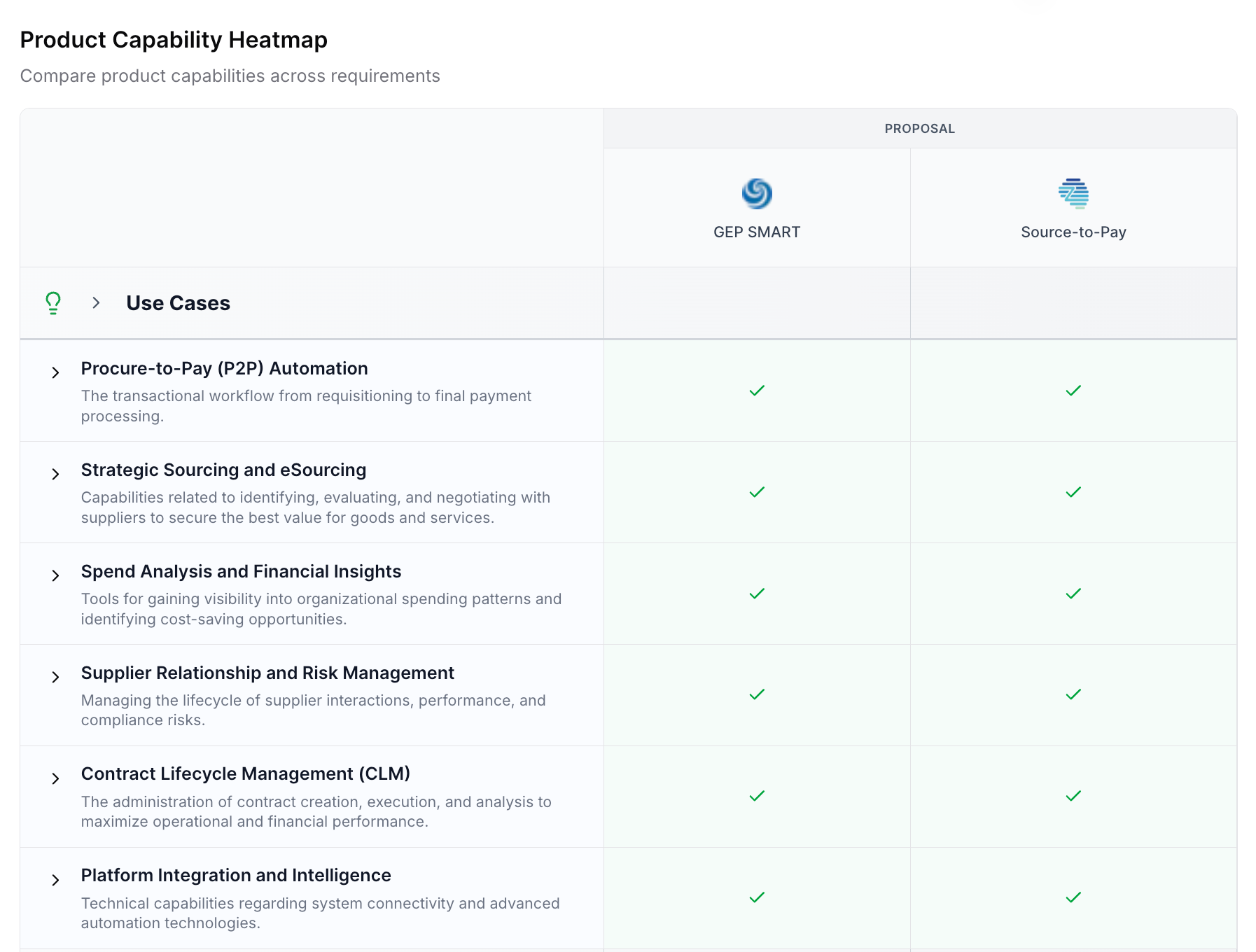
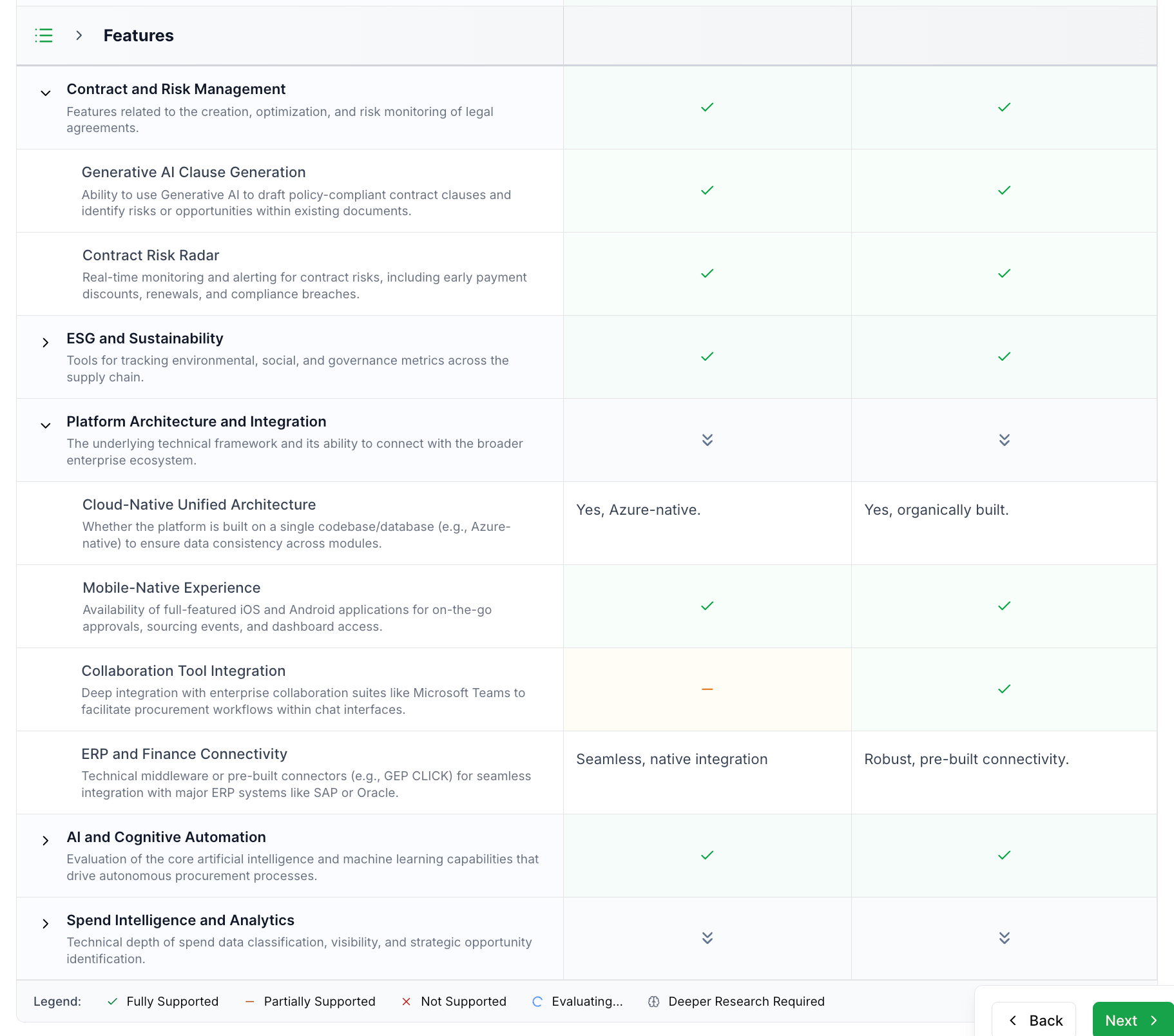
A glimpse of the Product Capability Heatmap checklist from the full report. Each Use case & Feature is evaluated individually for each product.
Platform Strengths
Zycus Source-to-Pay — Where It Leads
Zycus's clearest differentiator is the depth of its conversational procurement experience. Merlin Assist functions as an intelligent intake layer that guides business users through requests in natural language, which materially reduces non-compliant purchasing. The platform's specialized agentic bots — specifically the Invoice Data Extraction Bot and AP Smart Desk Bot — automate high-volume, repetitive AP tasks that typically require significant manual oversight. Its native integration with the Lythouse platform also gives procurement teams a dedicated ESG and carbon compliance layer without requiring a separate system. On user satisfaction, Zycus was named a Customers' Choice in the 2025 Gartner Peer Insights Voice of the Customer for Source-to-Pay Suites, with an overall rating of 4.6/5 based on 67 verified peer reviews — one of only eight vendors to qualify for that report. User reviews highlight flexible module configuration, strong customer success engagement, and measurable improvements in P2P cycle efficiency.
GEP SMART — Where It Leads
GEP SMART's primary advantage is architectural integrity. The platform is built on a single Azure-native codebase, which means every module — sourcing, contracts, invoicing, analytics — operates from the same data model without synchronization gaps. Its GEP CLICK connector provides middleware-free integration with SAP and Oracle, reducing both integration cost and ongoing maintenance overhead. GEP Quantum Intelligence — GEP's agentic AI orchestration layer, also known as GEP Qi, coordinates a network of intelligent agents across the full source-to-pay lifecycle rather than deploying point-specific bots. Spend Matters, which evaluated 115 procurement technology vendors in its Fall 2025 SolutionMap, ranked GEP SMART #1 for the ninth consecutive report across 15 categories, including S2P, sourcing, supplier risk, and intake and orchestration.
Feature Coverage Gaps
Zycus Source-to-Pay — Notable Gaps
No significant feature gaps were identified in this evaluation. Zycus achieves full coverage across all 13 evaluated feature categories, including partial-to-full parity with GEP SMART on ERP and Finance Connectivity through its Integration as a Service model with pre-built legacy adapters. User reviews note that integration setup between modules can require significant configuration effort, and some users flag that customization options can be constrained relative to the platform's cost.
GEP SMART — Notable Gaps
GEP SMART's only scored gap is Collaboration Tool Integration, where it receives a Partial Support rating. The platform provides a robust internal collaboration workspace, but it does not currently support native workflow execution in external chat applications such as Microsoft Teams. For organizations where procurement adoption depends on meeting users where they are in their existing communication tools, this is a practical limitation — approvals and requests must be processed within GEP's proprietary interface rather than within the Teams environment users already use daily. User reviews also flag release instability as a recurring concern, with some organizations noting that new releases periodically require reactive ticket management to resolve issues.
Comparison Insights
Insight 1: The gap between these platforms is narrow — and deliberately placed.
Both platforms score 100% on use-case coverage and differ on only one of 13 features. That gap — Collaboration Tool Integration — is not incidental. It reflects a deliberate product philosophy: GEP SMART has invested in a unified proprietary workspace, while Zycus has invested in meeting users where they already work. For procurement leaders, the question is whether user adoption risk lies within the procurement tool or within the organization's change management capacity.
Insight 2: Both platforms are Gartner Magic Quadrant Leaders — the differentiation is in how they got there.
Both Zycus and GEP SMART are named Leaders in the 2026 Gartner Magic Quadrant for Source-to-Pay Suites (21 January 2026). Gartner's evaluation of GEP SMART emphasized its agentic AI-powered orchestration across the source-to-pay lifecycle via GEP Quantum Intelligence. For Zycus, the recognition aligned with its Intake-to-Outcomes framework and Merlin Agentic AI investment — specifically its focus on intake-led user experiences and autonomous negotiation for tail spend. Shared quadrant placement does not indicate equivalent fit. The architectures and adoption models differ structurally.
Insight 3: Both platforms deploy autonomous negotiation at functional parity.
Zycus and GEP SMART both support AI-driven autonomous supplier negotiations within predefined guardrails, handling multi-round negotiations on tactical spend without buyer involvement. This capability, previously available only in specialized point solutions, is now table-stakes in the enterprise S2P category. Organizations evaluating autonomous negotiation alone will not find meaningful differentiation here.
Insight 4: ERP connectivity takes different forms — both are viable, but the complexity profiles differ.
Zycus offers robust, pre-built connectivity through an Integration-as-a-Service model with specialized legacy adapters. GEP SMART offers seamless, native integration via GEP CLICK with zero middleware. The practical difference: GEP SMART's approach reduces architectural surface area over time, while Zycus's adapter model offers greater flexibility in handling non-standard or heavily customized ERP environments.
Insight 5: ESG and sustainability capabilities are strong on both sides — but Lythouse gives Zycus a dedicated layer.
Both platforms track carbon footprints and monitor supplier ESG performance through third-party rating integration. Zycus goes a step further by integrating natively with Lythouse, a dedicated sustainability platform, giving procurement teams a more specialized tool for Scope 3 emissions analysis and ESG-linked sourcing decisions.
AI and Automation: Thematic Spotlight
Zycus Source-to-Pay — AI Approach
Zycus deploys AI through a combination of a conversational front-end (Merlin Assist) and task-specific autonomous bots. The AP Smart Desk Bot and Invoice Data Extraction Bot are purpose-built for high-volume, repetitive finance operations — reducing manual intervention at specific process bottlenecks rather than automating broadly across the lifecycle. IDC named Zycus a Leader in its 2025 AI-Enabled Source-to-Pay MarketScape, noting that the platform uses GenAI, Agentic AI, and advanced automation to streamline invoice-to-PO, contract, and receipt validation — with AI-driven anomaly detection flagging pricing mismatches, duplicate invoices, and policy violations to improve compliance.
GEP SMART — AI Approach
GEP SMART's AI strategy runs through a centralized engine, GEP Quantum Intelligence (also known as GEP Qi). Rather than deploying point bots, it orchestrates intelligent agents across the entire source-to-pay lifecycle — handling spend classification, contract risk detection, and autonomous negotiation from a single AI layer. GEP Qi is built on an open, LLM-agnostic architecture, allowing organizations to integrate third-party data sources or language models without being locked into GEP's infrastructure. Both approaches use Generative AI for contract clause drafting and ML for spend classification.
The key distinction is architecture: Zycus's AI is modular and task-oriented, making it easier to target specific process gaps. GEP SMART's AI is unified and lifecycle-wide, delivering more consistent intelligence across modules, but it requires the full platform to realize its value.
Evaluation Summary
Zycus Source-to-Pay — Evaluation Summary
Zycus achieves maximum scores across all 15 use cases and all 13 features in this evaluation. Its primary differentiators are the Merlin Assist conversational intake layer, specialized AP automation bots, and native Microsoft Teams integration — capabilities that directly address procurement adoption challenges in large, decentralized organizations. External validation is consistent: Zycus is a 2026 Gartner Magic Quadrant Leader, a 2025 Gartner Peer Insights Customers' Choice (4.6/5, 67 verified reviews), and a Leader in the IDC MarketScape for AI-Enabled S2P 2025. Procurement leaders should note that Zycus's integration depth with legacy ERP environments depends on its adapter model, which adds flexibility but may add complexity compared to middleware-free alternatives.
GEP SMART — Evaluation Summary
GEP SMART scores 100% on use cases and 96% on features, with its single gap limited to external collaboration tool integration. Its Azure-native single-codebase architecture is the platform's core structural advantage, delivering data consistency across all modules and simplified connectivity to major financial systems via GEP CLICK. GEP SMART is a 2026 Gartner Magic Quadrant Leader and has ranked #1 in the Spend Matters SolutionMap for nine consecutive reports — the most recent being Fall 2025. Organizations prioritizing architectural simplicity over user-interface familiarity will find GEP SMART's approach directly aligned with enterprise IT priorities.
How to Choose
Choose Zycus Source-to-Pay if your organization relies heavily on Microsoft Teams to drive procurement adoption across business units.
Why It Matters: Zycus provides native workflow execution within Teams, allowing users to submit requests and complete approvals without leaving their daily communication environment. GEP SMART currently routes these interactions through its internal workspace, which requires a separate context switch.
Choose GEP SMART if your IT strategy prioritizes middleware-free ERP and finance system connectivity.
Why It Matters: GEP CLICK provides plug-and-play integration with SAP and Oracle, eliminating the need for third-party middleware. This reduces integration complexity and ongoing maintenance overhead for organizations running major ERPs at scale.
Choose Zycus Source-to-Pay if your AP operations have specific bottlenecks — invoice processing backlogs, high supplier query volumes — that require targeted automation.
Why It Matters: Zycus deploys specialized task bots, including the AP Smart Desk Bot, that autonomously manage supplier queries and invoice data extraction for targeted finance operations. This is more granular than a lifecycle-wide AI engine for organizations with defined point problems.
Choose either platform if you need a unified solution for both direct and indirect procurement without maintaining separate systems.
Why It Matters: Both platforms natively handle the distinct workflows for direct (raw materials) and indirect (operational goods/services) sourcing. Either eliminates the need for separate point solutions for each procurement category.
Choose either platform if your organization needs autonomous negotiation to capture savings on high-volume tactical spend.
Why It Matters: Both Zycus and GEP SMART include AI agents capable of executing multi-variable supplier negotiations within predefined guardrails — delivering savings on tail spend without direct buyer involvement.
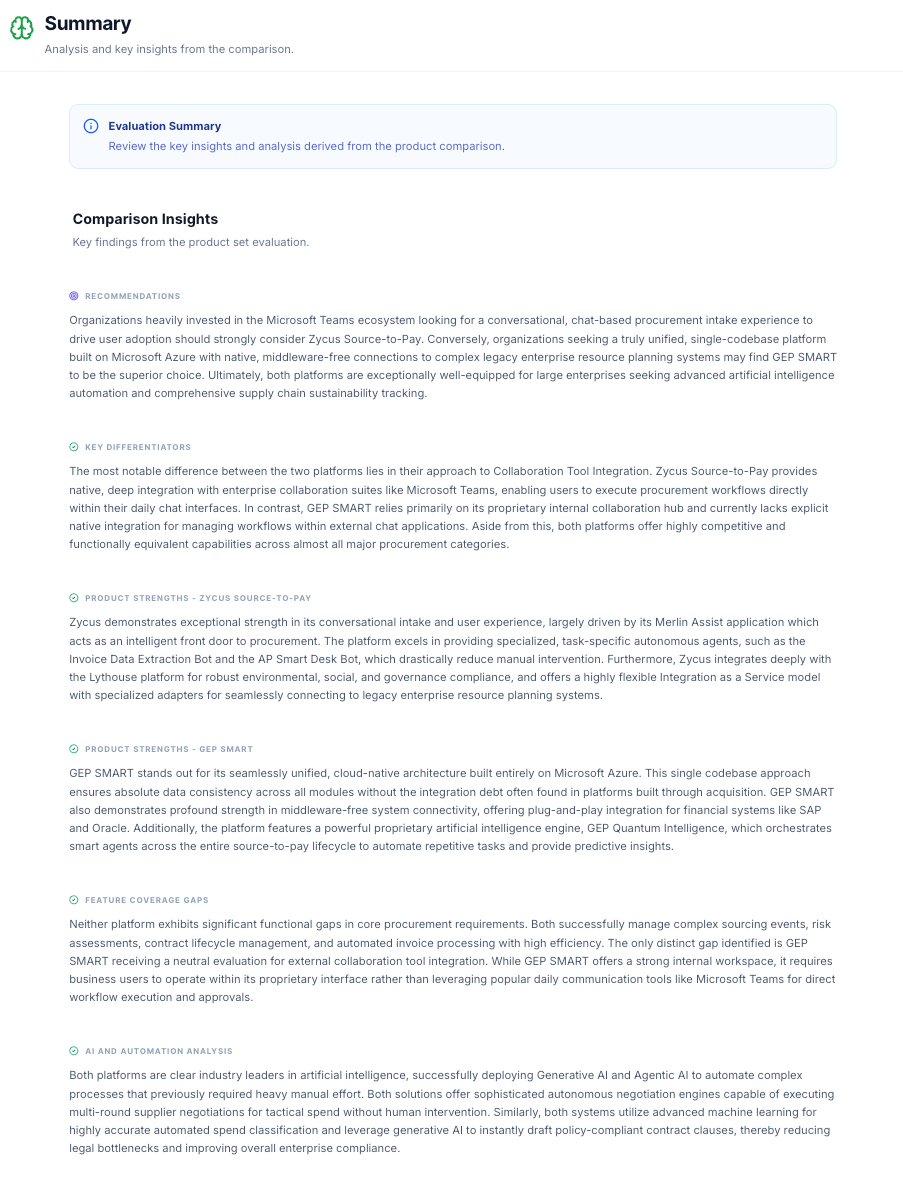
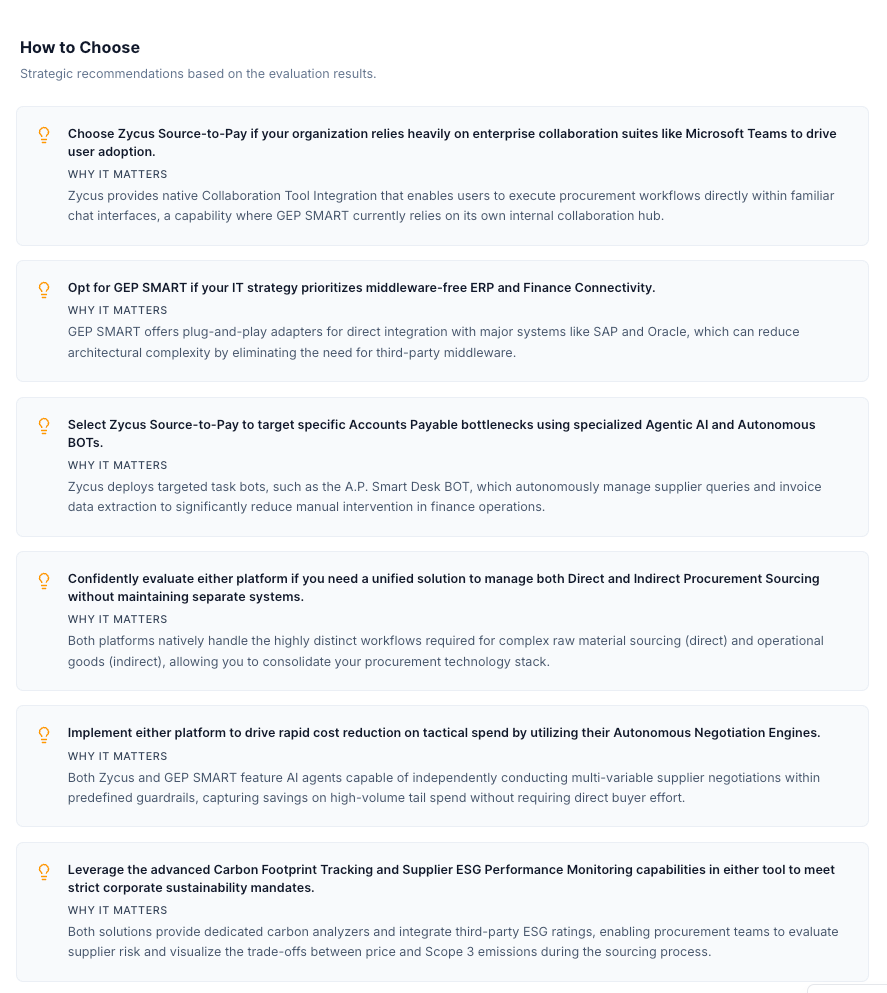
The full report includes structured recommendations tailored to your organizational profile.
Download the Full Comparison Report
This blog covers the key findings. The full Teem report goes deeper:
- ✅ Complete 15-point use case evaluation with individual scores per product
- ✅ Full 13-point feature checklist with ✅ / ⚠️ / ❌ per product
- ✅ Methodology and external research sources
- ✅ Printable PDF — ready for internal stakeholder reviews
Enter your email to get instant access. No spam. Unsubscribe anytime.
Want to see the Teem's Product comparison engine live with your own shortlist?
Book a demo, and we will walk you through it→ Demo
This report is generated by our internal platform using publicly available information, market data, and documented product capabilities. Information presented may change over time as vendors update their offerings.
This comparison was produced independently by Teem. Neither Zycus nor GEP has sponsored, reviewed, or influenced this report.