
ZipHQ vs. Coupa: Product Comparison Report
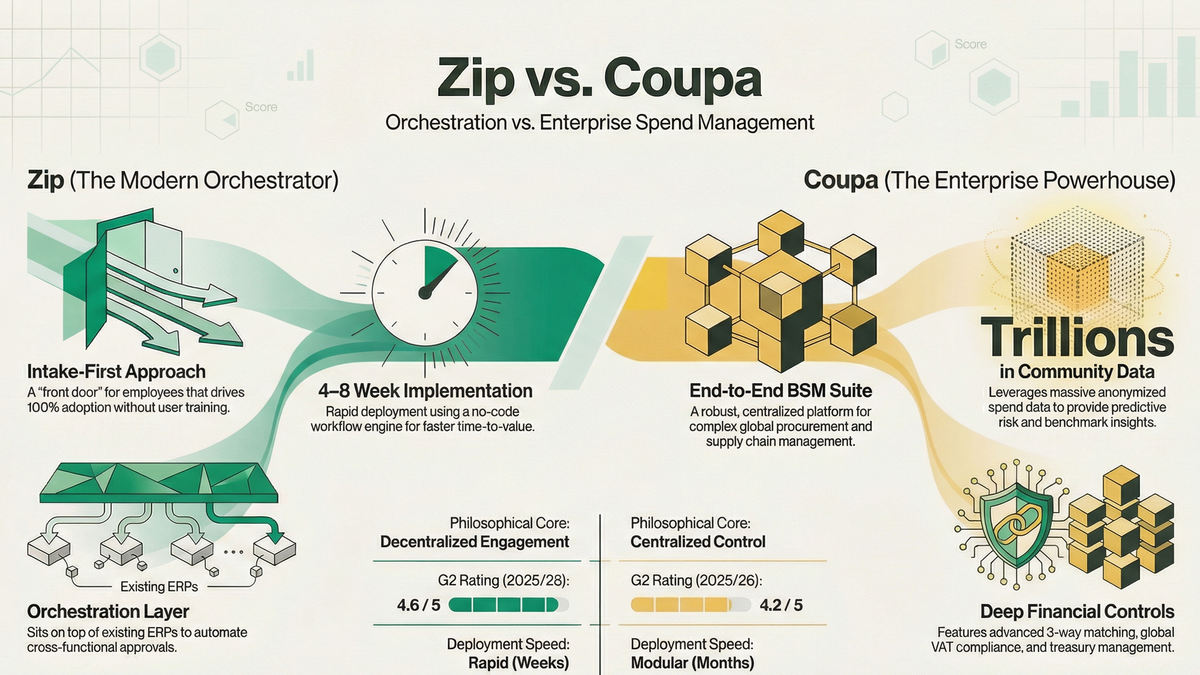
ZipHQ and Coupa both solves procurement — but they are built differently. This independent Teem analysis evaluates both platforms across 18 use cases and 40 features, maps their structural differences, and gives procurement leaders a clear framework for making the right architectural decision.
By Teem | February 2026 | Procurement / Spend Management / Procure To Pay
About this analysis: This article is a condensed summary of a full Teem's product comparison report, independently produced based on a structured evaluation of 18 use cases and 40 features across ZipHQ and the Coupa Business Spend Management suite, supplemented by external market research. No vendor has sponsored or reviewed this content.
Behind the Comparison Comparing Zip and Coupa isn't as straightforward as it sounds. The core challenge was that both vendors present their products very differently — and that difference matters when you're trying to do an apples-to-apples comparison.
Zip has evolved rapidly from a focused intake orchestration tool into a modular, end-to-end procurement platform. Its product lineup now spans Intake-to-Procure, Procure-to-Pay, Sourcing, Supplier Onboarding, Risk Orchestration, and an AI Procurement Concierge. In January 2026, Zip was named a Visionary in the Gartner® Magic Quadrant™ for Source-to-Pay Suites — the first intake-and-orchestration-native platform to be included in that evaluation. While Zip's roots are in orchestration, its current scope now overlaps significantly with traditional S2P suites.
Coupa, on the other hand, is a much broader Business Spend Management (BSM) platform spanning procurement, supply chain, treasury, expenses, contingent workforce, and more. This made it tempting to throw everything Coupa offers into the comparison, which would have been unfair and misleading. The real work was identifying which Coupa products fall within the same functional boundaries as Zip's Intake-to-Pay — and leaving out everything that Zip simply doesn't do. That meant carefully reading product descriptions and mapping capabilities rather than just matching names.
The result is a focused, fair comparison across 10 equivalent Coupa products that genuinely compete with Zip's offerings. The scores and findings that follow reflect that deliberate scoping decision — so you can trust that what you're reading is a like-for-like evaluation, not a distorted one. This comparison was generated using Teem's Product Comparison engine — the same tool you can use to evaluate any software shortlist against your own requirements.
Why This Comparison Matters
As organizations face mounting pressure to consolidate spend management infrastructure and reduce the operational overhead of fragmented procurement processes, the decision between ZipHQ and Coupa carries real architectural and financial implications. Both platforms address the intake-to-pay lifecycle — but from fundamentally different starting points and with increasingly overlapping capabilities. Understanding the remaining differences — and where they are converging — is the most consequential step a procurement, finance, or IT leader can take before committing to either.
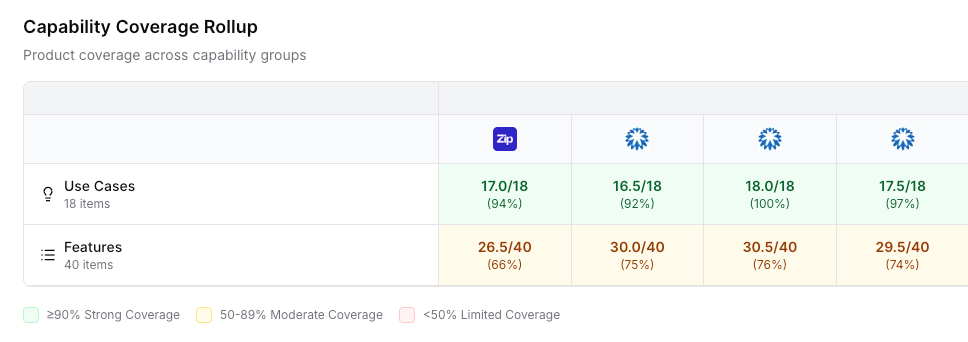
At a Glance: Capability Scores
Coverage Tiers: ✅ Strong — ≥90% ⚠️ Moderate — 50–89% ❌ Limited — <50%
ZipHQ achieves strong use-case coverage of 89%, reflecting its depth in orchestration and intake-centric workflows. The Coupa suite reaches full use-case coverage at 100% and near-complete feature coverage at 95% when evaluated across its combined modules — though that breadth comes with significant deployment complexity that buyers should weigh carefully.
Market Context Beyond the structured evaluation scores, third-party data reflects a consistent pattern. ZipHQ holds a 4.6/5 rating on G2 compared to Coupa's 4.2/5 — a gap that broadly tracks with the user adoption and experience advantages identified in this report.
In practise, the difference is notable: ZipHQ deployments typically complete in 8 weeks or less with a no-code setup, while Coupa enterprise implementations generally take 16–24 weeks and require dedicated implementation partners. For organizations weighing time-to-value alongside functional depth, this gap is material.
In the analyst community, both platforms received recognition in the January 2026 Gartner® Magic Quadrant™ for Source-to-Pay Suites. Coupa was named a Leader for the third consecutive year, positioned highest for Ability to Execute. ZipHQ was named a Visionary — the youngest company ever to appear on the S2P Magic Quadrant and the only procurement orchestration platform included. This dual recognition confirms that both platforms are now evaluated in the same competitive category, even though they approach the problem from different architectural origins.
Want to run this comparison for your own shortlist? See below how the Teem's comparison engine works:
Product Comparison Quick Overview-The scores above are generated directly from Teem's structured evaluation engine. Here's what the full report looks like inside the platform.
The Core Structural Difference
ZipHQ began as a centralized orchestration layer — a "single front door" for all employee spend requests — prioritizing user experience, no-code flexibility, and cross-functional process coordination. It has since expanded into a full intake-to-pay platform with native Procure-to-Pay, Sourcing (including RFx management), AP Automation, and global payments capabilities. Despite this expansion, Zip's architectural DNA remains orchestration-first: its primary strength is connecting people, systems, and workflows across procurement, rather than serving as a deep transactional back-end.
Coupa, by contrast, is a deep, modular Business Spend Management (BSM) platform built around transactional execution: its strength lies in operational depth across procurement, sourcing, invoicing, payments, inventory, and supply chain — anchored by a proprietary community intelligence dataset. In January 2026, Coupa further extended its AI capabilities with the Cirtuo acquisition (AI-driven category management, acquired May 2025), Coupa Navi (a generative AI agent launched September 2024), and the Coupa Card (a virtual card solution embedded in Coupa Pay, announced November 2025).
This structural difference — orchestration-first versus execution-first — still shapes each platform's core strengths, even as their feature sets increasingly overlap. Choosing between them is a question of which architectural philosophy best matches your organization's primary bottleneck: cross-functional coordination and adoption, or deep transactional execution and supply chain control.
Use Cases: Who Is Each Product Built For?
ZipHQ
ZipHQ earns strong coverage (89%, 16/18) across use cases that define the modern service-based procurement journey: Centralized Procurement Intake, Cross-functional Approval Orchestration, Supplier Onboarding, Tail Spend Management, and ERP Integration. Its architecture is purpose-built for organizations where the primary problem is getting spend under management in the first place — routing requests correctly across Legal, IT, Security, and Finance before any commitment is made. The two areas where ZipHQ scores lower are Strategic Sourcing and RFX Management (partial — Zip now supports RFx events and AI-assisted sourcing, but does not offer reverse auction formats) and Inventory-related workflows, which are outside its core design intent.
Coupa (Suite)
The Coupa suite achieves 100% use case coverage across all 18 evaluated scenarios when assessed as a combined platform. This breadth is genuine — Coupa natively handles everything from Reverse Auctions and Inventory Management to Global B2B Payment Execution, Community Benchmarking, and Fraud Detection. The critical caveat is modularity: individual Coupa modules do not cover all use cases in isolation. The Sourcing Module, for instance, cannot perform Purchase Order Automation or Payment Status Tracking without the Procurement or Pay modules. Buyers evaluating Coupa must define their intended module configuration before drawing conclusions about its capabilities.
Features Snapshot
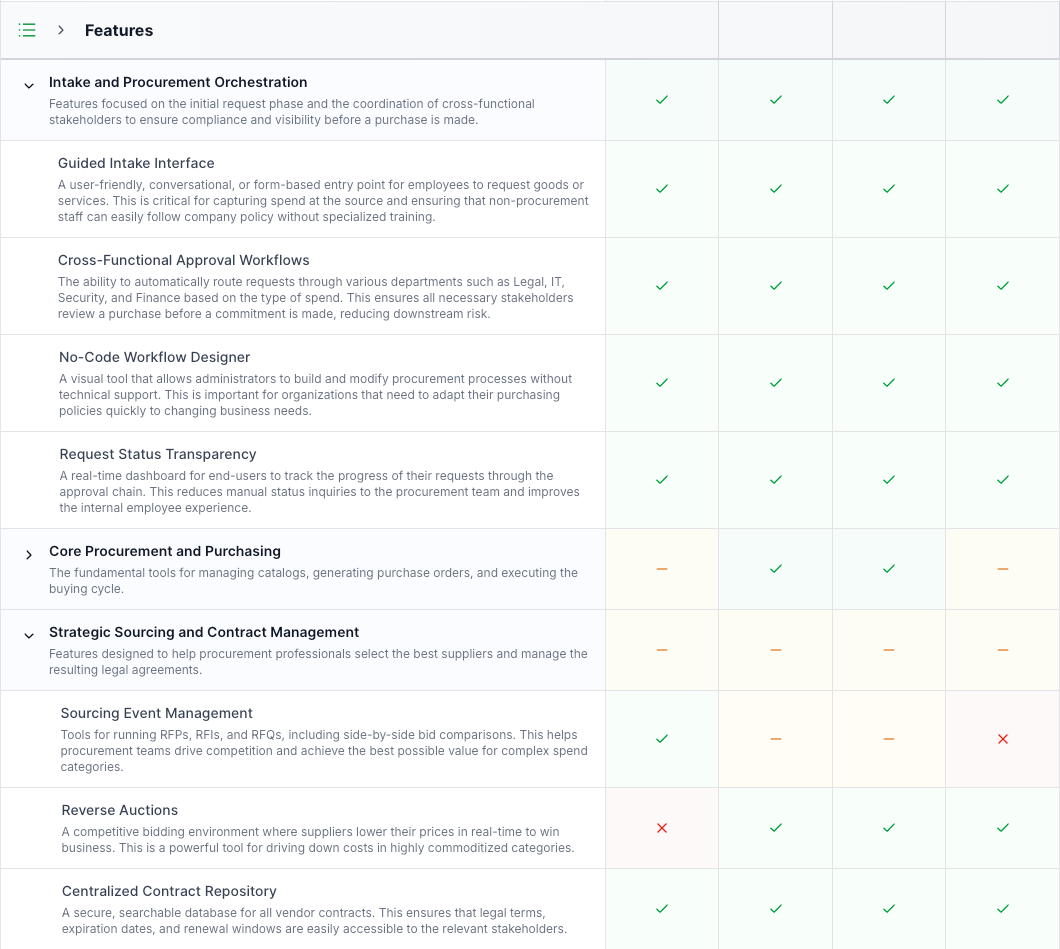
The full 40-point feature breakdown — with individual ✅ / ⚠️ / ❌ indicators per product.
Platform Strengths
ZipHQ — Where It Leads
ZipHQ's primary differentiator is its native architecture around the intake concept, combined with an increasingly capable AI agent framework. Its No-Code Workflow Designer is a standout capability, enabling non-technical administrators to build and modify complex, multi-department approval chains — spanning Legal, IT, Security, and Finance — without IT involvement. The platform's Request Status Transparency feature delivers a consumer-grade, "Amazon-like" request tracker that measurably reduces the volume of status inquiry emails to procurement teams, improving the internal employee experience without requiring a full platform replacement.
In 2025, Zip launched agentic procurement orchestration — a suite of over 50 purpose-built AI agents that autonomously handle tasks across procurement, finance, legal, IT, and security workflows. These include agents for intake validation, price negotiation (with industry benchmark data), contract review, vendor risk screening, and RFx generation. Enterprise customers, including T-Mobile, Dollar Tree, Prudential, and OpenAI, have adopted the platform, and Zip reports cumulative customer savings of over $6 billion as of late 2025, with more recent vendor claims reaching $8 billion.
For organizations that already have a functioning ERP or P2P backend but struggle with adoption, governance, and cross-functional orchestration, ZipHQ can still operate effectively as a flexible wrapper over existing infrastructure — but it can also increasingly serve as a standalone intake-to-pay platform for organizations that do not require inventory management or advanced auction-based sourcing.
Coupa (Suite) — Where It Leads
Coupa's advantage is depth, data, and supply chain integration. The Procure-to-Pay and Procurement modules offer native Inventory and Warehouse Management — a capability absent in ZipHQ — making Coupa essential for product-based businesses that require stock tracking integrated with purchasing workflows.
Coupa's Community Intelligence layer is a distinctive structural asset: it leverages over $8 trillion in cumulative anonymized community spend data (a figure that has grown from $4 trillion in 2022 to $6 trillion in 2024 to $8 trillion in 2025 — reflecting cumulative transaction volume across its customer base) to deliver Community Benchmarking, predictive pricing intelligence, and AI-powered Spend Guard fraud detection calibrated against industry peer behavior.
For strategic sourcing, Coupa supports sophisticated Reverse Auction formats (English, Dutch, and Japanese) that ZipHQ does not offer. Coupa Pay rounds out the suite with a mature Global Payment Processing engine, virtual card issuance (including the new Coupa Card, powered by Brex and accepted across the Mastercard network, announced November 2025), early payment discount automation, and deep treasury integration.
Coupa's AI capabilities have also expanded significantly. Coupa Navi, a generative AI agent launched in September 2024, provides in-product real-time navigation and support. The May 2025 acquisition of Cirtuo added AI-driven category strategy and supplier strategy capabilities to the sourcing suite. Coupa has also announced its first-ever developer conference (DevCon) for 2026 to support its growing agent and app ecosystem.
Feature Coverage Gaps
ZipHQ — Notable Gaps
ZipHQ's most significant gaps are in operational supply chain execution. It does not offer native Inventory and Warehouse Management, and its Strategic Sourcing capabilities — while expanding with RFx support and AI-assisted sourcing — stop short of Reverse Auctions, meaning organizations with commodity spend categories requiring competitive bidding will need a separate sourcing tool or Coupa's sourcing module. On the financial side, ZipHQ relies on integrations rather than native calculation engines for complex global Tax Compliance and Validation scenarios, which can introduce friction for multinational organizations with multi-jurisdiction VAT obligations.
Coupa (Suite) — Notable Gaps
Coupa's gaps are structural rather than functional. Individual modules frequently lack standalone utility: the Sourcing Module cannot execute Purchase Order Automation or Payment Status Tracking without the Procurement or Pay modules being active. This creates meaningful complexity for buyers who want to deploy Coupa incrementally or adopt only a subset of modules. Additionally, while Coupa has introduced a "Guided Experience" layer and Coupa Navi AI in recent releases, its core architecture remains transactionally oriented — ZipHQ's intake-native design delivers a more seamless employee-facing experience out of the box, and its 50+ AI agents offer a broader set of autonomous workflow capabilities at the point of intake. Organizations evaluating Coupa should plan for full or near-full suite deployment to realize the platform's full capability coverage.
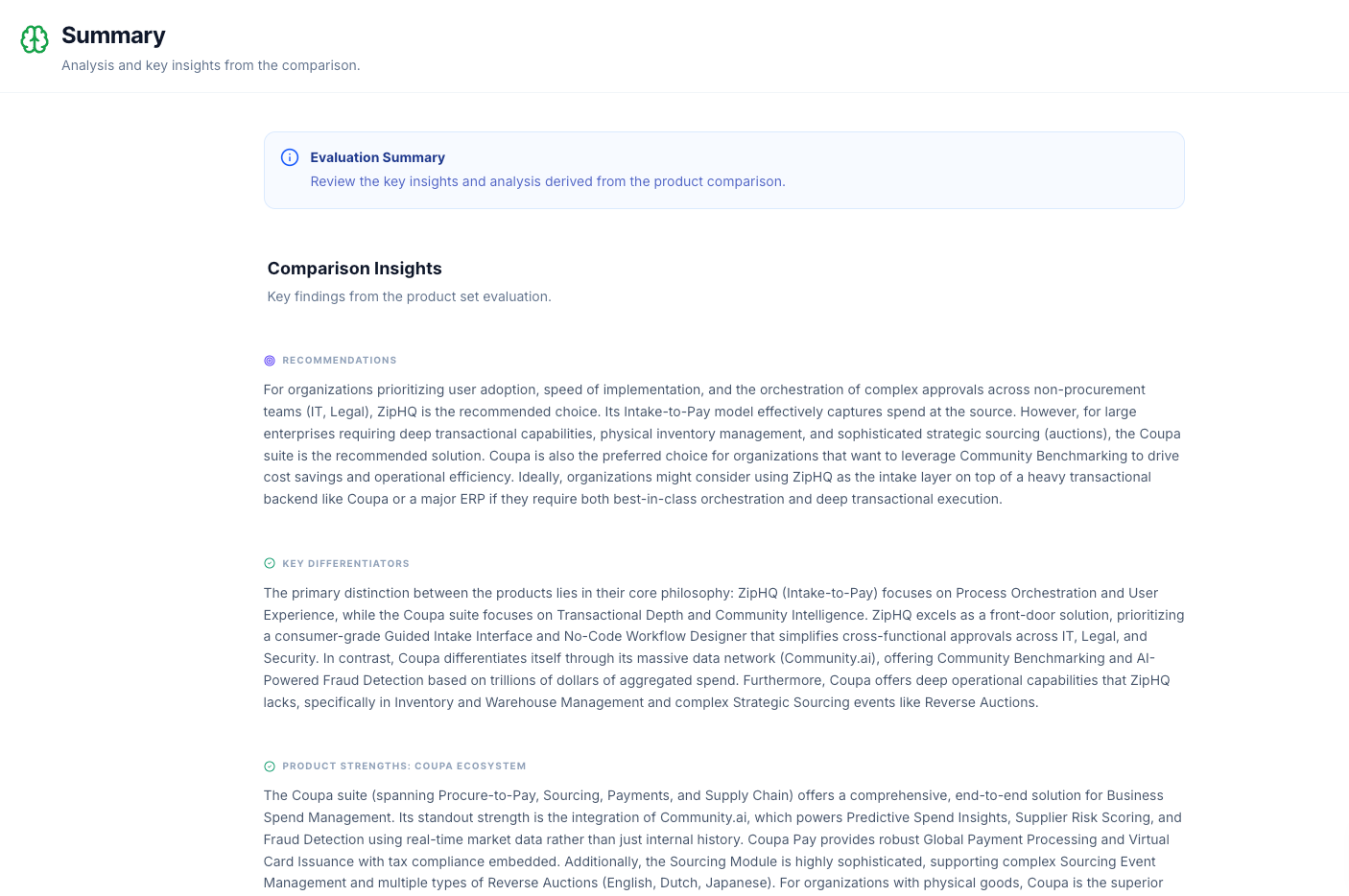
Comparison Insights
Insight 1: The Orchestration vs. Execution Distinction Is Narrowing — But Still Real
The fundamental question is no longer "orchestration OR execution" — Zip's inclusion in the 2026 Gartner® Magic Quadrant™ for Source-to-Pay Suites confirms that orchestration-first platforms are converging with traditional S2P suites. However, the distinction still matters at the edges: Zip's depth in cross-functional coordination, no-code workflow design, and AI-agent-driven intake remains ahead of Coupa's employee experience layer. Coupa's depth in inventory management, reverse auctions, supply chain optimization, and community-powered benchmarking remains ahead of Zip's execution layer. Organizations should evaluate which gap is harder to fill for their specific use case.
Insight 2: Community Intelligence Is a Compounding Advantage for Coupa
Coupa's community spends data — over $8 trillion in cumulative anonymized transactions — is a durable structural moat. The ability to compare your own pricing and processing performance against industry peers in real time creates a continuous improvement loop that standalone orchestration platforms cannot replicate. For procurement leaders whose mandate includes hard-dollar savings benchmarking, this data layer materially changes the ROI calculus. It is worth noting that Coupa's own materials present this figure inconsistently — sometimes as cumulative, sometimes as annual throughput — so buyers should clarify the precise basis during evaluation.
Insight 3: ZipHQ's Architecture Is a Deployment Accelerator — Whether as Overlay or Standalone
Because ZipHQ can operate either as a layer on top of existing ERPs or as its own intake-to-pay platform, it carries a significantly lower deployment risk profile than a full BSM suite implementation. Standard ZipHQ deployments complete in 8 weeks or less. For service-based organizations or those mid-transformation, ZipHQ can deliver rapid governance improvements — particularly in cross-departmental compliance — without requiring a full system overhaul. This is especially relevant for organizations that have already invested in SAP, Oracle, or NetSuite and need to extend intake governance without re-platforming.
Insight 4: Module Interdependency Is Coupa's Most Underestimated Risk
Evaluators frequently assess Coupa at the suite level without mapping which capabilities require which module combinations. The Sourcing Module, for example, cannot perform Purchase Order Automation or Payment Status Tracking without the Procurement or Pay modules. Organizations that budget for a subset of modules may discover material capability gaps post-implementation. A pre-purchase module dependency mapping exercise is not optional — it is essential.
A Note on Hybrid Deployment
For large enterprises, the choice between ZipHQ and Coupa is not always binary — and that is worth stating explicitly.
Because Coupa excels at back-end financial governance but has historically struggled with front-end user adoption, a growing number of Fortune 500 organizations are deploying a hybrid architecture: ZipHQ layered on top of Coupa as an intelligent front-end. In this model, employees initiate all spend requests inside ZipHQ, which handles the complex cross-departmental approval chain — Legal, IT, Security, Finance. Once fully validated, ZipHQ automatically generates the purchase requisition inside Coupa via a no-code connector. The result is the consumer-grade intake experience of ZipHQ combined with the financial compliance depth of Coupa, without either platform needing to overextend beyond its design intent.
This hybrid model does not apply to every organization — it requires the budget and operational maturity to run two platforms intentionally. But for enterprises that have already invested significantly in Coupa's BSM infrastructure and are experiencing adoption friction, it is a strategically viable path that avoids a full re-platforming decision. If your evaluation is framed as "Zip vs. Coupa," it may be worth asking whether the real answer is "Zip and Coupa."
Thematic Spotlight: AI, Risk & Compliance
ZipHQ — AI & Risk Approach
ZipHQ's AI strategy centers on agentic procurement orchestration. In 2025, the company launched over 50 purpose-built AI agents designed to operate autonomously within procurement workflows. These agents span the full intake-to-pay lifecycle: intake validation agents check requests for completeness and policy compliance in seconds; price negotiation agents benchmark quotes against historical invoices and industry data; contract review agents scan MSAs for risk clauses; and vendor screening agents flag negative press, DORA exposure, and compliance gaps. Zip reports that its AI has delivered over 10 million insights across 26 million approvals.
At the intake layer, Zip uses AI for automated invoice capture, document parsing, and intelligent routing to surface the right approval path and trigger the correct compliance checks. Its risk model is process-centric — designed to reduce the manual coordination overhead of multi-stakeholder vendor onboarding — but is increasingly augmented by data-driven agents that operate more autonomously.
Coupa (Suite) — AI & Risk Approach
Coupa's AI capabilities are anchored in its Community Intelligence layer and have been significantly expanded with recent investments. Spend Guard uses community-trained machine learning to detect ghost vendors, fuzzy duplicate invoices, and anomalous payment patterns by comparing transaction data against the behavior of thousands of peer organizations — a detection model that traditional rule-based matching engines cannot replicate. Predictive Spend Insights and Community Benchmarking similarly derive their value from Coupa's aggregated data set rather than from individual customer data alone.
Coupa Navi, launched in September 2024, is a generative AI agent embedded in the platform that provides real-time navigation, support, and contextual guidance for business queries. The May 2025 acquisition of Cirtuo added AI-powered category strategy, supplier strategy, and initiative management capabilities to the sourcing suite. Coupa has also introduced AI-powered transaction summaries, payment security alerts, and health insights that identify bottlenecks in approval chains.
Coupa's risk model is data-centric and community-verified — its strength lies in detection and prevention at the transaction level, powered by the scale of its $8 trillion community dataset.
The fundamental difference is directional but narrowing: ZipHQ applies AI agents to automate and improve the process of managing risk and procurement across stakeholders, while Coupa applies AI to detect and prevent financial risk at the transaction level using community-scale data. Both platforms are investing heavily in agentic AI, and the gap between their approaches is smaller today than it was a year ago. Organizations should evaluate both based on current capabilities rather than historical positioning.
Evaluation Summary
ZipHQ — Evaluation Summary
ZipHQ is a rapidly maturing intake-to-pay platform that delivers genuine value for organizations whose primary challenge is governance, adoption, and cross-functional approval coordination. Its 89% use case coverage reflects real capability depth in its design domain. In January 2026, Zip was named a Visionary in the Gartner® Magic Quadrant™ for Source-to-Pay Suites — a recognition that its capabilities now extend well beyond intake orchestration into full source-to-pay territory.
The most important limitations to understand remain in two areas: Zip does not offer native inventory management, and it does not support reverse auction formats for competitive commodity sourcing. Organizations expecting these capabilities will need to pair ZipHQ with complementary systems. For everything else in the intake-to-pay lifecycle — including procurement orchestration, sourcing via RFx, AP automation, supplier onboarding, risk management, and global payments — ZipHQ now offers native capabilities.
Coupa (Suite) — Evaluation Summary
The Coupa Business Spend Management suite achieves the broadest capability coverage evaluated in this analysis — 100% use case coverage and 95% feature coverage across the combined platform. Coupa was named a Leader in the 2026 Gartner® Magic Quadrant™ for Source-to-Pay Suites for the third consecutive year, positioned highest for Ability to Execute. Its differentiation is most pronounced in operational depth: inventory management, strategic sourcing complexity (including reverse auctions), global payment execution, supply chain optimization, and community-powered analytics.
The suite's most significant constraint is deployment complexity and module interdependency. Coupa delivers its full value at scale and requires deliberate architectural planning to realize it. Organizations that deploy it partially should expect partial capability returns.
How to Choose
Choose ZipHQ if your organization struggles with low procurement adoption, fragmented approval chains, or the need to route complex requests across Legal, IT, Security, and Finance — and you want a platform that can serve as either a governance layer over an existing ERP/P2P backend or as a standalone intake-to-pay system.
Why It Matters: ZipHQ's orchestration-first architecture and 50+ AI agents allow it to function as a governance layer over any existing system of record, or increasingly as a standalone platform. Deployment completes in 8 weeks or less, the employee experience improvement is immediate, and the ROI from spend visibility and compliance is realizable without a full platform migration.
Choose the Coupa Procure-to-Pay suite if your organization manages physical goods, requires native inventory and warehouse management integrated with purchasing workflows, or needs end-to-end source-to-settle execution in a single platform.
Why It Matters: ZipHQ does not offer inventory management. For product-based businesses where stock tracking and purchasing are operationally linked, Coupa's native integration of these functions is not a nice-to-have — it is a prerequisite.
Choose the Coupa Sourcing Module if your cost-reduction strategy depends on advanced competitive bidding formats, including Reverse Auctions (English, Dutch, or Japanese).
Why It Matters: Coupa natively supports mathematical optimization and real-time competitive auction formats for commoditized spend categories. ZipHQ supports RFx events and AI-assisted sourcing but does not offer reverse auction formats. The savings potential in high-volume commodity categories can be substantial.
Choose Coupa Procure-to-Pay combined with Community Intelligence if your organization's procurement mandate includes real-time market benchmarking and the ability to identify whether you are overpaying relative to industry peers.
Why It Matters: Coupa's community spend data — over $8 trillion in cumulative anonymized transactions — provides a benchmarking layer that no standalone platform can replicate from first principles. For procurement leaders accountable to hard-dollar savings targets, this intelligence changes what is negotiable.
Choose Coupa Pay alongside Procure-to-Pay if you need to unify the full source-to-settle lifecycle and automate global financial reconciliation, including cross-border payments, virtual card issuance (including the new Coupa Card), and early payment discount optimization.
Why It Matters: Integrating payments natively within the procurement platform eliminates the manual reconciliation overhead of disjointed banking portals and enables automated financial controls — including AI-powered fraud detection via Spend Guard — across the full transaction lifecycle.
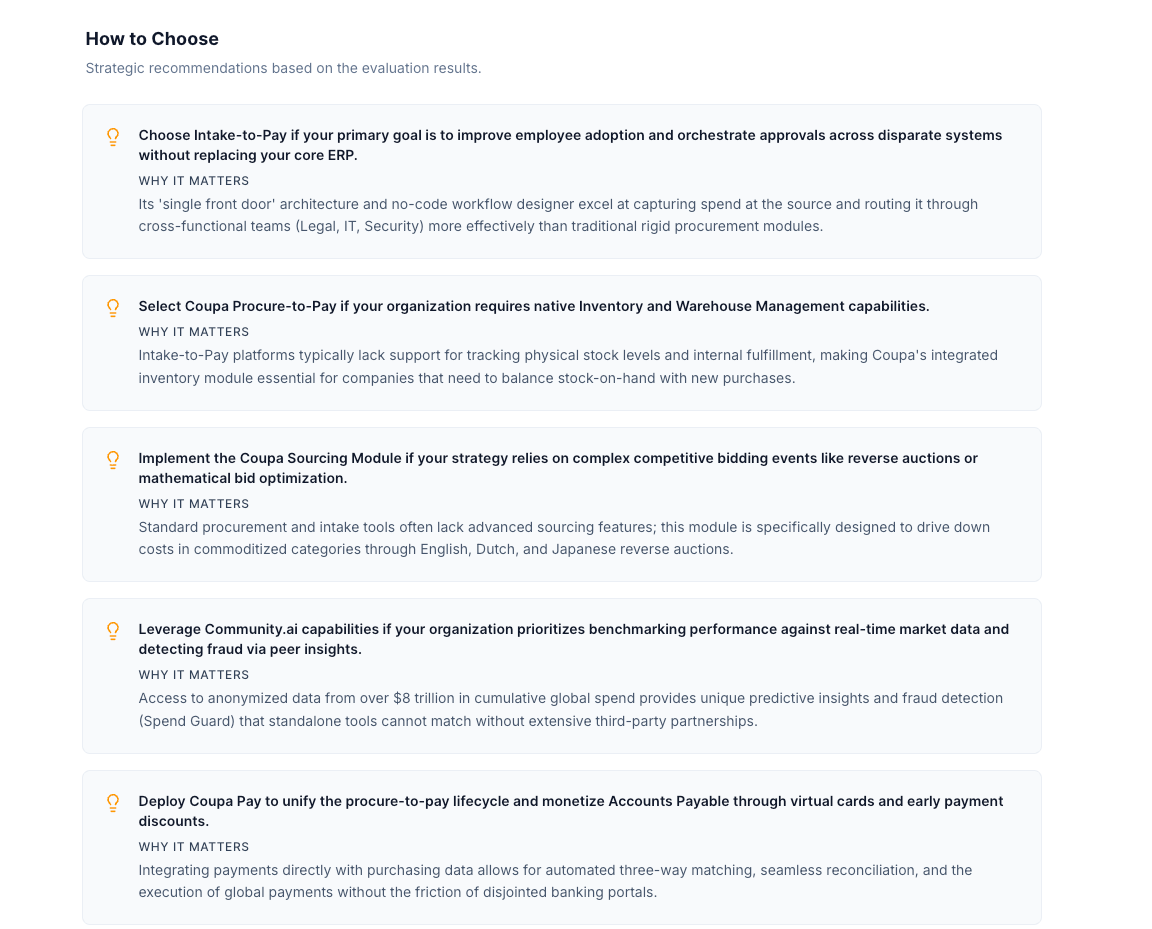
The full report includes structured recommendations tailored to your organizational profile.
The full Teem Finance report includes a complete scoring breakdown across all 18 use cases and 40 features — structured to help you build the internal business case.
Download the Full Comparison Report
This blog covers the key findings. The full Teem report goes deeper:
- ✅ Complete 18-point use case evaluation with individual scores per product
- ✅ Full 40-point feature checklist with ✅ / ⚠️ / ❌ per product
- ✅ Methodology and external research sources
- ✅ Printable PDF — ready for internal stakeholder reviews
Enter your email below to get instant access. No spam. Unsubscribe anytime.
Want to see the Teem's Product comparison engine live with your own shortlist?
Book a demo, and we will walk you through it→ Demo
This comparison was produced independently by Teem. Neither ZipHQ nor Coupa has sponsored, reviewed, or influenced this report.