Orcale vs. ServiceNow: Product Comparison Report
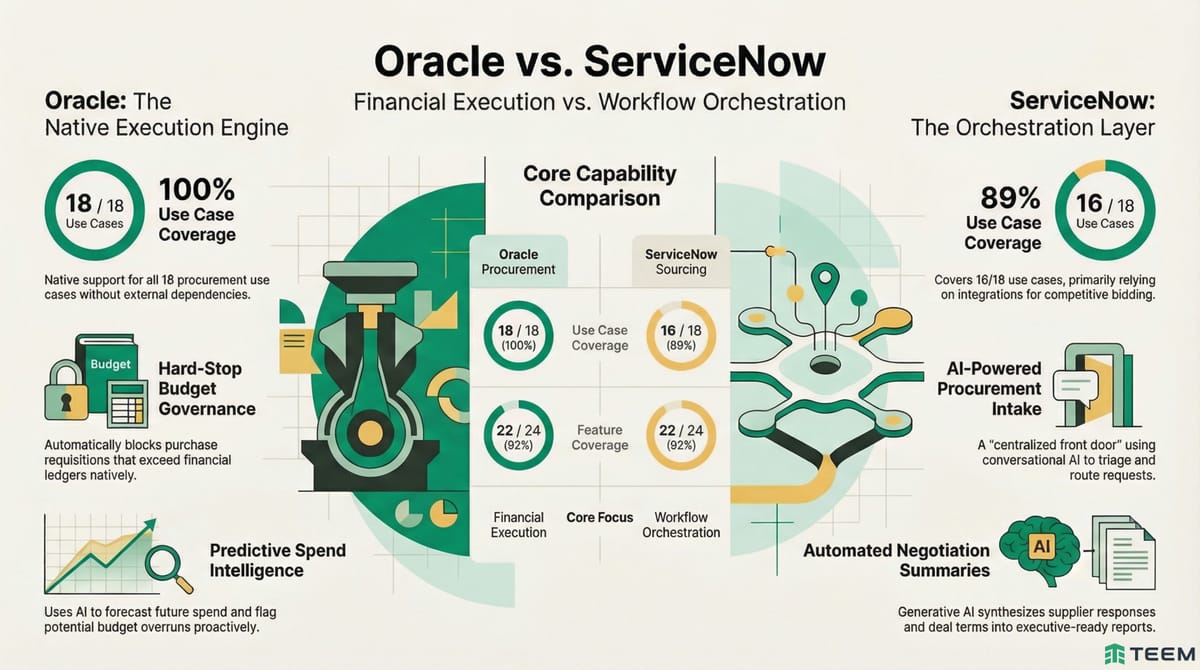
ServiceNow and Oracle both address procurement — but from different architectural positions. One executes financial controls natively. The other orchestrates across existing systems. Teem evaluates 18 use cases and 24 features to help you choose.
By Teem | April 2026 | Sourcing and Procurement Operations
About this analysis: This article is a condensed summary of a full Teem product comparison report, an independently produced comparison of Oracle Procurement and ServiceNow Sourcing and Procurement Operations based on a structured evaluation of 18 use cases and 24 features in the sourcing and procurement operations category. For brevity, the products are referred to as "Oracle" and "ServiceNow" throughout this report. The evaluation is structured to reflect the functional scope shared by both products — capabilities outside that shared scope were not included. Use cases and features were selected to surface meaningful differences in how each platform approaches procurement execution, financial control, and workflow management. No vendor has sponsored, reviewed, or influenced this report.
Why This Comparison Matters
Enterprises shopping for a procurement platform today are not choosing between two products that do the same thing. Oracle Fusion Cloud Procurement is a financial execution engine. ServiceNow Sourcing and Procurement Operations is a workflow orchestration and modernization layer for intake. Both address sourcing and procurement — but from fundamentally different architectural positions, and the downstream consequences of that difference are significant. Getting this decision wrong means either underbuilding financial controls or overcomplicating an employee experience problem that requires a lighter touch.
At a Glance: Capability Scores
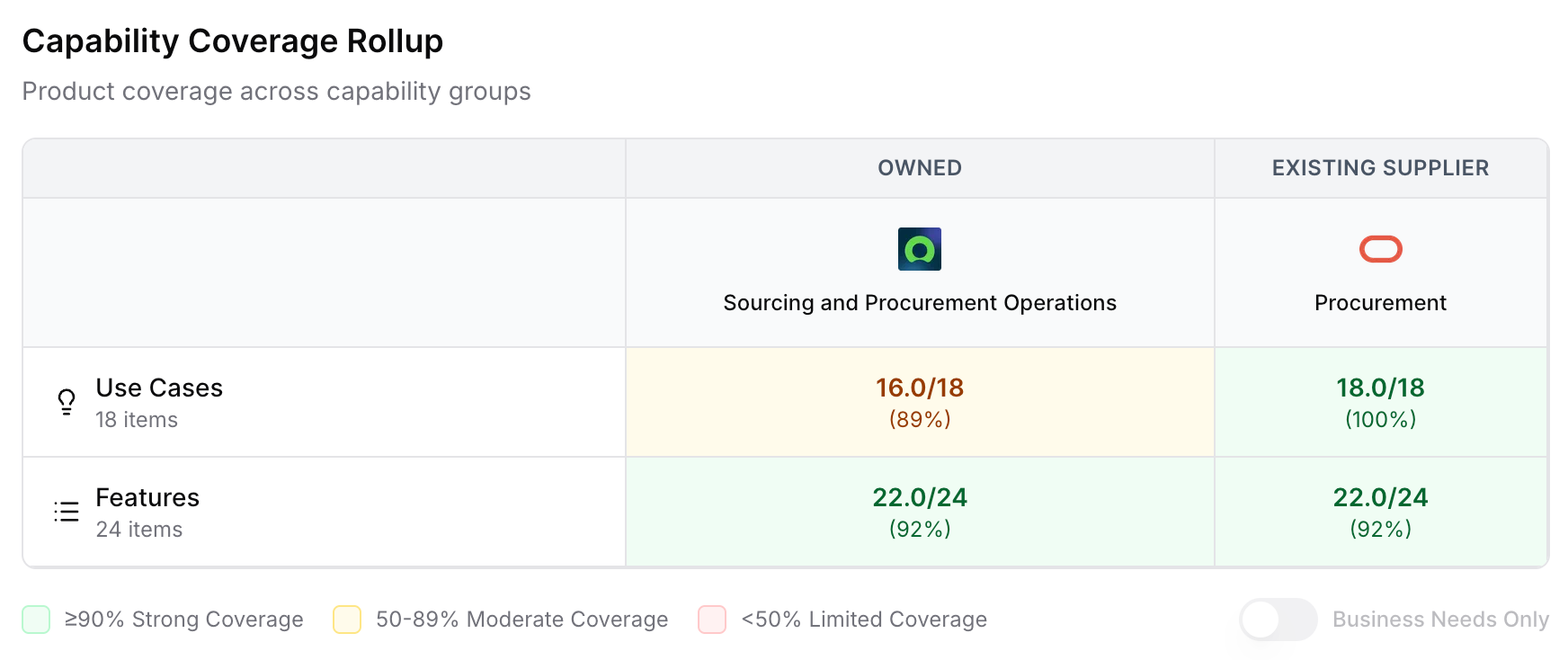
| Dimension | Oracle | ServiceNow |
| Use Cases | 18/18 (100%) | 16/18 (89%) |
| Features | 22/24 (92%) | 22/24 (92%) |
Both platforms score highly in feature coverage. Oracle achieves a perfect use-case score; ServiceNow falls two points short. The gap is not about breadth — it reflects specific architectural constraints in financial enforcement and sourcing execution.
Want to run this comparison for your own shortlist? See below how the Teem's comparison engine works:
Product Comparison Quick Overview-The scores above are generated directly from Teem's structured evaluation engine. Here's what the full report looks like inside the platform.
The Core Structural Difference
Oracle Fusion Cloud Procurement is a native, end-to-end execution system — its financial controls, strategic sourcing workflows, and contract lifecycle management all operate without external dependencies. ServiceNow Sourcing and Procurement Operations is built to connect and orchestrate what already exists: it unifies fragmented procurement environments through low-code workflows and conversational AI intake, but relies on integrations for heavy financial enforcement and competitive bidding execution. That foundational difference determines where each platform delivers value and where each falls short.
Use Cases: Who Is Each Product Built For?
ServiceNow
At 16/18 use cases (89%), ServiceNow effectively covers most procurement functions. It handles Procurement Intake and Request Management, Guided Buying, Invoice Automation, Supplier Performance Management, and ESG Reporting at full capability. Four use cases are partially supported: Strategic Sourcing and RFx Management, Contract Lifecycle Management, Spend Analysis and Visibility, and Budget Tracking and Control. These gaps are not incidental — they are a direct consequence of ServiceNow's orchestration architecture. Organizations evaluating ServiceNow should assess whether they have existing ERP and sourcing tools to bridge those gaps, or whether they will require them as net-new investments.
Oracle
Oracle covers all 18 evaluated use cases at 100%, with full or strong support across Strategic Sourcing, Contract Lifecycle Management, Spend Analysis and Visibility, Budget Tracking and Control, and Savings Lifecycle Tracking. Oracle is best suited to organizations that want to replace, not extend, their procurement infrastructure — and who require financial enforcement and predictive analytics to operate natively within a single platform.
Features Snapshot
| Feature Category | Oracle | ServiceNow |
| Requisitioning and Employee Experience | ⚠️ | ✅ |
| Strategic Sourcing and RFx Management | ⚠️ | ⚠️ |
| Contract Lifecycle Management | ✅ | ✅ |
| Supplier Relationship and Risk Management | ✅ | ✅ |
| Purchasing and Order Management | ✅ | ✅ |
| Analytics, Intelligence, and Reporting | ✅ | ⚠️ |
| Platform, Workflow, and Integration | ✅ | ✅ |
The full 24-point feature breakdown is available in the complete report. Download it here →
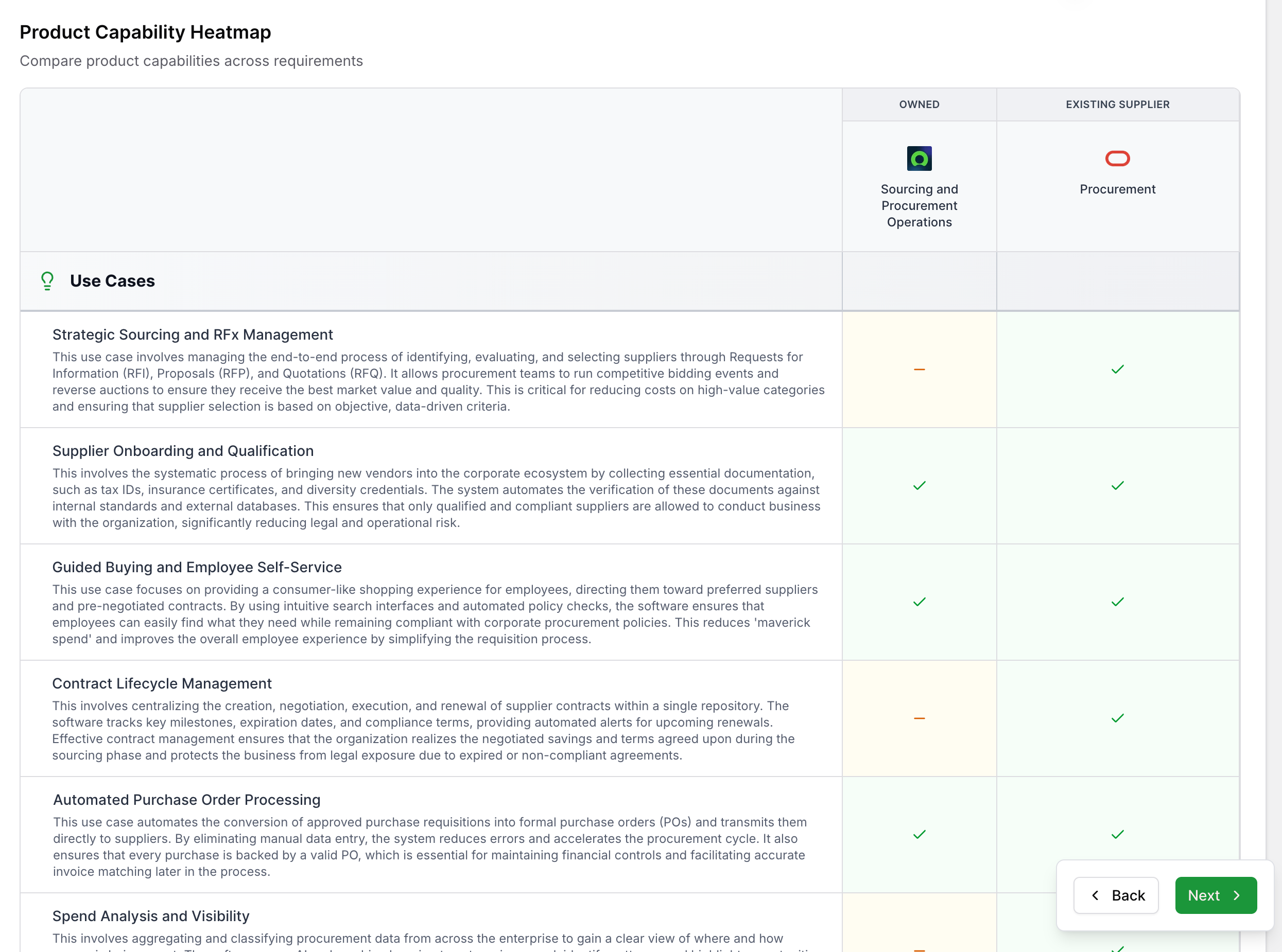
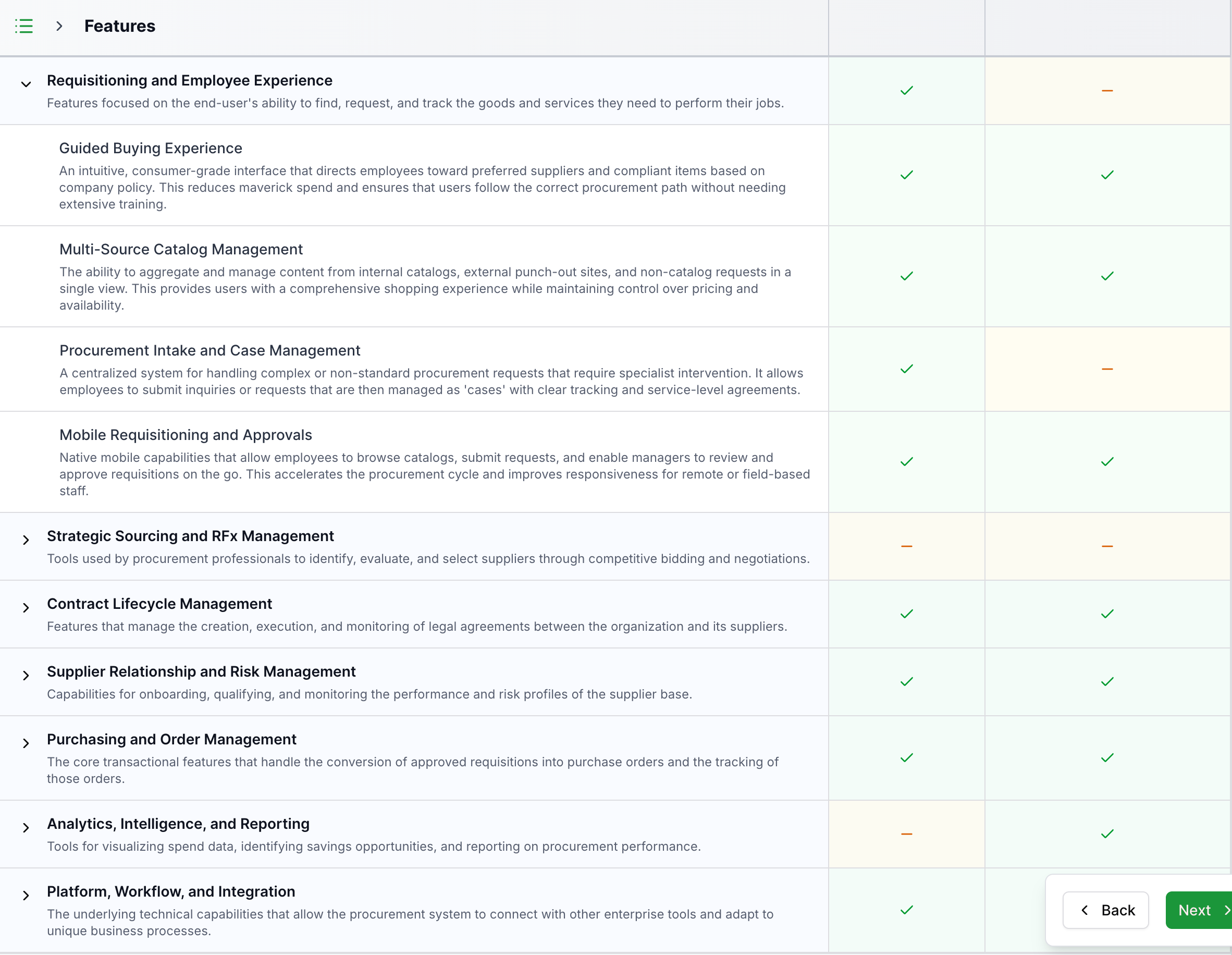
A glimpse of the Product Capability Heatmap checklist from the full report. Each of the 24 features is evaluated individually per product.
Platform Strengths
ServiceNow — Where It Leads
ServiceNow's most differentiated capability is its Procurement Intake and Case Management system. Powered by conversational AI, it creates a centralized front door for procurement requests — intelligently triaging non-standard inquiries and routing them to the right specialist with service-level tracking. This is native, not bolted on. Pairing this with Low-Code Workflow Orchestration means procurement teams can redesign approval chains and routing logic without relying heavily on IT — a genuine advantage for organizations operating across multiple legacy systems. One feature stands out as unique: AI-Assisted Negotiation Summarization. This generative AI capability automatically synthesizes negotiation histories and supplier responses into executive-ready summaries. Oracle does not offer this out-of-the-box.
Oracle — Where It Leads
Oracle's strength is in the financial and sourcing execution layer. Its Predictive Spend Insights capability forecasts future spend and flags potential budget overruns, using historical data and market trends to shift procurement from reactive to proactive. Budget Tracking and Control operates natively, allowing hard blocking of purchase requisitions that exceed defined financial ledgers, without requiring ERP integrations. On the sourcing side, Oracle supports Automated RFx Creation and Strategic Sourcing end-to-end — including reverse auctions — without routing through third-party tools. Contract Lifecycle Management is fully native, from authoring through milestone tracking and compliance monitoring, linked directly to purchasing execution. User review data corroborates Oracle's depth in core transactional execution: G2 ratings for Oracle's procurement capabilities include Purchase Orders (9.2), Requisition (8.7), Sourcing (8.6), Inventory Tracking and Ordering (8.6), and AP Automation (8.5).
Source: G2, Oracle Procurement — user review ratings
Feature Coverage Gaps
ServiceNow — Notable Gaps
Predictive Spend Insights is not supported. ServiceNow cannot natively forecast future organizational spend or identify budget overruns before they occur — even when procurement leaders work with ServiceNow, they rely on historical data, not forward-looking analytics. Budget enforcement has a similar limitation: ServiceNow cannot natively hard-block requisitions that exceed defined limits. Enforcing real-time financial controls requires custom ERP integration, which introduces implementation complexity and a dependency on a third-party financial system. Competitive sourcing is also constrained — executing formal RFx events and reverse auctions requires integration with external tools like SAP Ariba, as ServiceNow functions as an orchestration layer rather than a bidding platform.
Oracle — Notable Gaps
Oracle lacks native generative AI capabilities for negotiation summarization. Sourcing managers preparing for executive deal reviews must compile negotiation histories and supplier responses manually — the workflow that ServiceNow automates through AI-Assisted Negotiation Summarization is not available out of the box in Oracle. For complex, non-standard procurement case management, Oracle requires its Help Desk Cloud module to reach the depth of capability that ServiceNow delivers natively. Online Supplier Negotiations — including reverse auctions — are partially supported by both platforms, which is worth noting: neither delivers a fully automated, end-to-end competitive bidding environment without additional configuration.
Comparison Insights
Insight 1: Execution vs. Orchestration — Choosing the Right Model.
The architectural divide between these platforms is the most important factor in platform selection, and it is frequently underweighted. Oracle executes procurement natively — financial controls, sourcing events, and contract management run without external dependencies. ServiceNow orchestrates across existing systems — its value lies in harmonizing a fragmented environment, not replacing them. Organizations should be precise about which problem they are solving before evaluating features in isolation.
Insight 2: Financial Control Depth Favors Oracle Decisively.
Oracle's native Predictive Spend Insights and hard-stop budget enforcement represent a material advantage for any organization where financial governance is a primary procurement objective. ServiceNow's partial coverage on Spend Analysis and its reliance on ERP integrations for budget control are not configuration gaps — they are architectural constraints. A CFO-led selection process will likely surface this quickly.
Insight 3: Employee Experience and Intake Modernization Favors ServiceNow.
For organizations where procurement intake is the primary pain point — high request volumes, inconsistent routing, poor employee visibility — ServiceNow's conversational AI intake and case management system is the more capable tool. Oracle addresses this use case through a separate Help Desk Cloud module, which adds implementation scope and cost.
Insight 4: Both Platforms Have a Competitive Bidding Gap.
Online Supplier Negotiations are partially supported by both platforms. Neither delivers a fully native reverse auction or Dutch auction environment without additional integration or configuration. Organizations that run live supplier negotiation events at scale should pressure-test this limitation with both vendors during evaluation.
AI Spotlight
ServiceNow — AI Approach
ServiceNow's AI is focused on the intake and negotiation layers. Conversational AI powers the Procurement Intake and Case Management system — employees submit and route requests through natural-language interactions rather than through form-based workflows. The platform's most distinctive AI capability is AI-Assisted Negotiation Summarization: a generative AI feature that synthesizes negotiation histories, supplier responses, and deal terms into summaries formatted for executive review. The gap is in financial analytics — ServiceNow does not use AI for spend categorization at scale and lacks predictive capabilities for forecasting future spend.
Oracle — AI Approach
Oracle's AI operates in the financial intelligence and enforcement layer. Machine learning is used natively to categorize enterprise spend in real time — without manual mapping — providing procurement and finance teams with an accurate, continuously updated view of spend by category and supplier. Predictive Spend Insights applies AI to historical data to identify potential budget overruns before they occur. Oracle does not currently support generative AI for negotiation summarization; this workflow requires manual preparation.
ServiceNow's AI makes it easier for humans to navigate the process. Oracle's AI makes the financial data actionable and the governance automatic. The right AI investment depends on where the organization's most acute operational failure sits.
Evaluation Summary
ServiceNow — Evaluation Summary
ServiceNow covers 16/18 use cases (89%) and 22/24 features (92%), with particular depth in employee-facing intake, workflow orchestration, and AI-assisted negotiation tools. The core limitation is structural: ServiceNow is an orchestration platform, not a financial execution engine. Organizations that require native predictive analytics, hard-stop budget enforcement, or end-to-end competitive sourcing without integration dependencies will hit real constraints — not configuration problems.
Oracle — Evaluation Summary
Oracle covers 18/18 use cases (100%) and 22/24 features (92%), with comprehensive native capability across financial controls, strategic sourcing, contract lifecycle management, and spend intelligence. Its primary limitation is in the employee experience and AI-assisted negotiation layer — complex procurement case management requires an additional module, and generative AI negotiation summarization is not supported natively. Organizations prepared to deploy Oracle as a full-stack procurement platform will find the most complete native coverage of the two evaluated.
How to Choose
Choose Oracle if your organization requires AI-driven spend categorization and proactive budget forecasting as operational requirements, not optional enhancements.
Why It Matters: Oracle's native Predictive Spend Insights and machine-learning-based spend classification enable procurement leaders to identify budget overruns before they occur. ServiceNow relies on manual mapping for spend categorization and lacks built-in forecasting for future spend.
Choose Oracle if your legal and procurement teams need a unified, out-of-the-box contract authoring and compliance repository linked directly to purchasing execution.
Why It Matters: Oracle manages the full Contract Lifecycle natively — authoring, milestone tracking, and compliance monitoring — without additional modules. ServiceNow's Contract Management Pro module for authoring and legal workflows adds implementation scope.
Choose Oracle if strict, real-time financial controls that automatically block unauthorized spend are non-negotiable.
Why It Matters: Oracle hard-blocks purchase requisitions that exceed defined financial ledgers natively. ServiceNow requires custom ERP integrations to perform equivalent automated budget enforcement, introducing dependency and configuration risk.
Choose ServiceNow if your primary challenge is modernizing a fragmented procurement landscape and improving how employees submit and track procurement requests.
Why It Matters: ServiceNow's conversational AI-powered intake and low-code workflow orchestration are built for environments where employees interact with multiple legacy systems through a disjointed experience. Oracle addresses this through a separate internal help desk module, adding implementation complexity.
Choose ServiceNow if sourcing managers need automated, AI-generated summaries of negotiation histories for executive review.
Why It Matters: ServiceNow includes native AI-Assisted Negotiation Summarization, which automatically synthesizes supplier responses and deal terms. Oracle does not support this capability out-of-the-box — preparation for executive deal reviews is a manual process.
Download the Full Comparison Report
This blog covers the key findings. The full Teem report goes deeper:
- ✅ Complete 18-point use case evaluation with individual scores per product
- ✅ Full 24-point feature checklist.
- ✅ Methodology and external research sources
- ✅ Printable PDF — ready for internal stakeholder reviews
Enter your email to get instant access. No spam. Unsubscribe anytime.
Want to see the Teem's Product comparison engine live with your own shortlist?
Book a demo, and we will walk you through it→ Demo
This report is generated by our internal platform using publicly available information, market data, and documented product capabilities. Information presented may change over time as vendors update their offerings. While efforts have been made to ensure accuracy, readers should independently verify critical claims with the respective vendors before making business decisions.
This comparison was produced independently by Teem. Neither Oracle nor ServiceNow has sponsored, reviewed, or influenced this report.