Levelpath vs. Omnea: Product Comparison Report
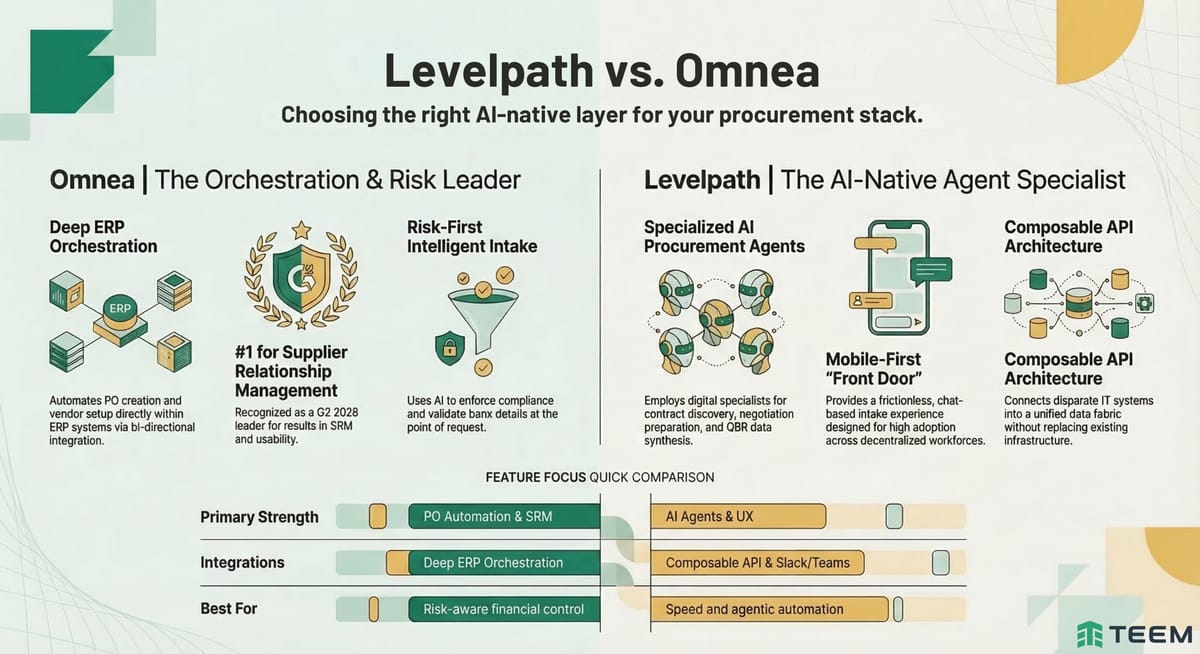
Two AI-native procurement platforms, both founded in 2022, both Series B, but built on fundamentally different architectural bets. Here's how Levelpath and Omnea score across 18 use cases and 27 features, and which one fits your stack.
By Teem | March 2026 | Procurement | Intake-to-Pay
About this analysis: This article is a condensed summary of a full Teem product comparison report, independently produced based on a structured evaluation of 18 use cases and 27 features, supplemented by external market research including Gartner, Spend Matters, G2, TechCrunch, and Business Wire. No vendor has sponsored or reviewed this content.
Why This Comparison Matters
Both Levelpath and Omnea were founded in 2022, have each completed a Series B round within the past 12 months, and are growing into a procurement orchestration category that Gartner now tracks as a distinct market. That timing is not a coincidence — it reflects the same demand signal from enterprises that have watched point solutions for intake, contracts, and supplier risk proliferate into fragmented stacks that nobody manages cohesively.
The founders of both companies know this problem firsthand. Levelpath's founders, Alex Yakubovich and Stan Garber, previously built Scout RFP, acquired by Workday for $540 million in 2019. They spent three years inside Workday observing where enterprise procurement technology still failed before building Levelpath. Omnea's CEO, Ben Freeman, identified the same dysfunction from the other side — as a vendor selling to large enterprises while serving as US GM at Tessian.
The result is two platforms that address the same problem from opposite architectural directions. One is a comprehensive procurement suite designed to replace legacy point solutions entirely. The other is an orchestration layer designed to sit on top of the systems organizations already have. For enterprises evaluating their stack right now, that difference determines what gets replaced, what stays, and what gets rebuilt.
At a Glance: Capability Scores
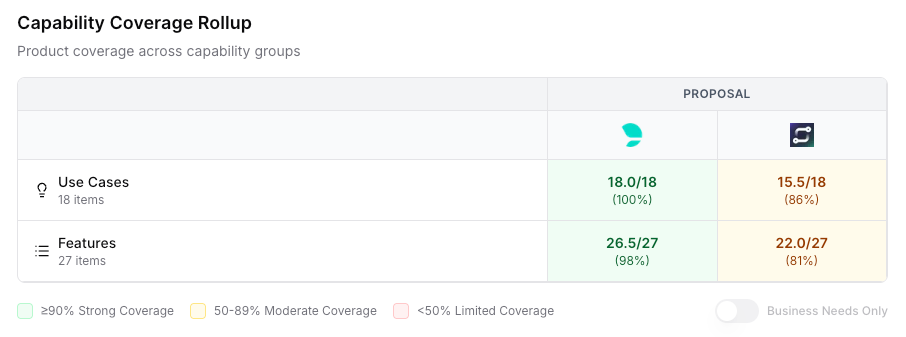
| Dimension | Levelpath | Omnea |
| Use Cases (18 Evaluated) | 18/18 (100%) | 15.5/18 (86%) |
| Features (27 Evaluated) | 26.5/27 (98%) | 22/27 (81%) |
Coverage Tiers: ✅ Strong — ≥90% ⚠️ Moderate — 50–89% ❌ Limited — <50%
Levelpath scores at or near full coverage across both dimensions. Omnea demonstrates solid use case coverage at 86%, with a more notable gap at the feature level — particularly in AI depth and supplier management tools.
Note: The AI and Intelligence row reflects granular sub-feature scoring (e.g., predictive spend forecasting, AI ethics documentation) where both platforms have partial gaps — not an assessment of overall AI architectural depth, which is covered in the Thematic Spotlight section below.
Want to run this comparison for your own shortlist? See below how the Teem's comparison engine works:
Product Comparison Quick Overview-The scores above are generated directly from Teem's structured evaluation engine. Here's what the full report looks like inside the platform.
The Core Structural Difference
Levelpath is a standalone procurement suite. Built from the ground up as an AI-native platform, it manages the full lifecycle natively — intake, sourcing, contracts, invoice matching, and supplier relationships — without requiring organizations to route core functions through external financial systems. Business Wire describes Levelpath as the only modern procurement platform with a native supplier system of record that supports sourcing, contract, risk, invoice, and other workflows natively while also providing orchestration capabilities.
Omnea takes a different position. It is an orchestration and intake layer designed to sit on top of existing ERP and CLM infrastructure. Its value proposition is not replacement but coordination — bringing together finance, legal, IT, and security teams across tools they already use. Spend Matters describes Omnea as a fairly new vendor taking a comprehensive approach focused on spend control through automated workflows and risk management, rather than displacing the financial systems of record underneath.
That architectural divide is not a matter of scale or maturity. It is two genuinely different answers to the same question about where procurement technology should live in the enterprise stack.
Use Cases: Who Is Each Product Built For?
Levelpath
Levelpath covers all 18 evaluated use cases, including several that require deep native AI infrastructure, such as automated invoice matching, AI-powered supplier discovery, and contract data extraction from legacy documents. Invoice Automation, launched in December 2025, extends the platform's scope toward full procure-to-pay, with an AI-driven Invoice Matching Agent that validates line items against contracts and purchase orders in-platform. Organizations replacing a fragmented mix of point solutions will find that the native breadth of capabilities directly addresses the consolidation gap. The primary caveat: organizations already invested in mature ERP or CLM systems may find themselves paying for functionality they already have elsewhere.
Omnea
Omnea scores 15.5/18, with partial coverage on Centralized Contract Lifecycle Management, Supplier Performance Tracking, and AI-Powered Contract Data Extraction, and no support for Automated Invoice Matching and Verification. The platform fits organizations with existing financial and contract systems that need a smarter front door for procurement requests — not a replacement for the back-end. Omnea's customer base includes Adyen, MongoDB, Spotify, McAfee, TeamViewer, and Proofpoint, most of which have mature ERP infrastructure already in place.
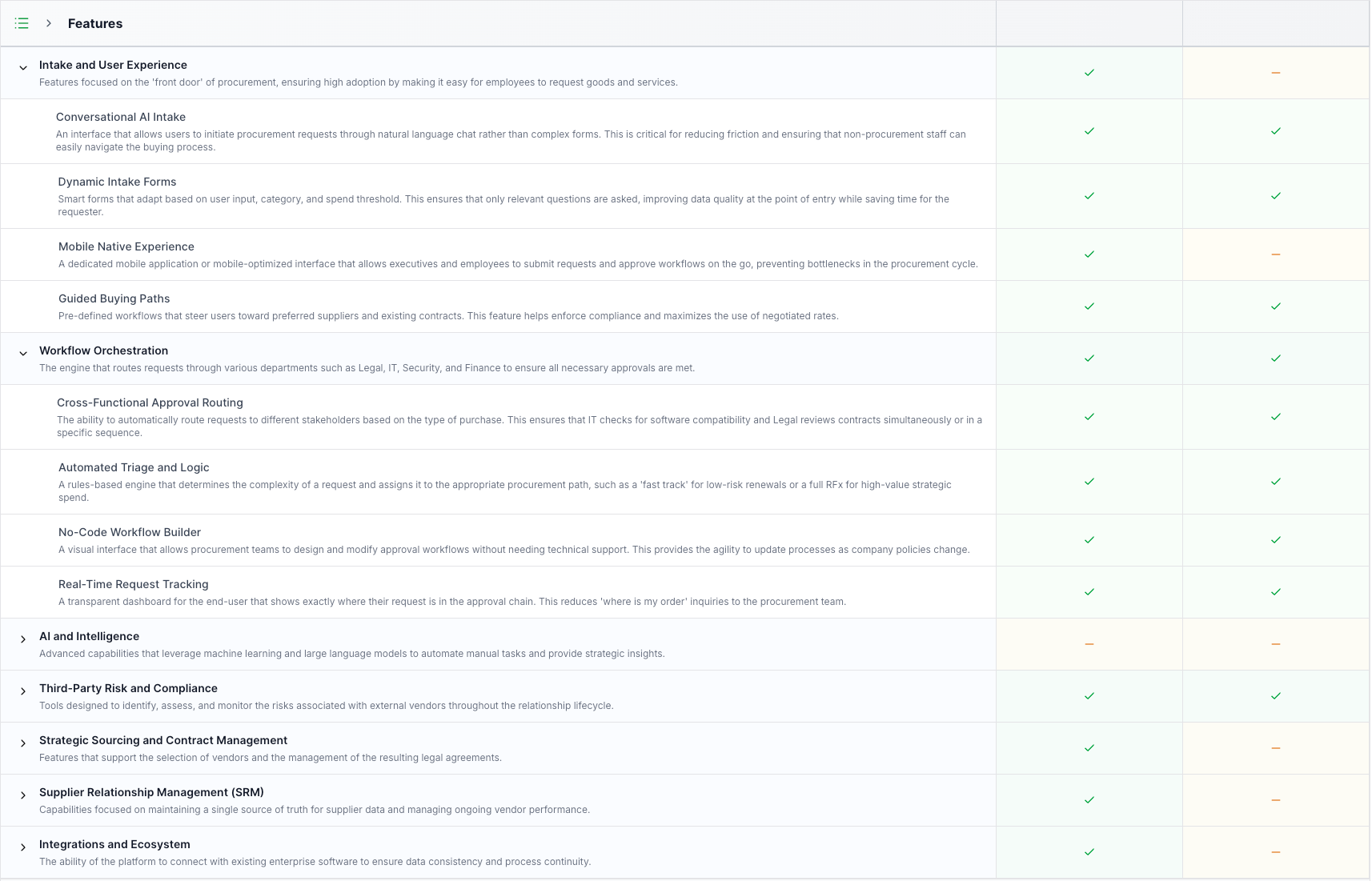
Features Snapshot
| Feature Category | Levelpath | Omnea |
| Intake and User Experience | ✅ | ⚠️ |
| Workflow Orchestration | ✅ | ✅ |
| AI and Intelligence | ⚠️ | ⚠️ |
| Third-Party Risk and Compliance | ✅ | ✅ |
| Strategic Sourcing and Contract Management | ✅ | ⚠️ |
| Supplier Relationship Management | ✅ | ⚠️ |
| Integrations and Ecosystem | ✅ | ⚠️ |
Legend: ✅ Fully Supported ⚠️ Partially Supported ❌
Platform Strengths
Levelpath — Where It Leads
Levelpath's proprietary Hyperbridge reasoning engine powers three tiers of embedded AI: Information Agents for data retrieval and enrichment, Task Agents for summarization and document processing, and Workflow Agents for coordinating multi-step procurement approvals. AI-Powered Supplier Discovery surfaces net-new vendors from external datasets — not just an organization's existing approved supplier list — which IDC analyst Patrick Reymann has cited as evidence of a truly AI-native platform approach.
The platform's native Invoice Matching Agent validates line items directly against contracts and purchase orders, addressing one of the more persistent sources of value leakage in procurement. A fully native CLM module handles contract drafting, redlining, and data extraction from legacy archives without requiring integration with third-party tools like Ironclad or Wordsmith. Levelpath also includes explicit IP Indemnification for AI-generated outputs — a detail that matters in regulated industries where AI liability exposure is a live concern.
Gartner recognized Levelpath in its 2025 Hype Cycle for Procurement and Sourcing Solutions as a Sample Vendor for Generative AI for Procurement and Intake Management, and separately in its Innovation Insight for Procurement Orchestration Platforms published in November 2025.
Omnea — Where It Leads
Omnea's TPRM module is the most differentiated capability in this comparison, and it goes beyond what the Teem feature checklist captures. Omnea's third-party risk management includes fourth-party risk coverage, automated scoring and tiering triggered at intake based on data usage and geography, pre-built compliance questionnaire templates for SOC 2, SOX, and DORA, continuous monitoring across sanctions, PEPs, watchlists, and adverse media, AI-generated remediation plans per supplier, and hands-free reassessment automation. Levelpath does not document equivalent fourth-party risk or regulatory-specific template coverage.
Omnea's intake layer is embedded into daily workflows through native Slack and Microsoft Teams integration, allowing employees to submit requests and complete approvals without leaving their primary communication tools. The No-Code Workflow Builder provides cross-functional routing configuration without IT involvement. Omnea reports 63% faster intake completion, 65% of risks auto-captured at intake, and a 75% reduction in procurement cycle time across its customer base.
Gartner named Omnea a Cool Vendor in Sourcing and Procurement Technology in August 2025. It also received the FinTech Breakthrough Award for Best Overall eProcurement Software 2025.
Feature Coverage Gaps
Levelpath — Notable Gaps
Levelpath does not hold the UK Cyber Essentials Certification or ISO 27001. Its compliance posture relies on SOC 2 Type II. For organizations operating in the UK public sector or under frameworks that require those specific certifications, this is a disqualifying gap regardless of feature breadth. Predictive Spend Insights is also only partially supported — the platform does not algorithmically forecast future procurement needs from historical market trends. Levelpath also acknowledges that multi-lingual support requires the use of its agentic AI Assistant rather than being native across all platform modules.
Omnea — Notable Gaps
Omnea's most significant gaps are in AI depth and supplier management. There is no native AI-Powered Supplier Discovery — procurement teams working from a fixed supplier list will stay there. Automated Invoice Matching is absent, meaning invoice reconciliation happens in downstream ERP or AP systems outside procurement's direct control. On the supplier management side, Performance Scorecards and a Supplier Self-Service Portal are only partially available. Omnea also lacks documented AI Ethics and Bias Mitigation policies, as well as IP Indemnification for AI outputs.
On the integration side, G2 user reviews note that integration with existing tech stacks can be improved, a consistent theme that reflects the orchestration model's dependency on the quality of the surrounding ecosystem. Open API Access is unavailable, limiting custom development for organizations with proprietary internal systems.
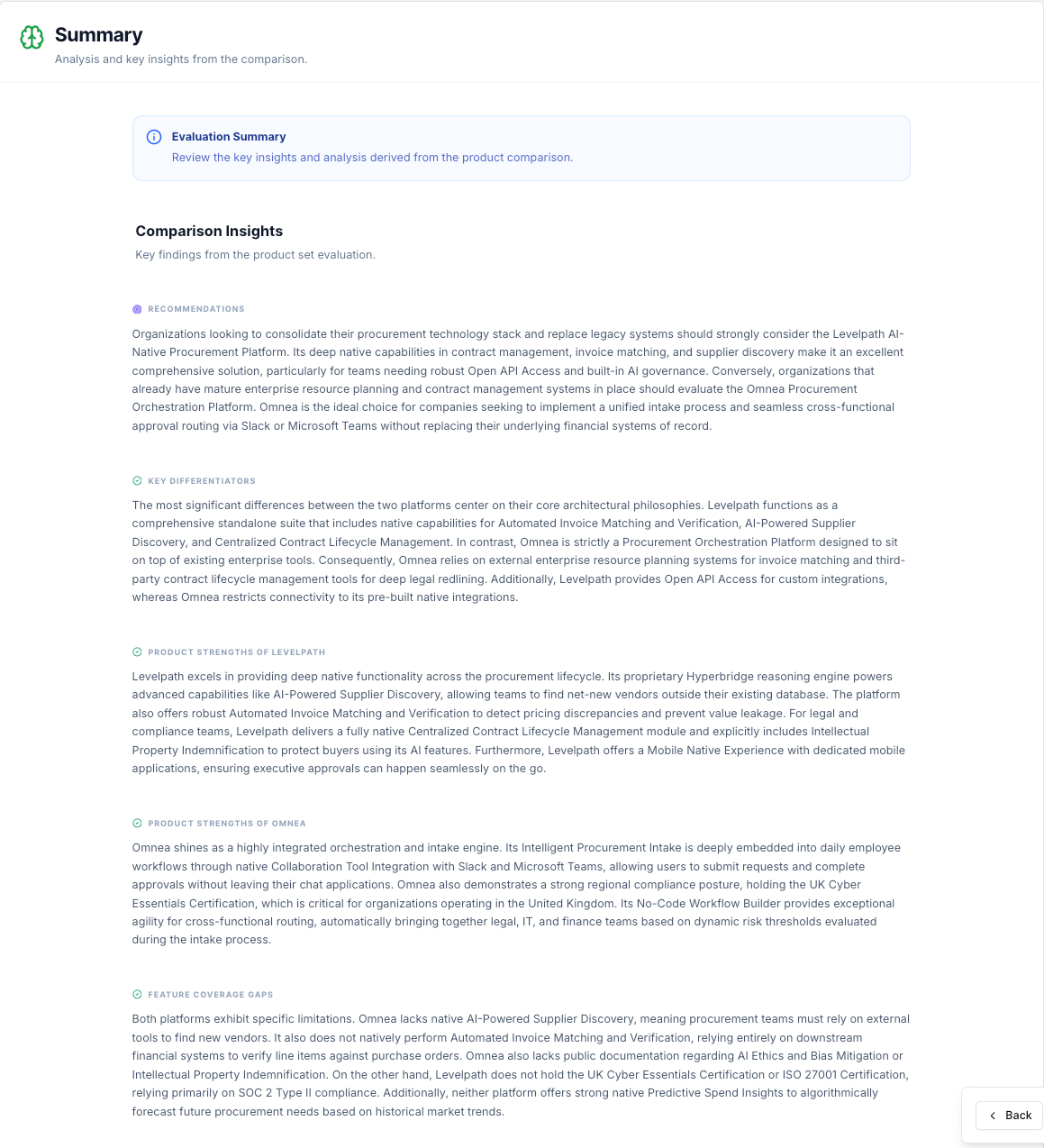
Comparison Insights
.
Insight 1: Invoice Reconciliation Sits Outside the Platform for Omnea Users. Omnea does not natively support automated invoice matching. For organizations where preventing overpayments is a primary procurement objective, this is not a minor gap — it means a core financial control point sits entirely outside the procurement platform. Levelpath's AI-driven Invoice Matching Agent, launched in December 2025, validates line items against contracts and purchase orders in-platform, keeping that control visible to procurement rather than buried in a separate AP system.
Insight 2: Omnea's TPRM Depth Exceeds the Checklist Score. The feature checklist rates both platforms highly for Third-Party Risk and Compliance. What it does not capture is depth. Omnea offers fourth-party risk coverage, pre-built templates for SOC 2, SOX, and DORA, and AI-generated remediation plans — capabilities that Levelpath does not publicly document. For organizations operating in regulated environments or with complex supplier ecosystems, Omnea's TPRM investment is a material differentiator that the headline scores understate.
Insight 3: AI Capability Is Not Evenly Distributed. Both platforms support Conversational AI Intake and Generative AI Document Summarization. Below that, their AI depth diverges. Levelpath's Hyperbridge engine runs across supplier discovery, contract analysis, and invoice verification. Omnea's AI focuses on intake intelligence — three modes (Assist, Command, Analyze) embedded directly into approval workflows, with context learning across every request. For organizations where finding new vendors or extracting obligations from historical contracts is routine work, Levelpath's AI layer is broader. For organizations where intake speed and auto-capture of risk are the priorities, Omnea's AI investment is applied more directly.
Insight 4: The Funding Trajectory Signals Product Direction. Levelpath's $55M Series B was led by Battery Ventures, whose General Partner, Neeraj Agrawal, previously led Battery's investment in Coupa, acquired for approximately $8 billion in 2023. That investor context matters: it signals an expectation of suite-level scale. Omnea's $50M Series B was led by Insight Partners and Khosla Ventures, with Vinod Khosla describing Omnea as the first full AI SRM platform. Both rounds closed within the same 12-month window — both companies are scaling simultaneously.
Insight 5: Supplier Performance Management Reflects Architectural Priorities. Levelpath's Supplier Relationship Management module tracks operational KPIs, such as on-time delivery and defect rates, within the supplier master record. Omnea's supplier performance measurement uses qualitative sentiment surveys, which are suitable for indirect spend or SaaS procurement but insufficient for organizations managing physical supply chain performance or enforcing hard SLA terms contractually.
Thematic Spotlight: AI Architecture
Levelpath — AI Approach
Levelpath's three-tier agent model treats AI as a core architectural layer rather than a feature set added on top of existing workflows. The Agent Orchestration Studio allows procurement teams to build custom AI agents without engineering support. The Supplier System of Record provides the data foundation that powers all three agent tiers — without clean supplier data, the agents have nothing reliable to act on. Levelpath explicitly includes IP Indemnification for AI-generated outputs, which indicates a deliberate governance stance.
Omnea — AI Approach
Omnea AI operates in three modes: Assist (concierge guidance at intake), Command (co-pilot for procurement tasks), and Analyze (insights across the supplier base). It is embedded directly into workflows, providing full context without requiring hours of configuration. Omnea's self-reported metrics — 63% faster intake, 65% of risks auto-captured, 75% cycle time reduction — reflect where its AI investment is concentrated: the front of the process.
The difference matters for organizations deciding whether they need AI to improve how employees submit requests, or to expand what procurement teams can do with supplier data, contracts, and invoicing across the full lifecycle. Those are not the same use case, and these two platforms have made different bets about which one to solve first.
Evaluation Summary
Levelpath — Evaluation Summary
Levelpath covers 100% of evaluated use cases and 98% of features. Gartner has recognized it in two separate 2025 publications — the Hype Cycle for Procurement and Sourcing Solutions and the Innovation Insight for Procurement Orchestration Platforms. It is a strong fit for organizations consolidating a fragmented procurement stack or replacing legacy point solutions with a single AI-native platform. The primary limitation remains the compliance certification scope: organizations that require ISO 27001 or UK Cyber Essentials will need to address that gap in their risk assessment.
Omnea — Evaluation Summary
Omnea covers 86% of use cases and 81% of features, with its most significant gaps in invoice matching and AI supplier discovery. It delivers genuine value as an intake and orchestration layer — Gartner named it a Cool Vendor in August 2025, and it holds the FinTech Breakthrough Award for Best Overall eProcurement Software 2025. Documented customer outcomes include a 62.5% reduction in procurement cycle time at Typeform, 1,685 hours saved at VEED in under 12 months, and a 4% EBITDA increase at TeamViewer. For organizations that are not replacing existing financial systems, Omnea's orchestration model is a fast, low-disruption path to spend control. For those who are replacing those systems, it is not the right tool.
How to Choose
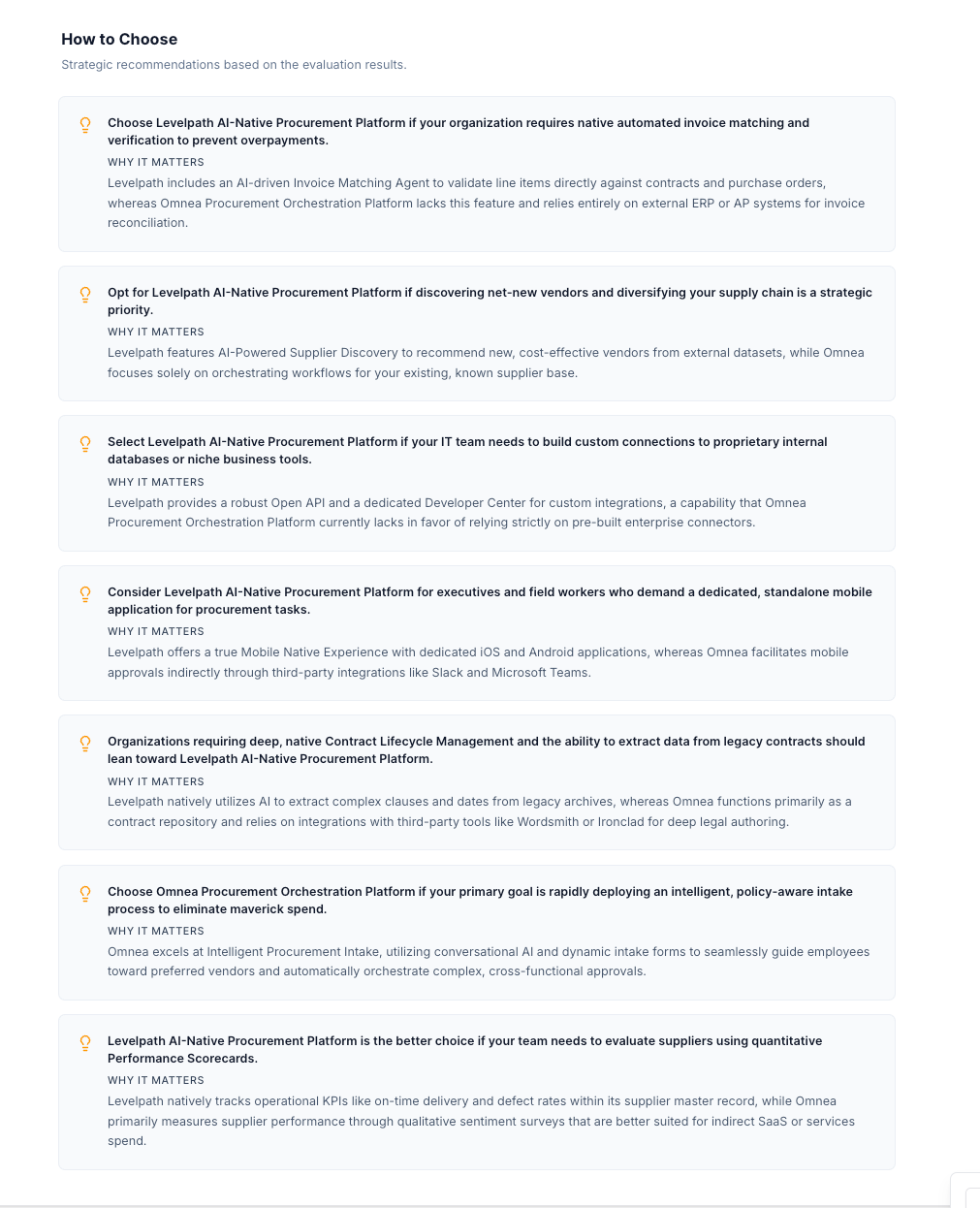
Choose Levelpath if your organization needs to prevent invoice overpayments natively within the procurement platform.
Why It Matters: Levelpath's native Invoice Matching Agent validates line items directly against contracts and purchase orders in-platform. Omnea does not perform invoice reconciliation natively — it routes that function to external ERP or AP systems, which removes procurement's direct visibility into the process.
Choose Levelpath if discovering new vendors and diversifying your supply chain are current priorities.
Why It Matters: Levelpath's AI-Powered Supplier Discovery recommends vendors from external datasets, beyond the organization's existing supplier base. Omnea focuses on orchestrating workflows for known, existing suppliers and does not surface new sourcing options.
Choose Levelpath if your IT team needs to build custom connections to proprietary internal systems or niche tools.
Why It Matters: Levelpath provides an open API and a dedicated Developer Center for custom integrations. Omnea restricts connectivity to pre-built enterprise connectors and does not expose an open API for custom development.
Choose Levelpath if executives and field workers require a dedicated mobile application — not approval via chat.
Why It Matters: Levelpath offers native iOS and Android applications. Omnea facilitates mobile approvals via Slack and Microsoft Teams, which work well for organizations already reliant on those tools but cannot replace a standalone mobile procurement interface.
Choose Levelpath if your organization needs native CLM with AI-driven extraction from legacy contract archives.
Why It Matters: Levelpath natively extracts clauses, dates, and financial terms from legacy contracts using AI. Omnea primarily operates as a contract repository and relies on integrations with tools such as Wordsmith and Ironclad for deep legal authoring and data extraction.
Choose Omnea if your primary goal is to deploy a fast, low-disruption, intelligent intake layer over existing financial systems.
Why It Matters: Omnea's conversational intake and no-code workflow builder can be deployed without replacing existing ERP or CLM infrastructure. For organizations with mature back-end systems that need a smarter front-end for procurement requests, Omnea avoids the disruption of a full platform migration.
Choose Omnea if your organization operates in a regulated environment requiring SOC 2, SOX, or DORA-specific third-party risk workflows.
Why It Matters: Omnea's TPRM module includes pre-built compliance questionnaire templates for SOC 2, SOX, and DORA, continuous monitoring across sanctions, PEPs, and adverse media data, and AI-generated remediation plans for each supplier. Levelpath's compliance tooling is designed for general enterprise use and does not document equivalent regulatory-specific template coverage.
Choose Levelpath if your team evaluates suppliers against quantitative operational KPIs.
Why It Matters: Levelpath tracks on-time delivery, defect rates, and other operational metrics within its supplier master record. Omnea's supplier performance measurement uses qualitative sentiment surveys, which are suitable for indirect spend or SaaS procurement but insufficient for organizations managing physical supply chain performance.
The full report includes structured recommendations tailored to your organizational profile.
The full Teem report includes a complete scoring breakdown across all 18 use cases and 27 features — structured to help you build the internal business case.
Download the Full Comparison Report
This blog covers the key findings. The full Teem report goes deeper:
- ✅ Complete 18-point use case evaluation with individual scores per product
- ✅ Full 27-point feature checklist with ✅ / ⚠️ / ❌ per product
- ✅ Methodology and external research sources
- ✅ Printable PDF — ready for internal stakeholder reviews
Enter your email to get instant access. No spam. Unsubscribe anytime.
Want to see the Teem's Product comparison engine live with your own shortlist?
Book a demo, and we will walk you through it→ Demo
This report is generated by our internal platform using publicly available information, market data, and documented product capabilities. Information presented may change over time as vendors update their offerings. While efforts have been made to ensure accuracy, readers should independently verify critical claims with the respective vendors before making business decisions.
This comparison was produced independently by Teem. Neither SAP nor Coupa has sponsored, reviewed, or influenced this report.