
Category Management: Why And Where Teams Get It Wrong
Category management in procurement is one of the most practiced and least executed disciplines in the function. Most organizations attempt it. Very few get it right.
The 2024 Global Category Management Report by Future Purchasing surveyed 324 organizations and found that only 50% of organizational spend is covered by formal category strategies, leaving 69% of available stakeholder value on the table. (Future Purchasing, 2024 Global Category Management Report) Only 5-7% of organizations are genuinely excellent at it. (Mark Webb, Managing Director, Future Purchasing, December 2024)
The problem is not skill. Procurement teams understand what category management is supposed to do. The problem is structural: broken data, hard-to-implement frameworks, and strategies written without the people who are supposed to use them. The result is the same across organizations of every size. Category strategies age in folders and quietly become wrong.
This post covers the three root causes, what good looks like at each stage, and what changes when the foundation is finally right.
What is category management in procurement?
Category management in procurement groups relates software, tools, or services to defined categories and manages each one as a distinct unit, with its own spend analysis, supplier assessment, and strategy. Rather than making one-off purchasing decisions, procurement teams build a structured view of what they own in each category, how well it performs, and where the gaps lie.
Done well, it gives procurement leaders full visibility into their software portfolio, a defensible basis for renewal and consolidation decisions, and strategies that stakeholders can actually get behind.
Done poorly, which is most of the time, it produces a spreadsheet nobody trusts, a PDF nobody reads, and a renewal meeting nobody was prepared for.
The three reasons category management fails
1. Spend data nobody trusts
Before you can build a category strategy, you need to know what is in the category. For most enterprise teams managing a large software portfolio, that sounds simple. It is not.
Application portfolios grow fast and sideways. Tools get procured by different departments under slightly different names. Some sit under category labels that made sense three years ago. Others are duplicates of something sitting in a different cost center. By the time a category manager starts the work, weeks have gone into just building a picture of what the organization owns in a spreadsheet, manually, and it is out of date before it is finished. (CADDi, Procurement 101: Category Management)
The problem goes deeper than messy data. Stefano Sollazzo of Creactives puts it plainly: the lack of trust in data prevents alignment among Procurement, Finance, and Operations. Without a single version of the truth, category strategies stay local, siloed, and impossible to scale. (Spend Matters, Category Management: Key Insights for 2026 from Creactives, February 2026) It does not matter how well the strategy is written. If the data behind it is contested, the conversation never moves past the data.
Best practice: Centralize and normalize your spend data, agree on a taxonomy that reflects how your organization actually works, and build your category portfolio from a single source. As OMNIA Partners puts it: "If you don't know what, where, or with whom you're spending, you can't optimize it." (OMNIA Partners, The Procurement Treatment Plan, 2025)
2. No way to assess what you actually find
Clean data is step one. Step two is knowing what to do with it. Most teams get stuck here.
Two questions tend to get collapsed into one. The first is functional fit: Does this application cover the business need it was purchased to cover? The second is technical fit: does it integrate with the infrastructure, meet security requirements, and work at the scale the organization needs? Answering both across a large software portfolio, without a structured framework, is effectively impossible. Teams fall back on assumptions, or the judgment of whoever is most vocal in the renewal meeting.
Portfolio frameworks, such as the Gartner TIME model, exist to address this. Placing each tool into Tolerate, Invest, Migrate, or Eliminate based on defined criteria is the right approach. The issue is that substantial criticism has emerged around these frameworks being hard to implement in practice. (ScienceDirect, Purchasing Category Management: Portfolio Management, Sourcing Levers and Strategy Formulation, October 2025) The theory is well understood. Consistent, evidence-backed placement across hundreds of applications is where it breaks down.
Best practice: Pick a framework and build the inputs it needs from the start. Functional and technical fit scores should come from defined evaluation criteria, not from memory or instinct. When the inputs are consistent, the decisions hold up.
3. Strategies built in isolation, then forgotten
The third failure is not about data or frameworks. It is about who is in the room when the strategy gets built, and who is not.
Only 21% of organizations believe stakeholders have actually adopted their category management process, and just 14% have a solid understanding of what category management involves. (Future Purchasing, 2024 Global Category Management Report, via Cirtuo) Mark Webb of Future Purchasing is direct about this: "Without stakeholder involvement, procurement teams have limited impact. Aligning strategies with stakeholder priorities is not optional — it's critical for success." (Art of Procurement, The Current State of Category Management, December 2024)
A strategy built without stakeholder input lacks relevance before it leaves the building. Finance needs cost and risk framing. Operations needs to understand the workflow impact. Business owners need the rationale before they agree to consolidate tools they depend on. When those conversations don't happen upfront, the strategy runs into resistance at execution — not because the recommendations are wrong, but because nobody was part of making them. (Cirtuo, Effective Stakeholder Management: The Key to Implementing Category Strategies)
Then there is the shelf life problem. Procurement teams spend months building a category strategy, only for it to sit. Markets shift. Vendors get acquired. New tools emerge. Refreshing a manually built strategy means starting the process from scratch, so most teams do not do it. (Precoro, Category Management in Procurement: A Practical Guide, December 2025) The spreadsheet stays in the folder and quietly becomes wrong.
Best practice: Bring stakeholders in early. Communicate in their language: numbers for Finance, workflow impact for Operations. Build strategies designed to stay current, with regular review points built in, not as a one-time exercise.
Build Category Strategies That Stick
Create category strategies with minimal effort and share them with stakeholders.
Teem's Category Management product addresses each of these problems at the data layer, where they all begin. Here is what that looks like in practice.
1. Teem Auto-Maps Your Products to the Right Category
Teem automatically organizes your application portfolio into categories, giving you full visibility when planning.
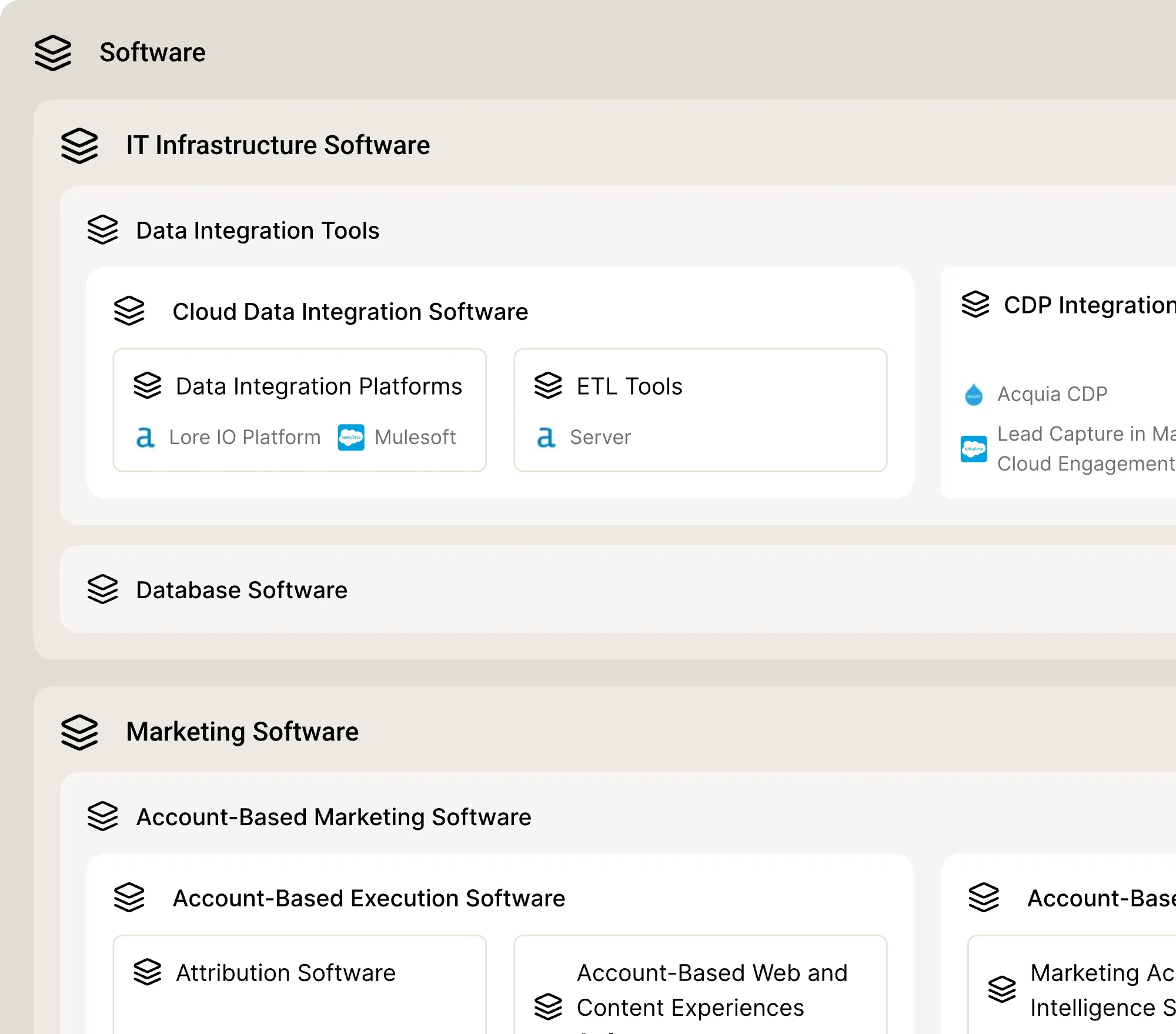
Teem maps your application portfolio into structured software categories with no manual taxonomy work and no weeks of spreadsheet cleanup. A category manager starts with a clean, current view of everything in the portfolio, organized around how the market actually classifies these tools. For organizations with their own internal taxonomy, custom mapping means the analysis reflects how the business works, not a vendor's assumption.
2. Capability Heatmap For Your Entire Category
Teem populates a comprehensive list of all applications in your portfolio and evaluates each one for functional fit and technical fit.
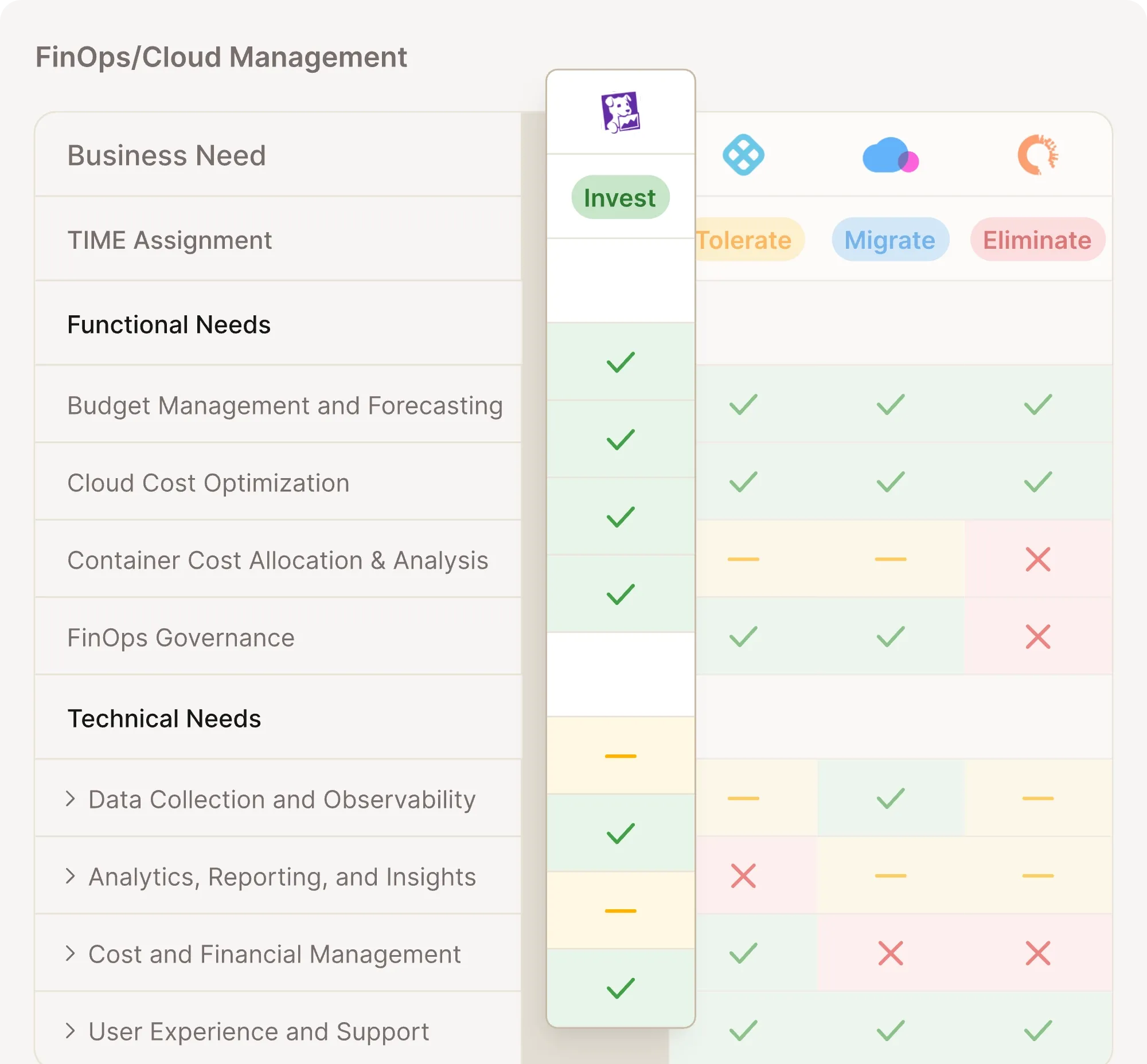
From there, Teem builds a Capability Heatmap across the category. Every application is evaluated for functional fit and technical fit against the category's defined business needs. The output is a single view showing which tools cover requirements, where gaps exist, and where redundancy occurs. Visible at a glance, without assumptions.
3. Track Suppliers with the Gartner TIME Model
Place each application into one of the four TIME quadrants based on its scores for technical and business fit.
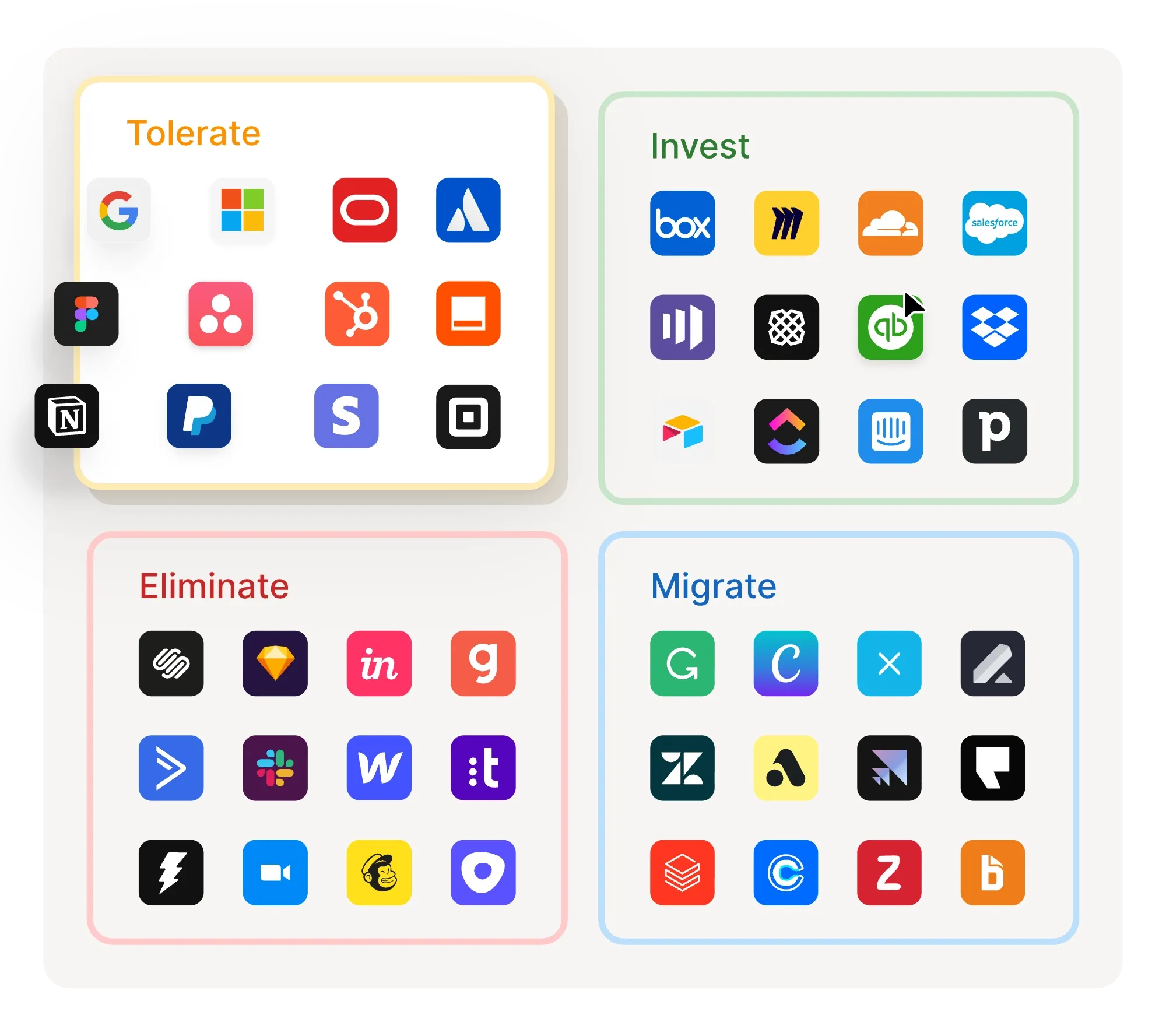
Those fit scores feed directly into the Gartner TIME model, placing each application into Tolerate, Invest, Migrate, or Eliminate based on actual evidence. For a category manager presenting to Finance or IT leadership, this is the difference between a recommendation that holds up and one that gets challenged. The strategy output is also built to be shared. Heatmaps and TIME placements go directly to stakeholders without rebuilding visuals in a separate tool. When the underlying data changes, the strategy updates with it.
The question is worth sitting with
Category management does not fail because procurement teams lack the intent or the skill. It fails because the foundation beneath the strategy is not built to support its weight. Fragmented data, frameworks that stay theoretical, and stakeholders brought in too late or not at all.
When those things are fixed, category strategies stop being documents that age in folders. They become something a team can actually use to decide what to invest in, what to consolidate, and what to walk away from at the next renewal.
Most organizations need a better category strategy. The harder question is whether the infrastructure behind it can produce one that actually sticks.
Frequently Asked Questions
What is category management in procurement?
Category management in procurement groups relates products or services to defined categories and manages each one as a business unit, with its own spend analysis, supplier assessment, and sourcing strategy.
Why do category strategies fail?
Most category strategies fail due to three root causes: unreliable spend data, a lack of a structured framework for assessing tool fit, and strategies built without meaningful stakeholder involvement. (Future Purchasing, 2024 Global Category Management Report)
What is the Gartner TIME model?
The Gartner TIME model classifies applications into four quadrants — Tolerate, Invest, Migrate, and Eliminate — based on their technical and functional fit scores.
What is a capability heatmap in procurement?
A capability heatmap maps every application in a portfolio against defined functional and technical requirements, showing coverage, gaps, and redundancy across a category at a glance.
How does Teem help with category management?
Teem automatically organizes application portfolios into software categories, evaluates each tool for functional and technical fit via a Capability Heatmap, and applies the Gartner TIME model to produce data-backed category strategies that can be shared directly with stakeholders.
See what your category portfolio actually looks like →With Teem