
Application Rationalization: The Stack You Own vs. The Stack You Actually Use
Most organizations are paying for a software portfolio they can only partially see. The gap between the stack you own and the stack you actually use is not a data problem. It is a process problem—and it starts well before any application is retired.
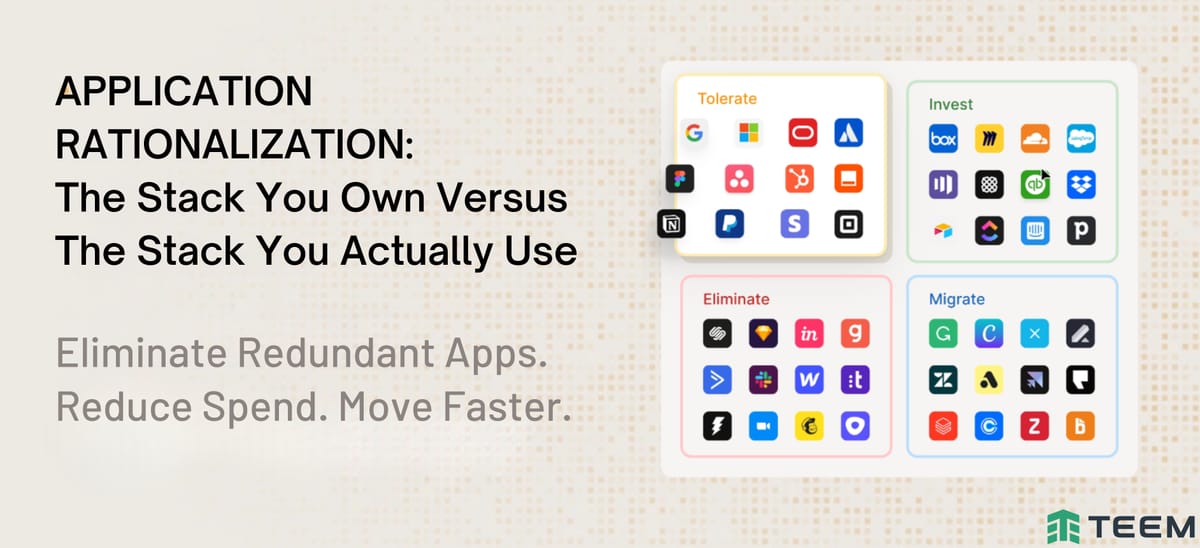
Most organizations carry two software portfolios. One is the official list — licenses purchased, contracts signed, renewals calendared. The other is what people actually use: a patchwork of sanctioned tools, department-bought subscriptions, and apps acquired outside any procurement process.
The gap between them is expensive. Gartner estimates that roughly 30% of software budgets are wasted on unused or redundant applications. Zylo's 2025 SaaS Management Index puts a dollar figure on it: the average enterprise leaves $18 million in unused licenses on the table every year. (Zylo, 2025 SaaS Management Index) That is not a rounding error. That is a procurement failure hiding in plain sight.
Application rationalization is the process that closes this gap. But most organizations approach it in ways that guarantee short-lived results — or no results at all. This post covers the five reasons that happen, what better practice looks like at each step, and where technology can help.
What Is Application Rationalization in Procurement?
Application rationalization is the process of reviewing an organization's entire software portfolio to determine which applications to tolerate, invest, eliminate, or migrate. The goal is to eliminate waste, remove redundancy, and ensure every tool in the stack earns its place.
It is closely related to application portfolio management (APM)—the broader discipline of maintaining ongoing visibility and governance over applications throughout their lifecycle. Where APM is continuous, rationalization is the structured analytical exercise within it: scoring applications against defined criteria and making deliberate decisions about what stays and what goes.
Many organizations treat rationalization as a one-time project. The ones that get lasting results treat it as a function embedded in how they manage their software stack over time.
The Five Reasons Application Rationalization Fails
1. The Inventory Does Not Exist
You cannot rationalize a portfolio you cannot see. Yet this is where most Rationalization efforts begin—with a spreadsheet already out of date.
According to Productiv's 2024 State of SaaS report, only 3% of IT executives have complete, real-time visibility into their SaaS tools. 48% of enterprise applications are completely unmanaged, with no oversight of renewals, usage, or compliance. (Productiv, 2024) Gartner estimates that shadow IT accounts for 30-40% of IT spending in large enterprises. Separately, Gartner found that 41% of employees are already acquiring or modifying technology without IT's knowledge — a number the firm projects will reach 75% by 2027.
The result is that rationalization begins with a partial picture. Some tools are visible. Many are not. Decisions are made based on purchases made through official channels, while a significant portion of what is actually in use goes unexamined. The process looks rigorous because it follows a framework. But if the input data is wrong, the output will be too.
Best practice: Before any application is scored or classified, build a
complete inventory by pulling from finance systems, expense reports, SSO
logs, and endpoint data — not just the official procurement record. The
starting point is knowing what you actually have.
2. Every Team Evaluates Applications Through a Different Lens
Even when the inventory is reasonably complete, rationalization frequently fails because the evaluation is fragmented. Finance looks at the license cost. IT looks at system stability. Operations look at usage frequency. Each team reaches conclusions that make sense from their perspective. None of them is working with the full picture.
Zylo's 2025 SaaS Management Index found that 84% of applications — and 74% of SaaS spending now sit outside IT's direct responsibility. (Zylo, 2025 SaaS Management Index). That fragmentation is not just a governance problem. It means no single team has the context to evaluate an application properly on its own.
A February 2026 analysis by Bizzdesign illustrates what happens when evaluation stays siloed. Finance reviews an application and sees high licensing costs relative to its user base. IT sees a stable system with low incident rates. The business sees something used occasionally — nothing critical. Enterprise architecture sees a legacy integration point that could be retired as part of a broader modernization effort. Each conclusion is locally reasonable. The application gets flagged for retirement. Leadership approves. Three months later, a critical month-end process fails. The application handled a small but essential data transformation step buried in a chain of integrations — visible in the architecture diagrams, but never documented as business-critical. (Bizzdesign, February 2026)
Best practice: Establish shared evaluation criteria before any application
is scored. IT, procurement, and finance need to be working from the same
framework — business value, technical health, functional fit, and cost
assessed together, not in separate conversations.
3. The People Closest to the Tools Are Not in the Room
Application rationalization is frequently led by IT or procurement, with business units consulted after the key decisions have been made. This gets the sequence wrong.
LeanIX, citing Gartner research, notes that rationalization initiatives without the active support of business leaders rarely get off the ground. The reason is not purely organizational politics. The people most likely to reintroduce retired tools, the teams that depended on them, were never asked whether those tools were critical to their work.
Gartner found that 41% of employees already acquire technology without IT's knowledge, which is relevant here too, and not only as a visibility problem. It tells you something about how business units operate: when they need a tool, they find one. Excluding them from rationalization decisions does not change that behavior. It just means the tool you retired reappears three months later on someone's expense report.
Best practice: Build stakeholder input into the classification process,
not as a sign-off step at the end. The teams using the tools have operational. knowledge that IT and procurement do not. Ignoring it does not make it disappear— it surfaces later, after decisions have already been reversed.
4. Cost Is the Only Dimension Being Scored
License costs are the easiest to measure, so they tend to dominate rationalization decisions. An application with high annual fees looks like a target. An application with low fees looks safe. Neither conclusion is necessarily right.
A low-license tool deeply integrated into three other systems carries far more real cost than its price tag suggests. Retiring means migration planning, integration rework, user retraining, and workflow disruption — none of which appear in a spend report. Meanwhile, a high-license application with clean boundaries, strong adoption, and no functional overlap may be the most defensible tool in the portfolio when evaluated properly.
The right evaluation framework scores applications across at least four dimensions: business value, technical health, functional fit, and cost. The Gartner TIME model — Tolerate, Invest, Migrate, Eliminate — is a practical way to structure this. So is any scoring system that requires a team to answer not just "what does this cost?" but "what does it do, what already does the same thing, and what would replacing it actually require?"
Best practice: Decisions made on cost alone tend to look correct on paper
and create operational problems six months later. Bring functional and
technical fit into the scoring before any retirement or consolidation
decision is finalized.
5. The Buying Behavior That Created Sprawl Was Never Addressed
The portfolio gets rationalized. The project closes. Then it starts drifting again, usually faster than anyone expected.
This is not a coincidence. Zylo's 2025 SaaS Management Index found that the average enterprise has 6-7 new applications entering its environment every month. Left unmanaged, that compounds to over 30% annual portfolio growth. (Zylo, 2025 SaaS Management Index) The Grip Security 2025 report found that, per employee, SaaS tool usage grew 85% between 2022 and 2024, from 7 to 13 tools. (Grip Security, 2025 State of Shadow AI Report)
The underlying problem is that rationalization cleaned up the portfolio without addressing the purchasing behavior that initially filled it. With 84% of SaaS spend outside IT's direct control, new tools enter the environment constantly — through departmental budgets, individual expense claims, and free trials that convert to paid subscriptions without anyone's review. Rationalizing a portfolio without a procurement gate is clearing out a room and leaving the door open.
Best practice: Embed a purchasing review into the rationalization program. Any new application should be evaluated against existing applications before a decision is made. If a functional need can be met by something already in the portfolio, that is not a new purchase — it is a configuration or training problem.
Eliminate Redundant Apps. Reduce Spend. Move Faster.
Teem automatically maps your applications, highlights overlap, and surfaces consolidation opportunities — turning software sprawl into a streamlined, intentional stack.
The five failure modes above share a common thread: they are all information problems. The inventory is incomplete. The evaluation criteria are fragmented. Stakeholder knowledge is not collected. Fit is not measured. New purchases are not checked against existing items. Teem's Application Rationalization product addresses the visibility gaps that enable these failures.
1. Eliminate Redundancy in Your Stack
Teem maps every application and its capabilities so you can spot overlaps, retire unused tools, and consolidate vendors with confidence.
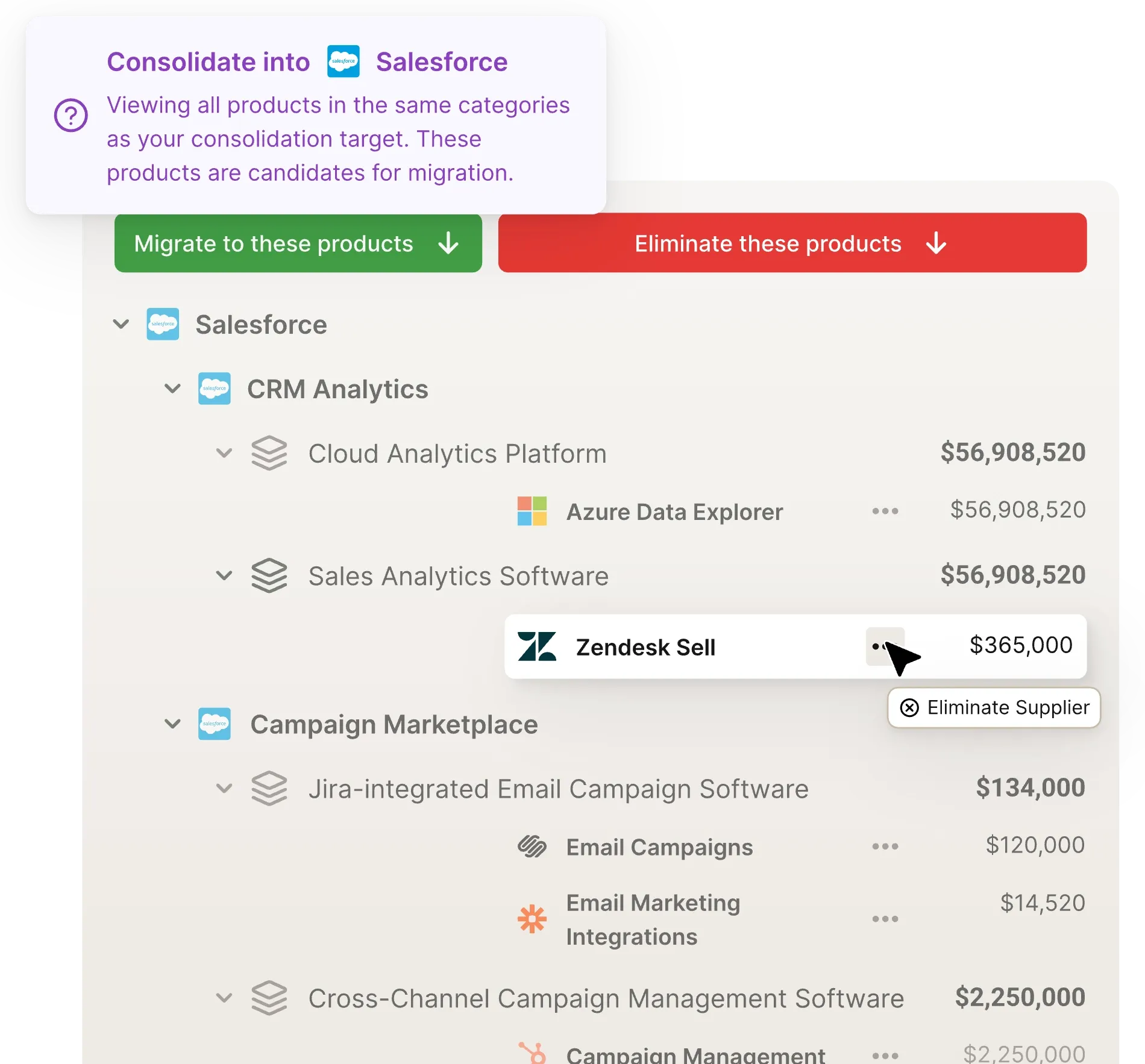
Teem builds a mapped view of the full application portfolio — not just what was purchased through official channels, but what is actually in use. Each application is evaluated for functional and technical fit. Overlapping tools are surfaced automatically. The output is a shared, data-driven picture of the portfolio that IT, procurement, and finance can work from together, rather than scoring applications separately and arriving at conflicting conclusions.
This directly addresses pain points 1, 2, and 4. The inventory is built from actual usage data. The evaluation covers fit alongside cost. And because the mapping is shared, the siloed-lens problem that leads to decisions like the Bizzdesign scenario—where a locally reasonable retirement breaks a business-critical process- becomes harder to address.
2. Compare Similar Tools Side-by-Side
Feature-level comparisons that make overlap, gaps, and strengths immediately clear.
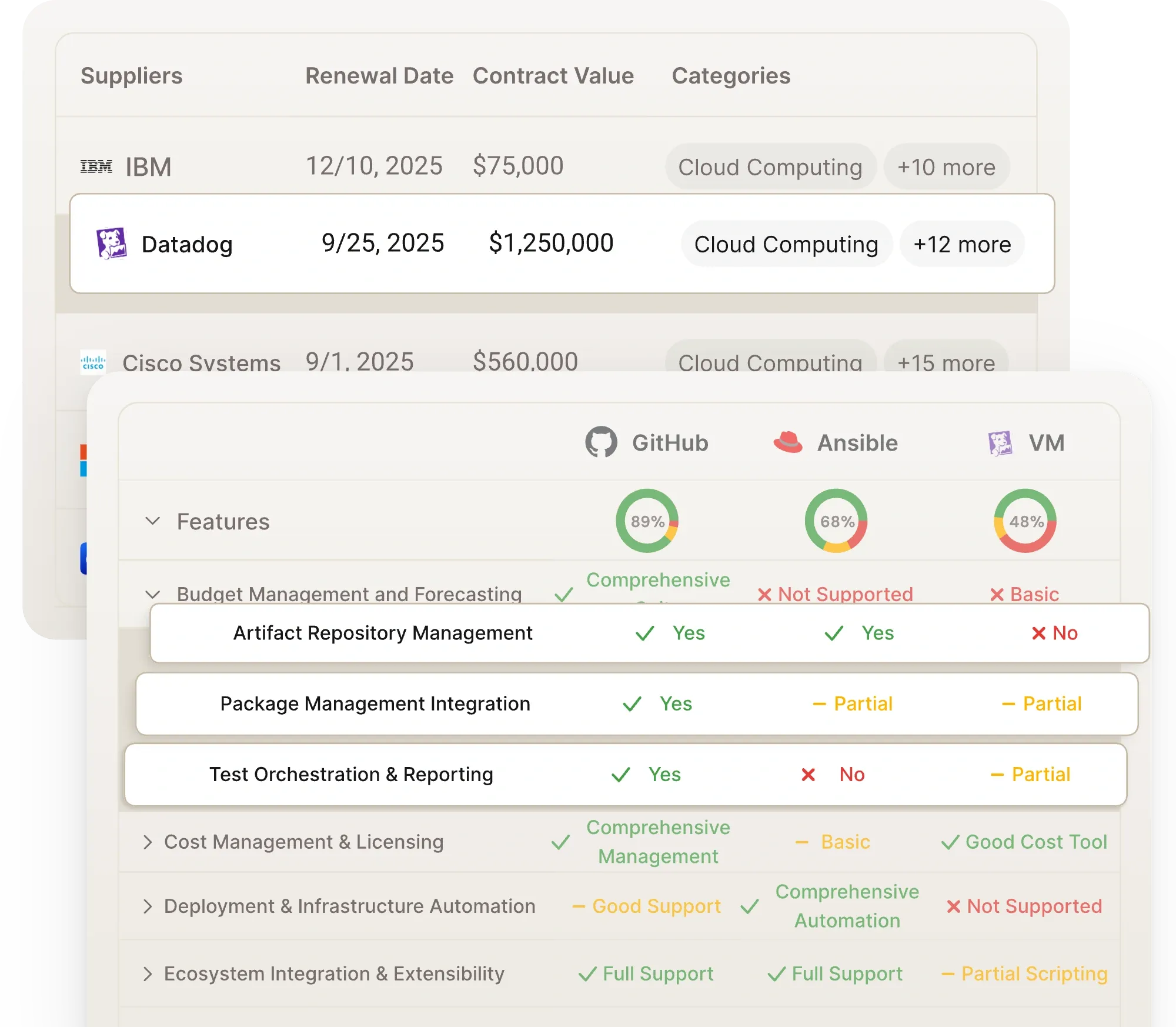
Where two tools appear to serve similar functions, Teem enables feature-level Comparison — mapping what each application actually does against the other. This allows confirming functional overlap before a consolidation decision is made, rather than discovering gaps after a retirement is already in progress.
This is Teem's Product Comparison capability. The full picture of how it works across sourcing and renewal decisions is covered in real life. In the app rationalization context, the value is straightforward: consolidation decisions made without feature-level comparison carry real risk. You retire what appears to be a duplicate, only to find out later that it does something the surviving tool does not.
3. Bring Stakeholder Input Into Every Rationalization Decision
Give stakeholders a voice in the process with clean, organized insights that help you make decisions that everyone can support.
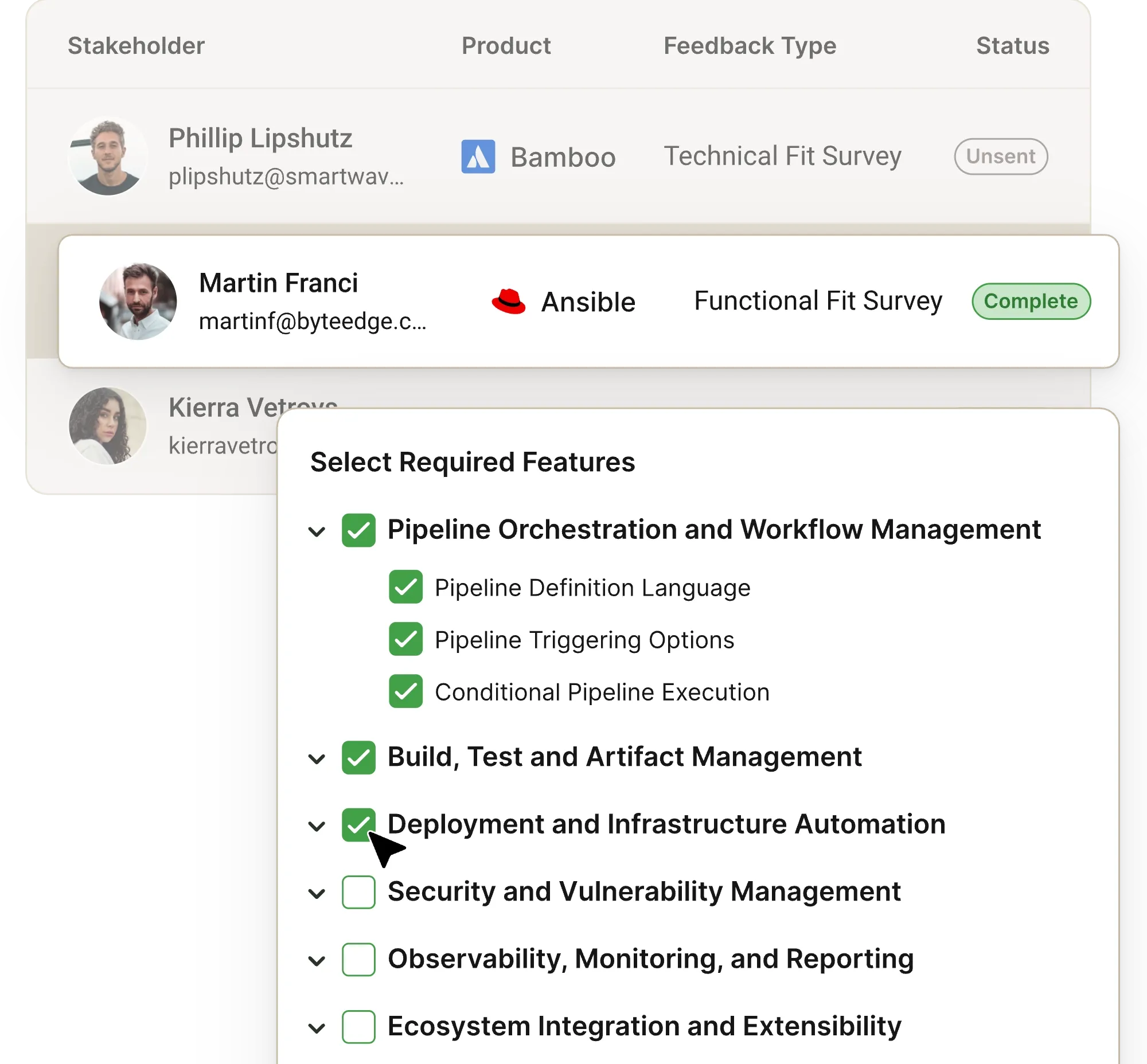
Teem integrates stakeholder surveys directly into the rationalization workflow. Before an application is classified for migration or elimination, the teams using it are asked about functional fit and actual usage. This is a data collection step. The input from business units is incorporated into the scoring, not a conversation that happens after classification is complete.
Pain point 3 describes what happens when this step is skipped. Teem builds it into the process, so skipping it is structurally harder. The full Stakeholder Survey capability is covered in Post 8 of this series.
The Stack Is a Decision, Not a Default
Software portfolios do not rationalize themselves. They drift — tool by tool, department by department — until someone looks up and finds that 30% of what they are paying for is not being used, and 40% of what is being used was never formally approved.
The rationalization process exists to fix that. But it only works when it starts with a complete picture, evaluates applications across more than one dimension, includes the people who actually use the tools, and builds a gate against the purchasing behavior that caused the problem in the first place.
The stack you own and the stack you actually use are two different documents. Closing the gap between them is not a one-time cleanup. It is a procurement discipline.
Frequently Asked Questions
What is application rationalization in procurement?
Application rationalization is the process of reviewing an organization's full software portfolio to determine which applications to keep, consolidate, retire, or replace. In a procurement context, it means ensuring every tool in the stack was purchased deliberately, is being actively used, and does not duplicate something already in the portfolio.
What is the difference between application rationalization and application portfolio management (APM)?
Application portfolio management is the ongoing discipline of maintaining visibility and governance over software across its full lifecycle. Application rationalization is a specific analytical exercise within APM — the systematic scoring and classification of applications against defined criteria. APM is
continuous; rationalization is the structured review that feeds into it.
Why does application rationalization fail in most organizations?
The most common failure modes are: an incomplete inventory due to shadow IT and decentralized purchasing; fragmented evaluation, where each team scores applications through its own lens; exclusion of business-unit stakeholders from classification decisions; and reliance on license cost as the only scoring dimension. And treating rationalization as a one-off project rather than an ongoing program. Any one of these will produce results that erode quickly.
What is shadow IT, and why does it matter for application rationalization?
Shadow IT refers to applications purchased or used without formal IT or procurement approval. Gartner estimates it accounts for 30 to 40 percent of IT spending in large enterprises. It matters for rationalization because any process that only reviews officially procured tools is working with an incomplete picture. A portfolio cleaned up without addressing shadow IT will drift back toward sprawl almost immediately.
What is the Gartner TIME model, and how does it apply to applications
rationalization?
The TIME model classifies applications into four categories: Tolerate (keep running as-is), Invest (prioritize and develop), Migrate (move users or data to a better-fit application), and Eliminate (retire without replacement). It is a practical rationalization framework because it forces evaluation across the business value and technical health together, rather than cost alone.
How often should an organization rationalize its application portfolio?
Treating rationalization as a one-time project is the most common mistake. With an average of 7.6 new applications entering enterprise environments every month (Zylo, 2025), A portfolio rationalized once will drift significantly within a year. Best practice embeds portfolio review into the procurement cycle — new purchases are evaluated against existing tools, and the full portfolio is reviewed at least annually.
How does Teem support application rationalization?
Teem maps the full application portfolio, scores each application for functional and technical fit, surfaces overlaps and redundancies, enabling feature-level comparison between similar tools, and integrates stakeholder input before classification decisions are made. The output is a shared view of the portfolio that IT, procurement, and finance can work together.
See what your application portfolio actually looks like. → With Teem