AI Governance Audit in Procurement Starts With Procurement Intelligence
The reason most enterprises can't run a procurement AI audit isn't intent. It's infrastructure. Here's what a procurement intelligence layer actually does.
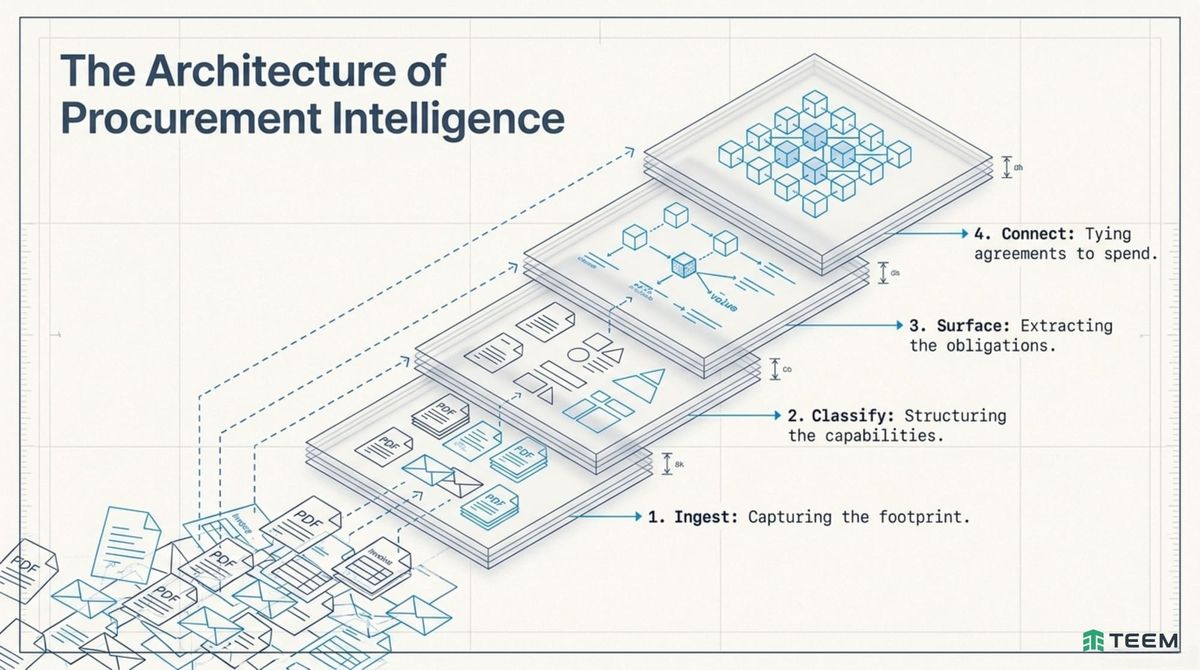
What a procurement intelligence layer actually does, and where most enterprises are stuck without one.
Part 1 — AI Governance Isn't a Deployment Problem. It's a Discovery Problem. — established why most enterprises cannot see their AI exposure.
Part 2 — AI Governance: We Ran the Discovery Audit. — documented what we found when we audited 261 contracts and mapped the risks.
This post addresses what makes the audit impossible for most enterprises, and what the infrastructure to fix it actually looks like.
In Part 1 of this series, we argued that AI governance in procurement is a discovery problem before it is a deployment problem.
 Sandip Biswas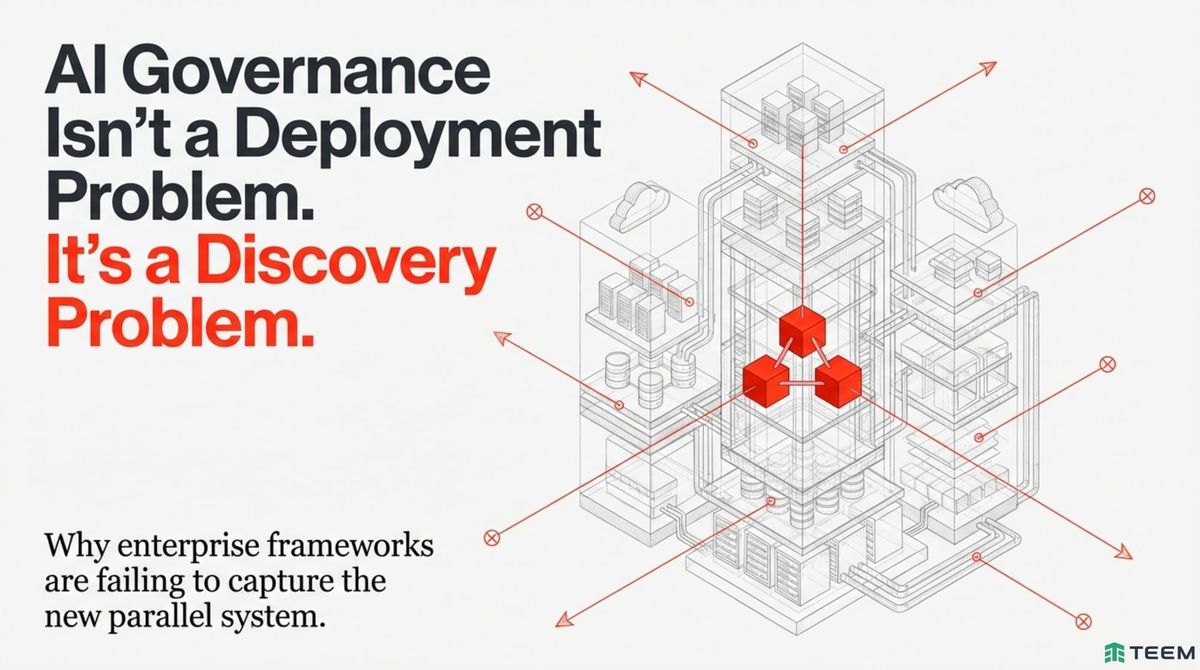
AI Governance: Discovery Problem
In Part 2, we ran a discovery audit on 261 enterprise software contracts to prove it.
Sandip Biswas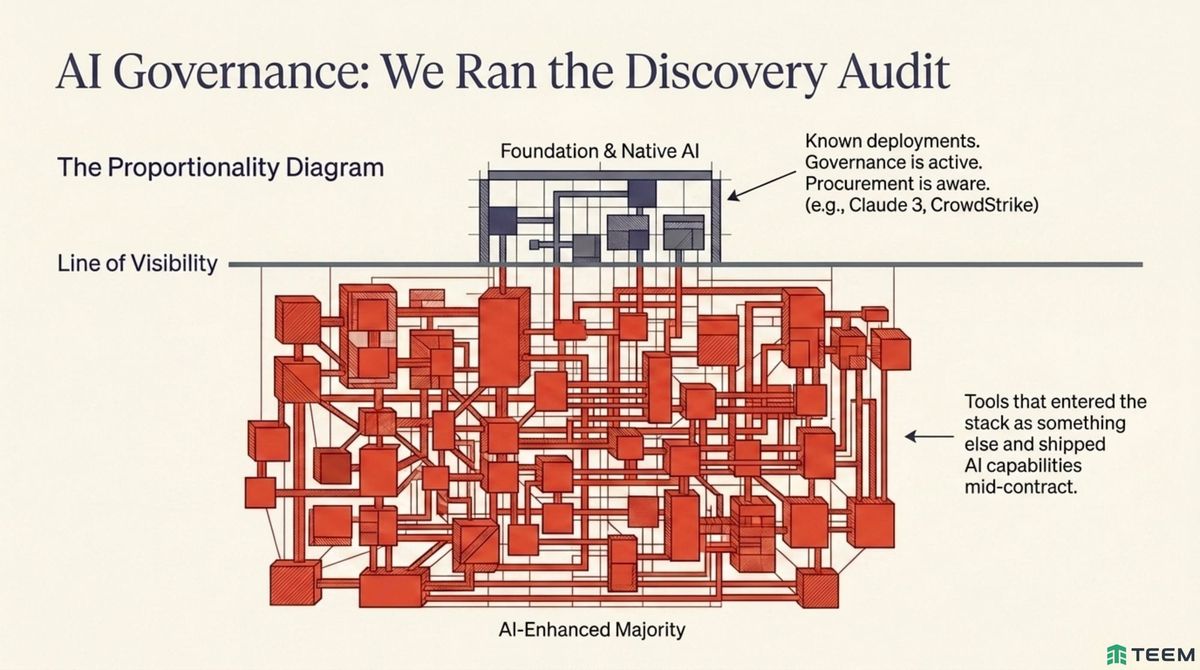
AI Governance: Discovery Audit
What we found – AI obligations buried in contracts nobody had reviewed, auto-renewals attached to capability expansions nobody had approved – validated the argument more than we expected.
But the response we heard most after publishing Part 2 wasn't about the findings themselves. It was a version of the same question, asked by procurement leads, IT directors, and CFOs who read it: how do you even run that audit?
That's the question worth answering.
Because it explains why 74% of procurement leaders say their data isn't AI-ready (Gartner, 2025 Leadership Vision for CPOs). It explains why 49% of organizations piloted generative AI last year, but only 4% deployed it at scale (Hackett Group, 2025). And it explains why MIT found that 95% of enterprise AI pilots deliver no measurable ROI.
Ambition is not the problem. It's that most enterprises are missing the layer that makes any of this tractable: a complete, structured catalog of what they actually have.
Why Enterprises Can't Run a Procurement AI Audit.
The 261-contract audit required assembling data from places that had never been assembled together before. Finance systems. Legal repositories. Procurement platforms. Spreadsheets are maintained by people who have left the organization. Contracts signed by department heads on corporate cards that never touched a formal procurement process.
That assembly was manual. It took longer than the analysis itself.
And that manual assembly is exactly what makes this kind of audit a one-time project for most organizations rather than an ongoing practice. Here's why.
Enterprise software stopped flowing through a single procurement channel about ten years ago. Before SaaS, most software purchases went through IT and procurement. The contract arrived, cleared an approval process, and landed in a system of record. Slow, sometimes frustrating, but it produced a catalog as a byproduct.
SaaS broke that. Departmental buying, free trials that convert to paid subscriptions, usage-based pricing that scales without a new contract – software now enters the enterprise through channels procurement never sees. A team lead approves a tool on a corporate card. A free account becomes an enterprise license after a vendor's email conversation. A renewal occurs automatically because no one flagged the date.
The result is a software stack that no single team has a complete view of. IT sees some of it. Finance sees the spend but not the contracts. Procurement sees what cleared a formal process, which is a fraction of the whole. Legal holds the signed agreements but has no visibility into active usage.
When you try to run an AI governance audit against that landscape, you are not running an audit. You are first running an archaeological dig – pulling fragments from different systems, reconciling duplicates, figuring out what is still active and what was quietly canceled two years ago. And then, only after that, running the audit.
That's the real reason most organizations can't do it. Not because the intent isn't there. The catalog that would make it possible simply doesn't exist.
The AI governance question -- which of our vendors have embedded AI into their core functions, and what did we agree to when they did -- cannot be answered from a standing start. It can only be answered from a catalog.
What a Procurement Intelligence Layer Does That a Contract Repository Can't
A procurement intelligence layer is not a better spreadsheet. It's not a contract repository with a search bar. It's a continuously updated, structured view of the enterprise software stack that procurement can use to make decisions.
The distinction matters because the catalog problem is not a storage problem. Most organizations already store their contracts somewhere. The problem is that stored data is unstructured, not connected across systems, and out of date.
A procurement intelligence layer continuously ingests, classifies, and connects enterprise software data across procurement, finance, and legal systems -- producing a complete, structured catalog that contract repositories cannot.
Here's what that means in practice.
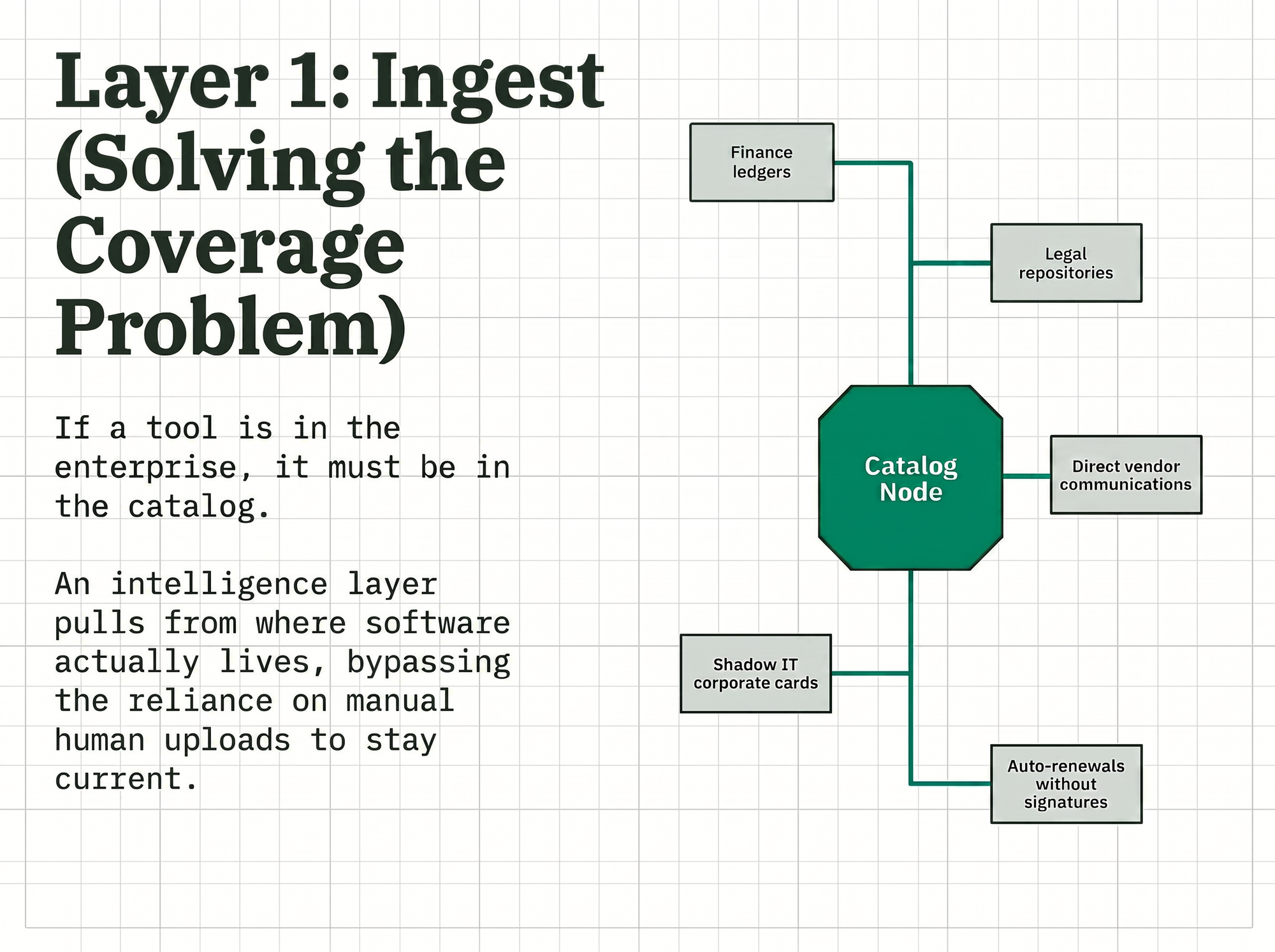
- It ingests from everywhere software actually lives – not just what procurement approved. Contracts from finance, legal, direct vendor relationships, and auto-renewals that happened without a signature. If a tool is in the enterprise, it is in the catalog. This is the coverage problem. An intelligence layer solves it by pulling from the actual sources rather than requiring manual uploads to keep it current.
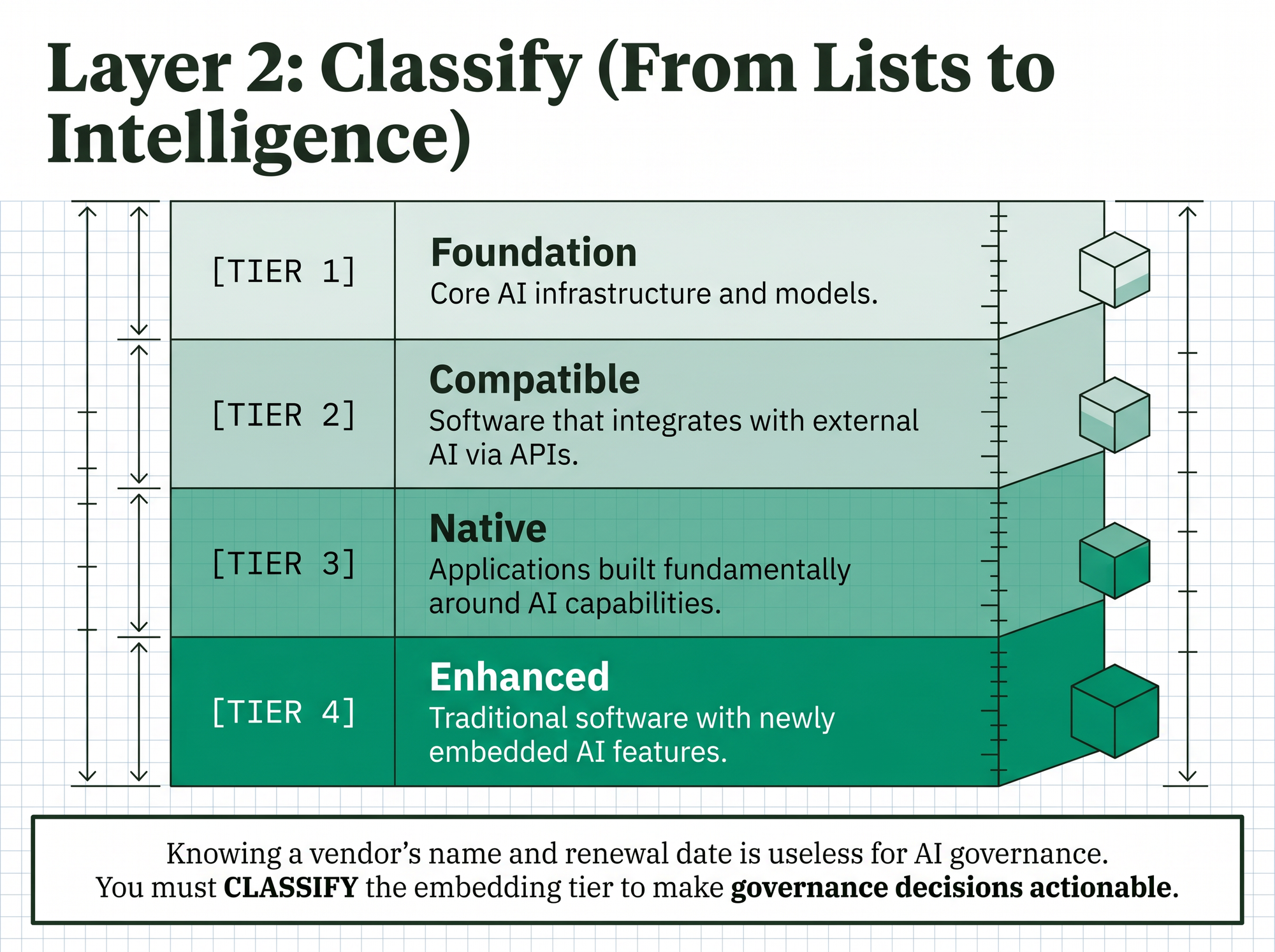
- It classifies what it finds. Not just vendor name and renewal date. What the software does, the AI capabilities it offers, and the AI embedding tier it represents. The four-tier framework from Part 2 – Enhanced, Native, Compatible, Foundation – is the kind of structure that makes governance decisions actionable. Without classification, you have a list. With it, you have intelligence.
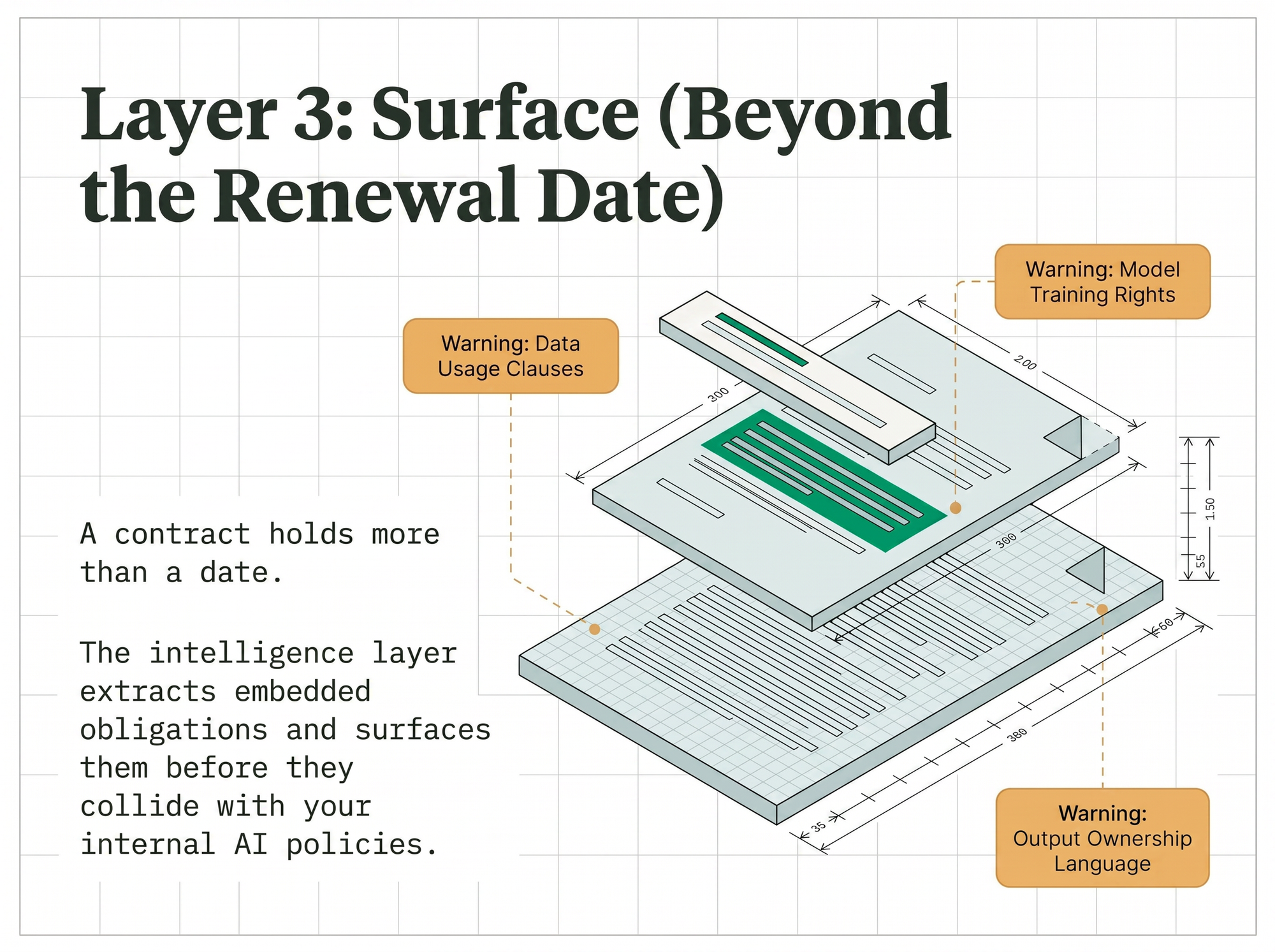
- It surfaces obligations, not just terms. A contract has a renewal date. It also has data usage clauses, model training rights, output ownership language, and capability expansion provisions. An intelligence layer extracts those obligations and surfaces them before they matter – before a renewal, before a procurement decision, before a new AI governance policy collides with a contract that quietly contradicts it.
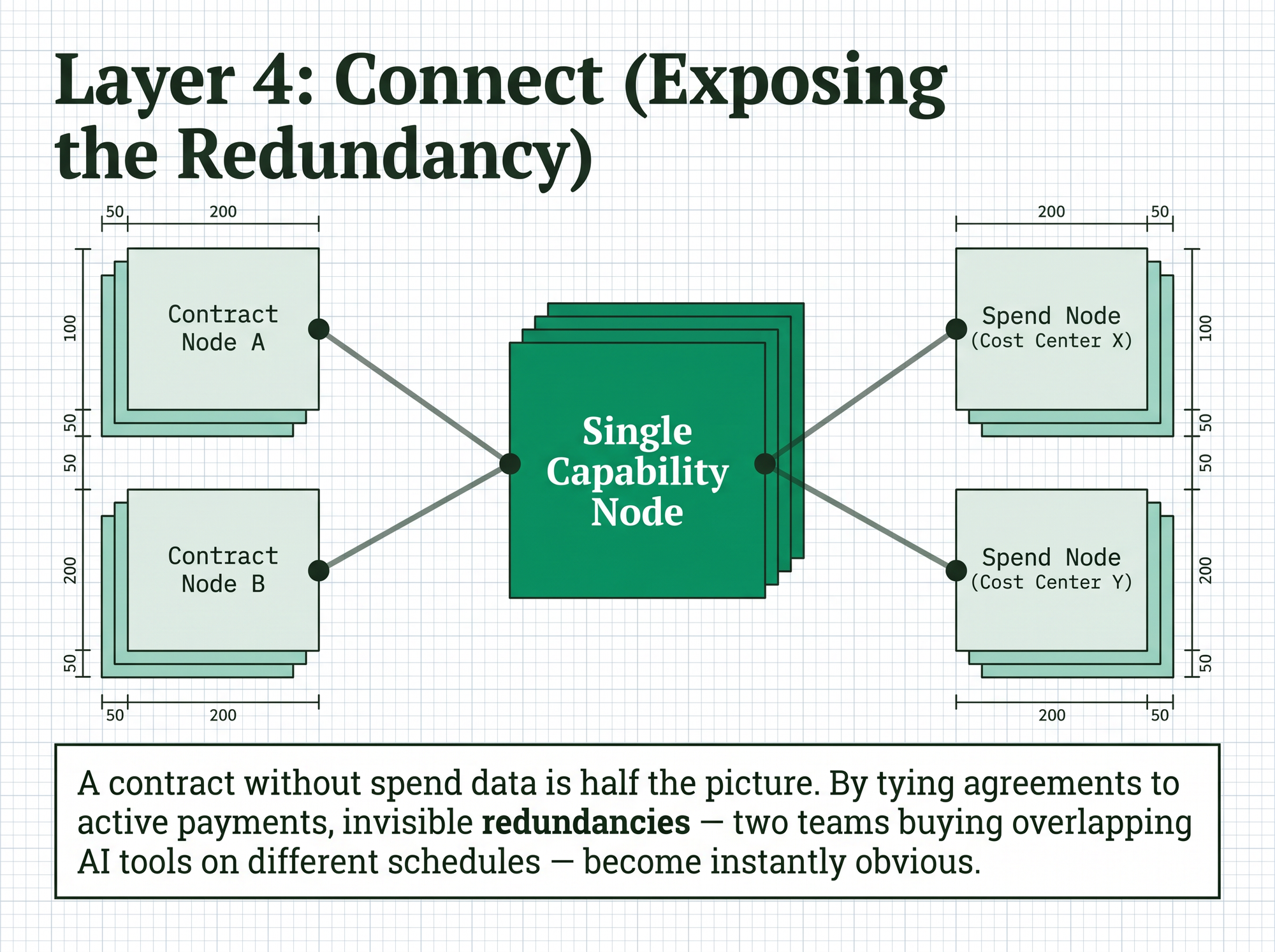
- It connects the catalog to spend. A contract without spend data is half the picture. Tying what the organization has agreed to against what it is actually paying is how redundancy becomes visible. Two contracts for tools that do the same thing, purchased through different channels, held by different teams, each renewing on its own schedule. That pattern is invisible in a contract repository. In a connected catalog, it is obvious.
Together, these four things make the Part 2 audit repeatable. Not a one-time excavation requiring manual assembly. A continuous practice running against a catalog that is already structured and current.
How Teem Builds the Enterprise Software Catalog
Three capabilities map directly to the three problems the catalog problem creates.
Supplier Discovery
You cannot audit what you cannot see. Supplier Discovery surfaces the full software stack—not just what cleared procurement, but everything the organization actually uses and pays for. It resolves the coverage problem that makes the manual audit so expensive in the first place.
Once Supplier Discovery has run, you have the catalog. The audit can begin—and, more importantly, run again next quarter without starting from scratch.
For organizations trying to meet what Gartner describes as "AI-ready data," this is where that work starts. Supplier Discovery doesn't assume a clean system of record already exists. It builds the catalog from the actual sources where software spend and contracts live.
Redundancy Identification
Once the catalog exists, Redundancy Identification shows what's in it twice. Overlapping tools bought through different channels. Duplicate spend is sitting in separate cost centers. Software with AI capabilities that the organization is paying for across multiple contracts without knowing it.
This is where the governance argument becomes a cost argument, which is the conversation that tends to get the budget approved. Redundancy Identification delivers that at the catalog level, before a renewal cycle locks in another year of unnecessary spend.
Renewal Management
This is the finding from Part 2 that stayed with us longest. Contracts in the Enhanced and Native AI tiers included auto-renewal clauses for AI capability expansions that procurement teams had never formally reviewed. The renewal happened. The obligation was accepted. Nobody had flagged the date or surfaced the terms in time to act on them.
Renewal Management closes that loop. Upcoming renewals surface with full context: AI tier classification, embedded obligations, and capability changes since the last renewal cycle. The renewal stops being a calendar deadline and becomes a procurement decision, with the information to make it correctly.
The catalog problem is solvable. But it requires infrastructure, not more manual effort. The organizations that build a procurement intelligence layer now will be the ones running AI governance audits continuously rather than archaeologically. They will also be the ones ready when the agentic procurement future Ben described in March Rise of Agentic Procurement arrives and starts demanding structured data to reason over.
The ones that don't will still be digging.
See how Teem builds the catalog your AI governance audit needs. Choose a Slot.
Bruce Pomazal